Facebook
 Google
 GitHub
 Linkedin
I have a BK Precision 1801 Frequency Counter which I wanted to test its accuracy. I used a NEO-7M GPS module to output a 10MHz frequency when there is a satellite lock. I found that my unit was off by several hundred hertz. Adjusting the on board trim capacitor (C202) I was able to bring it to read 10,000,000Hz. After about an hour and a half the unit was reading 5Hz lower. Adjusting back to 10MHz and coming back after 3 hours the unit was reading 5Hz higher.
The manual indicates a temperature stability of better than +/- 10ppm (0-50c ambient). I believe the variations I am seeing above are due to this (it uses a 10MHz crystal).
The manual also indicates that "..If greater measurement accuracy is required than afforded by the internal time base, the instrument can be modified for use with a higher precision external time base. Modification instructions include provision for a switch to select either the internal or external time base..." (I could not locate any modification instructions in the manual)
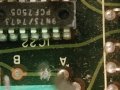
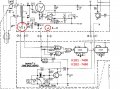
Looking at the schematic, I believe the modification needed (for a permanent external time base [no switch]) would be to cut the trace between points A and B, and jumper A and C. A 10 MHz reference signal would then be fed into point D. I was thinking to use a TCXO. See attached schematic with modifications circled.
Does this sound correct?
Full Schematic: http://bama.edebris.com/download/b&k/1801/bk_1801.pdf
The manual indicates a temperature stability of better than +/- 10ppm (0-50c ambient). I believe the variations I am seeing above are due to this (it uses a 10MHz crystal).
The manual also indicates that "..If greater measurement accuracy is required than afforded by the internal time base, the instrument can be modified for use with a higher precision external time base. Modification instructions include provision for a switch to select either the internal or external time base..." (I could not locate any modification instructions in the manual)
Looking at the schematic, I believe the modification needed (for a permanent external time base [no switch]) would be to cut the trace between points A and B, and jumper A and C. A 10 MHz reference signal would then be fed into point D. I was thinking to use a TCXO. See attached schematic with modifications circled.
Does this sound correct?
Full Schematic: http://bama.edebris.com/download/b&k/1801/bk_1801.pdf