Modifying a DC-DC buck converter

Thread Starter

anishkgt

Joined Mar 21, 2017
549
I've read them but none says how the switching frequency determined ? Rearranging the existing formula to find the inductance
L = (Vin-Vout)xD/(fx0.4xIout)
Rearranging to find f(Frequency)
f = (Vin-Vout)xD/(0.4xIout)
substituting the above formula i get 3.25E-8 strange.
 

Thread Starter

anishkgt

Joined Mar 21, 2017
549
Does the LTC3824 have current limit. I did not see anywhere mentioned about iLIM but there has to some limitation to current. I maybe looking at the wrong IC. One of the forums says single phase IC are limited to 20A above which can be problematic. Hence a multi phase is recommended for currents above 20A or parallel multiple 20As.
 

Irving

Joined Jan 30, 2016
5,109
I've read them but none says how the switching frequency determined ? Rearranging the existing formula to find the inductance
L = (Vin-Vout)xD/(fx0.4xIout)
Rearranging to find f(Frequency)
f = (Vin-Vout)xD/(0.4xIout)
substituting the above formula i get 3.25E-8 strange.
You didn't divide by L - f = (Vin-Vout)xD/(0.4xIoutxL) If L = 100nH = 625kHz (for dV=4, I=80, D = 0.5)

Does the LTC3824 have current limit. I did not see anywhere mentioned about iLIM but there has to some limitation to current. I maybe looking at the wrong IC. One of the forums says single phase IC are limited to 20A above which can be problematic. Hence a multi phase is recommended for currents above 20A or parallel multiple 20As.
As I said above in post #18, you need 2-phase, or possibly 4-phase might be easier on PCB layout.

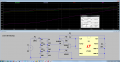
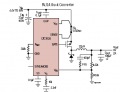
LTC3824 is similar to many controllers, it does high-side sensing... look at the diagram below... can you see where? The information is in the data sheet, you just aren't reading it fully...

1596472932030.png

But that's not the solution to achieve constant current. You don't want to limit the current, you want to control it. The limit is an error condition, not a control option. You probably don't even need it, if your supply is going to limit at 85A anyway.

You need to think think sideways.

The voltage regulation on the LTC3824 is done with a voltage divider, putting 0.8v at the Vfb pin. If Vfb>0.8 the duty-cycle reduced, if <0.8v its increased. How might that be repurposed for current control?

The LTC3824 isn't ideal, but I can see how 4 of them could be used to make an 80A CC regulator...
 
Last edited:

Thread Starter

anishkgt

Joined Mar 21, 2017
549
Does the LTC3824 have current limit.
I meant how do we decide between single phase or multiphase, thought it had something to do with current (voltage at resistor dividers) in some way. Secondly how is the frequency determined ? I read Higher current is best at lower frequency and low current with higer frequency. But how high is HIGH ?
 

Deleted member 115935

Joined Dec 31, 1969
0
Looking at those super caps you indicated.

The ESR and capacitance is measured using a current of around 3 to 4 amps, 10 mA per Farad is the expected.

Look at the thermals, these things have a high ESR, and get hot when currents flow.
you are looking at a max of 23A discharge,

They also have a limited charge / discharge rating of 500,000. and thats at 25 degrees, If they get hot that goes down,
500,000 , at one per second, as say the spot welder your saying about might need , is 16 , 8 hour days of use till End of Life.

As super caps go, these are good, but ,,
 

Thread Starter

anishkgt

Joined Mar 21, 2017
549
Is the single or multiphase determined by the peak current ? I will look at some 2 and 4 phase now. In a multiphase the current is shared within the individual phases. So when design do we divide total total current by number of phase and determine the incductance ?
 

Irving

Joined Jan 30, 2016
5,109
Frequency determines the inductor size. Higher frequency = smaller inductor = lower resistance = less losses at higher current so I'm not sure where you read lower frequency for higher current. Though, higher frequencies travel in outer layers of conductors (skin effect) therefore higher frequencies may find higher resistances at higher currents. I need to go think on that a bit. But 200 - 500kHz or even 1MHz aren't uncommon frequencies.

Multiphase converters have multiple switching elements oh a round-robin basis, each having its own inductor, each contributing to a proportion of the output. So a 4-phase converter would run at a higher frequency than a single phase. Watch this. Read this
 
Last edited:

Irving

Joined Jan 30, 2016
5,109
The more I read about these supercaps, the more i'm thinking there must be a better solution. On the basis you may need to have some form of balancing, and passive balancing using MOSFET and resistors is just wasteful, an active balancer is attractive and is a form of SMPS that uses energy from the high voltage cap to to add charge to the lower voltage cap(s). If that could be integrated within an overall SMPS CC charging function, that would be a great option.
 

Thread Starter

anishkgt

Joined Mar 21, 2017
549
I had this schematic earlier in mind before i came to mosfets. The mosfets gate thresholds are based on the voltage rating of the supercaps which is 2.7 and stop conducting when below. Here is thread talking about it.
 

Attachments

Last edited:

Thread Starter

anishkgt

Joined Mar 21, 2017
549
In the schematic
CAP+ = Positive supply pin of the power supply
SCAP2 = second cap in series
SCAP3 = Third cap in series
GND = Common ground.
 

Irving

Joined Jan 30, 2016
5,109
Yes, Ive seen those balances. They are similar to the passive ones used for LiPo batteries. They'll be all but useless at your charge current just as they are at the 50A charge I use on my 5kW LiFePO4 pack. For a passive balancer to work you need to reduce charge current to the balance current.

Active balancing makes more sense.
 

Thread Starter

anishkgt

Joined Mar 21, 2017
549
Not sure how this would be a bad choice when the mosfets would start conducting 1.9V(Vth) with 0.0001uA and 3000uA when the Gate is at 2.7V which is bypassing the voltage across the capacitor. Based on the leakage current of .75mA per cap and two in parallel would be 1.5mA.
1596557617941.jpeg
 

Thread Starter

anishkgt

Joined Mar 21, 2017
549
So browsing on Digikey i found this evaluation board. Seems to be something i've been trying to do. Just need to adjust the Vout to be 8.1V with RF12 = 10k and RF11 = 125K use two of them with common Vin and Vout tied together. Would that be ok ? My Vin is 12V so based on that i calculate an inductance of 1.75uH at 300kHz. Not sure i should change or leave it as it is in the eval board.
 
Last edited:

Irving

Joined Jan 30, 2016
5,109
The evaluation board is certainly one way to build it, assuming it can be repurposed ok for voltage, etc. You'll probably need a different inductor, and modify the board to deliver CC operation, but that shouldn't be impossible.
 

Irving

Joined Jan 30, 2016
5,109
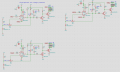
So, I've been playing around with the idea of balancing, and here I'm showing a typical passive balancing approach which monitors the voltage across the cap and attempts to bypass the charge current around the cap once its reached 2.7v.

So you see there is a 3S2P array with values selected at the extremes of the range of capacitance values from the data sheet. Its being charged at 80A and in this simple example there is a bypass on the middle caps that triggers at 2.7v and aims to route the current around the the caps. But as you can see, even at 15A it has very little impact on the charging regime. By the time the lower capacitors reach 2.70v, the middle ones are at 2.87v and the top only 2.65v! That voltage trip is far more precise than the FET solutions proposed and sinks far more current, yet is still unable to stop them overcharging, unless you reduce the charge current significantly. But then you're slowing charging for all the caps. A much better solution is a charger per cap section which stops at 2.7v...

1596718298834.png
 

Thread Starter

anishkgt

Joined Mar 21, 2017
549
couple of questions regarding the ADP1850 buck converter.
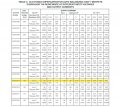
Under ‘Setting the current sense gain’ on page 17 calculating V_CSMAX requires the Rdson_MIN and MAX resistance. Is this RDSon value from the datasheet of the mosfet or something to with the duty cycle. The max is not defined so i presume it is the same like MIN.Then there V_COMMAX where the ton is required. How can i calculate this ?

The duty cycle is Vout/Vin = 8.1/12 = 0.675 which is 67.5% of the time the high side mosfet is ON. 67.5% of 200,000Hz is 130,000. So how can i substitute it to the formula as a time.
 

Irving

Joined Jan 30, 2016
5,109
What MOSFET? link to datasheet... Rds(on)_min won't be the same as Rds(on)_max

200kHz -> cycle time is 1/200000 = 5uS a duty cycle of 67.5% = 5 * .675 = 3.375uS
 

Thread Starter

anishkgt

Joined Mar 21, 2017
549
The MOSFET
So i get the following setting Acs = 3V
Vcsmin = 0.738912
Vcsmax = 0.757392
Vcopmax = 0.757393

With Acs = 24V
Vcsmin = 0.661296
Vcsmax = 0.809136
Vcopmax = 0.809137

The datasheet talks about it here. But not sure if the values are ok
The voltage range of the internal node, VCS, is between 0.4 V and 2.2 V. Select the current sense gain such that the internal minimum amplified voltage (VCSMIN) is above 0.4 V and the maximum amplified voltage (VCSMAX) is 2.1 V. Note that VCSMIN or VCSMAX is not the same as VCOMP, which has a range of 0.85 V to 2.25 V. Make sure that the maximum VCOMP (VCOMPMAX) does not exceed 2.2 V to account for temperature and part-to-part variations.
As per datasheet Vcsmin seems ok but about Vcsmax do they mean it should not exceed 2.1V.
 
Top