Model Railroading - LED Lighting

Thread Starter

Jason Cox

Joined Jan 5, 2018
2
Hello all,
I am new to the world of circuitry but I did take a Science Technology Class in high school 17 years ago...

I am a model railroader and I have a few passenger train cars that have an incandescent light that powers while power is supplied to the rails. The power controller has a max output of 1000ma and 16vdc. A few of my passenger cars need replacement of the lighting so I was going to use LED's. After some online research I found that I was going to need to use a resistor as not to blow the LED. I have 3v LED's with 20ma. With my calculations, I would need 680 resistors with the power controller I have.

So naturally, once I have this idea wired up, the power supply would power the rails, powering the LED. Then turn off when the controller is off.

So, the next step I would like to do is to add a capacitor to take a charge and light the LED's. I would like to see the LED's illuminate when the train is running and then continue to illuminate (for a short time) after the controller is turned off. With the figures provided, what do I need to do to make this work? Thank you for reading and have a nice day.
 

RichardO

Joined May 4, 2013
2,270
Unlike incandescent lamps, LED's are polarity sensitive. They only light when the anode is more positive than the cathode. They can be damaged by applying the opposite polarity.

Some solutions that come to mind...

The most efficient is to wire two LED's in parallel with the anode of one connected to cathode of the other. You only need one resistor. Put it in series with the parallel pair of LED's.

Put a 1N4001 in parallel with every LED. Again, connect anode to cathode.

Power the LED's through a diode bridge. The disadvantages are more parts and the LED's need a higher voltage before they start to turn on.

If you need several LED's you can put them in series and use only one resistor for the series group. Each LED could be a parallel pair. LED's in series drop more voltage so you need to recalculate the resistor value. And like the diode bridge version, they will not light at low voltages.

By the way, are you using DCC? That may change my thinking.
 

Thread Starter

Jason Cox

Joined Jan 5, 2018
2
I'm running a DC layout. Ok, so wiring in the 1N4001 will protect the LED from blowing. How do I choose the correct capacitor to collect, store and disperse enough energy to illuminate the LED?
 

Alec_t

Joined Sep 17, 2013
15,118
If 20mA is the rated maximum current you may well find that gives too bright a light for realism, so a lower current could be used. Besides, it is good practice to run LEDs at less than their maximum rated current if you want them to have a long and happy life.
 

AnalogKid

Joined Aug 1, 2013
12,128
We'll skip the exponential equation and reduce it to an approximate form:

E x C = i x t >> Voltage times capacitance equals current times time.

You're doing doing well so far; 680 ohms yields 19 mA peak current. Round that up to 20 mA. As the capacitor discharges, the current decreases and the LED gets dimmer and dimmer until the capacitor terminal voltage is below 3 V, at which point the LED is completely off (it might be too dim to see before that). Another approximation - 20 mA peak down to 0 mA eventually = 10 mA average.

E = the voltage drop in capacitor voltage as it discharges = 20 V - 3 V = 17 V
i - the average discharge current = 10 mA

Now, we can relate capacitor size to time:

C = i t / E
t = E C / i

If you want 10 seconds of dimming light, C = 10 mA x 10 sec / 17 volts = .01 x 10 / 17 = 0.00588 F = 5900 uF

If you have a 1000 uF (0.001 F) capacitor and want to know how long it will last, t = 17 x 0.001 / .01 = 1.7 seconds

Note that there are several approximations and assumptions in here, but this is a starting point. For example, if you notice that the voltage range for *useful* light output isn't down to 3 v, but down to 8 V, then E, the voltage change during discharge, now is 12 V. Recalculate and you'll see that the capacitor size for that same 10 seconds just went up. You probably will find that the real world capacitor size for any given set of conditions is larger than the value reached with this approximation. As a starting point I would increase the calculated result by 10% - 20%.

ak
 

Bernard

Joined Aug 7, 2008
5,784
Is this a 2 rail system , 1 rail +, other - ?, unless you are backing, so @ RichardO is right in using a bridge rectifier. Is each car a separate circuit ? What is the average running V ?
 

Bernard

Joined Aug 7, 2008
5,784
Ramblings from a 91 year old:
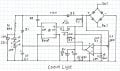
A 1 farad @ 5.5 V C with a boost converter kept a white LED starting at 15 mA on for over 1 min.
FET switch not tried yet, red LED as simple V ref. Out of time for today, must get ready for dining & dancing tonight.Coach Light 00000.jpg
 

Bernard

Joined Aug 7, 2008
5,784
If the boost does not draw too much unloaded, then might leave out the FET, comparator, & V ref. ' paid about US $ 1.50 for 1 F C.
 

Bernard

Joined Aug 7, 2008
5,784
The 600 ohm current limiting R might be lowered some depending on how many cars are used & how much boost draws.
How many LEDs are needed per car ?
 
Last edited:

Bernard

Joined Aug 7, 2008
5,784
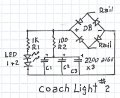
This is as simple as I can get it. LEDs stay bright for 10 sec. off in about 60 sec. R2 can be increased to about 450 ohms to reduce inrush current. To reduce further add two diodes to OR the two supplies to LEDs & increase R2 which will increase charging time. In US can buy 40 , 2200 @ 16V for $ 6.00 + S&H.Coach Light #2 00000.jpg
 
Top