MIssing voltage 250512

Thread Starter

allenpitts

Joined Feb 26, 2011
182
Hello forum,

Working on a circuit that will
fade eight 5 mm LEDs ove an eight second
interval.

https://www.arduino.cc/en/Tutorial/BuiltInExamples/Fade
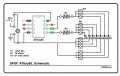
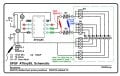
SPSF_ATtiny85_schematic_250509.jpg

The breadboard worked well the functioned
as designed. That is, it fades from full brightness
to off and back to full brightness
over an eight second frequency.

A PCB was drafted and manufactured.
But the board does not work. Spent
hours troubleshooting the board
with no luck.
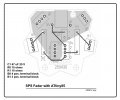
SPS_PCB_Multi_outs_B&W_250430.jpg
So it was decided to build a new
board and test every component and connection
as the PCB is built.

The microntroller was installed
and tested. A simple sketch to send
output from pin 5 on the ATiny85 was
written for testing and is attached
herewith below.

A test between the ATtiny85 pin 5
(sketch pin 0) and R0 csues the
multimeter the multimeter to
oscillate between 0 amd 4.6 volts
at the one second interval spec'd
by the delay in the sketch.

When a test is done between
R0 and B1 the meter reads zero volts
and does not go up to 4.6 volts
and back down to zero as the circuit
does on the microcontroller side
of the resistor.

It was expected that the voltage
would drop a little, say one half
to three-quarters of a volt to
around 4.0 volts because of a
voltage drop caused by the resistor.

But did not expect zero volts.
Perhaps the LEDs have to be installed
for the current to be drawn thru the
resistor for the voltage to register.

Thanks.

Allen Pitts
 

Attachments

WBahn

Joined Mar 31, 2012
32,702
It looks like the MCU's reset pin (pin 1) is floating.

This is probably a bad idea.

Your first post says you want to fade eight LEDs. I only see seven. Where is the eighth?

When you talk about a test between R0 and B1, where, exactly, are you putting the two meter probes? Since R0 has TWO pins, there's ambiguity as to which side of the resistor you are probing.

If you are probing R0 on the side away from the MCU, then all that there is between your two probes is a metal trace, which has very low resistance. Any reasonable amount of current flowing in the trace is going to produce only a very small voltage drop across it.

If there is no load on the resistor (e.g., no LED), then there will be no current flow in the resistor. What is the voltage drop across a resistor that has no current flowing in it?
 

Dave Lowther

Joined Sep 8, 2016
332
It looks like the MCU's reset pin (pin 1) is floating.
Having nothing externally connected to the reset pin shouldn't be a problem. There's an internal pullup on that pin.
From the datasheet:
1747129054125.png
I have a few ATtiny85 projects that work reliably without any external pull up on the reset pin.
There should be a 100nF ceramic decoupling capacitor between 5V and Gnd as close as possible to the ATTiny85.
 

BobTPH

Joined Jun 5, 2013
11,463
Why are you measuring between R0 and B1? Did you mean R0 and B0?

Also as @WBahn pointed out, when you say “measuring between A and B”. most of us interpret it as one probe in A and the other on B. I think perhaps what you mean is between ground and the junction of A and B.

For any measurement, state clearly where the two probes are. If one is on ground, you can name only the other one, for instance, you might say “the voltage at pin 5”, meaning black probe on ground and red on pin 5.
 

Thread Starter

allenpitts

Joined Feb 26, 2011
182
Hello WBahn, AlbertHall, Dave Lowther, BobTPH and the AAC forum,

Sorry guys, I was in hurry to post because my wife
was waiting on me to take her to the auto mechanic.
So my post #1 lacked proofing and so has several typos and ambiguities

Your first post says you want to fade eight LEDs. I only see seven. Where is the eighth?

Typo: There are not eight LEDs. There are seven LEDs.

The description of the tests was obviously unclear because
there were several questions about the tests. An attempt to make the
tests more coherent follows.

SPSF_ATtiny85_schematic_250513.jpg

*** Tests of Output from ATtiny85 Pin 0 ***

Test 250513.1

Preconditions:
1. Circuit as shown in schematic titled 'SPSF ATtiny85, Schematic'
dated 250509, revised 250513
2. Sketch loaded at ATtiny85:
'ATtiny_Tester_250512.ino' attached to post marked #1.
3. Black probe at ground between ground input and C1.
4. Red probe at R0 lead on the ATtiny side of R0.

Action: Apply power: 5.1 VDC

Expected Result: Meter reads 5 VDC
Actual Result: Meter reads 4.5 VDC

Test 250513.2
Preconditions:
1. Circuit as shown in schematic titled 'SPSF ATtiny85, Schematic'
dated 250509, revised 250513
2. Sketch loaded at ATtiny85:
'ATtiny_Tester_250512.ino' attached to post marked #1.
3. Black probe at ground between ground input and C1.
4. Blue probe at R0 lead on the LED side of R0.

Action: Apply power: 5.1 VDC

Expected Result: Meter reads 5 VDC
Actual Result: Meter reads 0 VDC

So the question is:
Why does the meter read 4.5 volts in Test 250513.1
and the meter reads 0 volts in Test 250513.2?

Perhaps the best answer is given in post #2 from
WBahn where the question is answered with a question:

What is the voltage drop across a resistor that has no current flowing in it?

The surmise is, because there is no current there can be no voltage.
It is further deduced that when the LEDs are installed the
voltage at a test similar to Test 250513.2 will then be a little less
than 4.6 VDC. That is, with the LEDs drawing current the
voltage at a tests similar to Test 250513.1 will still be
around 4.6 VDC. But with the LEDs drawing current the
voltage at a tests similar to Test 250513.2 will become
around 4.6 VDC less whatever voltage drop is caused by R0.

Finally, the ceramic capacitor recommended by Mr. Lowther,
if my arithmetic is correct is .1uF which is in my components
inventory.
Please accept a request for an answer to two questions about
this capacitor:
Capacitor question 1. The function of C2 is to protect the
ATtiny from power surges or peaks, right?
Capacitor question 2. Except for thr increase in cost,
is there reason why a larger capacitor, say 1000 nanofarad
or 1 microfarad, could not be used? That is, if the function
of C2 is to protect the sensitive circuitry in the microcontroller,
would a larger cap provide more protection? Is there
any drawback to using a larger ceramic cap?

Thanks.

Allen Pitts
 
Top