Chorus pedal bias trimmer missing, how to add?

Thread Starter

sonohe

Joined Jan 11, 2025
67
I need to adjust the bias on my Behringer UC100 chorus pedal to fix the sound, usually these pedals have a dedicated trimmer for this purpose. But when disassembling the pedal, I noticed that trimmer was not added in the factory. Its place and solder points are added however. And the schematic also mentions it. It would be fairly easy to solder a trimmer to its place on the board. But I am not sure if I need to remove elements from the circuit if the trimmer is there? I guess it is the resistor R3 that sets the bias now (see on the schematic). Should I remove that if I add the trimmer?

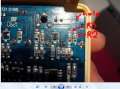
Here is the photo of the place of the trimmer:
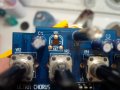
IMG_20260405_010239.jpg

Here is the Schematic (the Bias trimmer underlined by red):

https://drive.google.com/file/d/1Bh8Nzv7c56FY9VhYZ2Lf_1KRi0tHhdQQ/view?usp=sharing
 

Alec_t

Joined Sep 17, 2013
15,106
The schematic shows a shorting 0 Ohm resistor R2 which needs to be removed if trimmer VR1 (4k7) is inserted.
[Edit] R2 might actually be just a circuit trace or a wire link.
 

Thread Starter

sonohe

Joined Jan 11, 2025
67
The schematic shows a shorting 0 Ohm resistor R2 which needs to be removed if trimmer VR1 (4k7) is inserted.
[Edit] R2 might actually be just a circuit trace or a wire link.
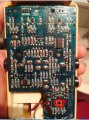
This is how the other side looks, where the small elements are soldered. Does it clarify anything?

poti2.JPG
 

Jerry-Hat-Trick

Joined Aug 31, 2022
779
Maybe just power it up and measure the voltage across R2 - it should be zero if R2 is zero ohms. Then measure the voltage between R2 and ground - it should be around 2/3 of Vcc, with R9 and R3 acting as a potential divider. For a double check, is the voltage across the two lower pins of VR1 (as shown in the photo) also zero as R2 should be between them? Disconnect power. Solder in VR1 - nothing should change. Take our R2 - VR1 should change the bias.
 
Last edited:

Thread Starter

sonohe

Joined Jan 11, 2025
67
I am ready to measure it, but when assembled, there is a spring that is mounted on the circuit board at the point that you can see encircled on the photo attached. When assembled, one end of the spring touches the encircled area, the other end touches an isolated metal plate on the case. Now as the board is taken out there is no contact between the board and the metal plate. Can I power it up like this, or the connection between the board and metal plate should be restored before powering it up? And can I use that area where the spring is as a GND point? Sorry if the questions are dumb but I am not an electronic expert.

GND.JPG
 

Alec_t

Joined Sep 17, 2013
15,106
I'm guessing the metal plate provides some screening, but its absence is unlikely to affect your resistance check per post #7.
 

Thread Starter

sonohe

Joined Jan 11, 2025
67
I have some news!!!

I think I am in the good direction with this. So I bought a 5K trimmer, but by mistake I desoldered R3, and it bounced away, so that's gone. This way I desoldered R2, and soldered it to the place of R3. I confirmed the signal goes through that point. But now at the moment I can only modify downwards.

However, even this way I managed to improve the sound a lot. However there is still some problem remained. The essence is: At 5K the intermodulation is strong. When you decrease the resistance, it starts disappearing, and around 50% it only appears around frets:20-24, just like on the Keeley Compressor. But along with it, clipping appears at those frets. On the other frets the sound is clean. You can listen to how it sounds at the sweet spot:
https://drive.google.com/file/d/1m_Nuk2s5dasGyDdKKnjKeX4kC-ji2CzF/view?usp=sharing

I think this is because some thresholds are tight and the signal hits a celling that trigger clipping and intermodulation. My guitar sounds louder as you advance from the headstock to the body. At the lowest frets the jump in loudness in exponential, I think this causes that the intermodulation still happens at those frets. But, I have a Schecter Omen guitar with me, that one has more balanced volumes along the neck. However at the lowest frets, even that guitar triggers the same problem. So the thresholds are tight even for that guitar as well.

Decreasing the resistance more, under 50% the intermodulation is still there but the clipping gets worse and worse. Around 15-20% when the resistance reaches a point the chorus effect stops, and the sound becomes clean, no clipping, no intermodulation. This applies even at 0.

Any idea how to get rid of the problems still present at 50%? The pedal sounds quite good anyway, only that small section is problematic now. I can solder/desolder most stuff, because the SMD is on the back and the larger parts on the front. So there is space to work.

Here is the full test:
https://drive.google.com/file/d/1qNDmVfYHlLymNxJkfQYHfVrmT3KDpKhe/view?usp=sharing
 

Jerry-Hat-Trick

Joined Aug 31, 2022
779
By replacing R3 with the zero ohm resistor your adjustment is now zero to 5K where it should be 4K7 to 9K4. I’d recommend removing R2 from the R3 position and solder a conventional thru hole 4K7 resistor between the leg of the trimmer (which connected to R3) and ground
 

Thread Starter

sonohe

Joined Jan 11, 2025
67
By replacing R3 with the zero ohm resistor your adjustment is now zero to 5K where it should be 4K7 to 9K4. I’d recommend removing R2 from the R3 position and solder a conventional thru hole 4K7 resistor between the leg of the trimmer (which connected to R3) and ground
Yeah but you see from the results that the sweet spot is at about 2.5K, if you increase the intermodulation becomes stronger and stronger so what's the use of increasing the resistance more and test in a higher resistance range?
 
Top