Measure approximate wind speed

Thread Starter

AlbertHall

Joined Jun 4, 2014
12,619
I am designing a circuit for a fountain. I want the pump to stop if there is no water, if there is a risk of the water freezing or if the wind is strong enough that the water will blow far enough to miss being collected and so empty the reservoir. The first two are fairly easy to arrange but how do I measure the wind speed? An anemometer would be overkill.

I had an idea for using two thermistors across the 5V supply with values low enough that the power dissipation would warm them slightly. Then, with one of them inside the box and one of them exposed to the wind the voltage would be a rough measure of the wind speed as the wind cools the exposed one.

Is this viable? Are suitable components available?
Is there a better way?
 

MrSalts

Joined Apr 2, 2020
2,767
I am designing a circuit for a fountain. I want the pump to stop if there is no water, if there is a risk of the water freezing or if the wind is strong enough that the water will blow far enough to miss being collected and so empty the reservoir. The first two are fairly easy to arrange but how do I measure the wind speed? An anemometer would be overkill.

I had an idea for using two thermistors across the 5V supply with values low enough that the power dissipation would warm them slightly. Then, with one of them inside the box and one of them exposed to the wind the voltage would be a rough measure of the wind speed as the wind cools the exposed one.

Is this viable? Are suitable components available?
Is there a better way?
For wind speed, you can use a "hot" wire method (power input needed to maintain a constant temp above ambient).
https://en.m.wikipedia.org/wiki/Anemometer#Hot-wire_anemometers
 

MrChips

Joined Oct 2, 2009
34,626
A hot-wire anemometer is the first thing that comes to mind.
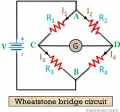
Here is what I would try, a basic Wheatstone bridge circuit:

1653008880106.png

You can start off experimenting with four identical resistors, for example 100Ω ¼W carbon film resistors.
Three of the four resistors are sealed and not exposed to the wind. One resistor exposed to the wind will have a lower temperature as wind velocity increases.

If this is not sensitive enough you can try using four thermistors instead. Try low value resistances in order to obtain self heating effect.
 

cmartinez

Joined Jan 17, 2007
8,722
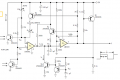
Albert, I'm giving away to you the product of many hours of work inside the attached zip file. Start by taking a close look at the PDF in the root directory. The circuit is based on the thermal difference between two matching transistors. The attached files include not only the circuit diagram itself (which I based on someone else's design) but also the assembly source code for the AT89LP8051 and the corresponding VB.net code to interface it with. As a matter of fact, this post could easily be included in the "completed projects" collection of this site, but I'm up to my neck with work at this moment to bother going into the necessary details and extra work for it to qualify as such.

1653023027085.png

Feel free to ask any questions about this small project anytime you like.
 

Attachments

Thread Starter

AlbertHall

Joined Jun 4, 2014
12,619
Lots of interesting circuits there but they do invlove quite a lot of extra hardware.

In #1 I said that I also want to switch off the pump if there is a risk of the water freezing. I have decided to use the DS18B20 for that temperature which requires so little hardware. It does need extra software but I am not short of ROM space. It has occurred to me that I could use a second such sensor mounted on top of a 1206 resistor to warm it up by 10C to 20C above ambient as the wind sensor.

As this thing will be out in the rain as well as the wind and sun both sensors should be out in the weather. This only requires three connections. I feel some experiments coming on...
 

Ya’akov

Joined Jan 27, 2019
10,226
Lots of interesting circuits there but they do invlove quite a lot of extra hardware.

In #1 I said that I also want to switch off the pump if there is a risk of the water freezing. I have decided to use the DS18B20 for that temperature which requires so little hardware. It does need extra software but I am not short of ROM space. It has occurred to me that I could use a second such sensor mounted on top of a 1206 resistor to warm it up by 10C to 20C above ambient as the wind sensor.

As this thing will be out in the rain as well as the wind and sun both sensors should be out in the weather. This only requires three connections. I feel some experiments coming on...
You might want to check out these [two] [boards] which look interesting.
 

atferrari

Joined Jan 6, 2004
5,001
I am designing a circuit for a fountain. I want the pump to stop if there is no water, if there is a risk of the water freezing or if the wind is strong enough that the water will blow far enough to miss being collected and so empty the reservoir. The first two are fairly easy to arrange but how do I measure the wind speed? An anemometer would be overkill.

I had an idea for using two thermistors across the 5V supply with values low enough that the power dissipation would warm them slightly. Then, with one of them inside the box and one of them exposed to the wind the voltage would be a rough measure of the wind speed as the wind cools the exposed one.

Is this viable? Are suitable components available?
Is there a better way?
The closer to ground level your measurements are made be ready to get surprising differences depending of the direction. That's why in vessels the wind vane is well up there.
 

Thread Starter

AlbertHall

Joined Jun 4, 2014
12,619
The closer to ground level your measurements are made be ready to get surprising differences depending of the direction. That's why in vessels the wind vane is well up there.
Well, The water from the fountain isn't far above ground level and I only need a measurement good enough to stop the pump if the water may get blown away.
 

bassbindevil

Joined Jan 23, 2014
918
If there's WiFi available, maybe an ESP32 could get wind speed data from your area. I believe there are sites that collect data from home weather stations, for example. Or maybe just install a WiFi anemometer somewhere nearby.
 

Thread Starter

AlbertHall

Joined Jun 4, 2014
12,619
The local wind at the fountain, which is what matters, could be very different from the regions wind due to house, hedges, terrain, etc. so i think it makes sense to measure near the fountain. My latest idea adds just two components to the rest of the circuitry, a resistor and a DS18B20 - simple cheap. I now have a program which can read two sensors so the experiment can progress.
 

atferrari

Joined Jan 6, 2004
5,001
The local wind at the fountain, which is what matters, could be very different from the regions wind due to house, hedges, terrain, etc. so i think it makes sense to measure near the fountain. My latest idea adds just two components to the rest of the circuitry, a resistor and a DS18B20 - simple cheap. I now have a program which can read two sensors so the experiment can progress.
Albert
I dare to insist: direction (even if not frequent) could make for a difference.
 
Top