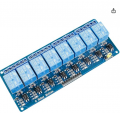
MCU control of 100v to a number of outputs

Thread Starter

sirch2

Joined Jan 21, 2013
1,069
Related to my other post about geophysics resistivity I am contemplating ways of switching a 100v output to say one of eight output lines. I.e. I have a 100v source and I want to switch it to each of 8 outputs in turn using a micro-controller. In practice it will actually be double pole as both -ve and +ve of the 100v supply need to be switched.

What I'd really like is something like an old fashioned eletro-mechanical telephone selector that I could drive from one pin on the MCU but I guess that's unlikely and probably too large and heavy. A few ways of doing this come to mind, assuming I have enough output pins on the MCU (or I use some sort of demux) - relays or MOSFETs. I will need to reverse the output polarity which I feels makes the MOSFET option more complex.

I'm just asking if there is another way I haven't thought of I do I just go with relays?
 
Last edited:

ericgibbs

Joined Jan 29, 2010
21,412
hi s2,
An Arduino MCU will have enough pins to drive 8 output lines

Not sure what you mean by,
I will need to reverse the output polarity which I feels makes the MOSFET option more complex

Do you mean invert the MCU pin output signal.?
E
 

Thread Starter

sirch2

Joined Jan 21, 2013
1,069
I'll need to use some of the MCU I/O pins for other things, I haven't nailed down the complete design yet, as I said multiplexing is an option.

I mean reverse the polarity of the output, e.g. I have 8 pairs of wires A1,B1 .. A8,B8 I need to make A1 100V and B1 0V, then make A1 0V and B1 100V and then do that for A2,B2 etc. Using relays I am thinking of a DPDT relay to reverse the polarity and then that feed the selector relays.
 
Last edited:

Thread Starter

sirch2

Joined Jan 21, 2013
1,069
Thanks for the replies, my question was really, other than mosfets and relays, is there anything else that could do the job with a lower component count, although with the pre-made relay board I guess that's like a single component.
 

crutschow

Joined Mar 14, 2008
38,388
Switching both the plus and minus lines, plus polarity reversing makes an all solid-state design somewhat complex.
Going with relays, such as in post #5 would seem to be the simplest way.
 

Reloadron

Joined Jan 15, 2015
7,867
I'll need to use some of the MCU I/O pins for other things, I haven't nailed down the complete design yet, as I said multiplexing is an option.
They do make relay cards which are I2C and that gets you out of the pin problem. A Google of I2C Relay Boards should get you some possibles. Something like this maybe and they also make 16 channel flavors. I see where ronsimpson covered I2C relay boards.

You mention 100 volts but I see no mention of the current to your 100 volt loads? Polarity change can be done with relays (DPDT Relays) but be it a H Bridge or Relays the load current needs known.

Ron
 

MisterBill2

Joined Jan 23, 2018
27,260
Thanks for the replies, my question was really, other than mosfets and relays, is there anything else that could do the job with a lower component count, although with the pre-made relay board I guess that's like a single component.
YES, and possibly available, as well.. Long ago PINBALL MACINES used a style of stepper relays for a bunch of different functions. Some even drove seven-segment digital displays. Either a scrapped older pinball machie or a company that repairs them might be a source of that type of relay.
For just driving the relay there are also darlinton transistors that can do it. And those transistors can be driven directly from 5 volt CMOS logic.
 

MisterBill2

Joined Jan 23, 2018
27,260
There are also schemes that can use a stepping mechanism with the contacts and connections on a PC board. That scheme is not at all new, except for your application, whatever that actually is. The one challenge being that using a stepper relay scheme you have a single fixed sequence.
 

drjohsmith

Joined Dec 13, 2021
1,577
What current per output
What switching time , ns , ms ?
Are you allowed "bounces" or do you need a clean transition ?
Are you allowed the +ve and -ve to switch at different times ?
 

Reloadron

Joined Jan 15, 2015
7,867
YES, and possibly available, as well.. Long ago PINBALL MACINES used a style of stepper relays for a bunch of different functions.
In my pile of junk I still have a stepper relay going back to the early 60s. I used it to step up or increment up but unlike a simple relay it can't step to a chosen step. It counts up and at a preset number it will reset. A fine mechanical delight it is. :)

I am going to run with the relay card. Simple and modular. Simple is a good thing and since there is a uC already I like using the I2C feature. That allows the user to program exactly what they want and when. While it can be done with simple relays using I2C really reduces the number of lines needed. That plus the flexibility make for a good solution.

Would MOSFETs work? Yes assuming DC and the MOSFETs source and drain are rated for the 100 volts they are switching and using a MOSFET I would suggest a Logic Level Gate variety. However we are back to tying up more digital out lines of the uC.

Additionally since the first post mentions switching polarity of 8 outputs a 16 channel I2C relay board seems logical. I am seeing these boards capable of the 100 volts mentioned. Shop wisely as I see prices all over the map along with switched voltages.

Ron
 

MisterBill2

Joined Jan 23, 2018
27,260
There are steppers that reset and also steppers that continue to rotate, starting over . AND for those custom functions, there are steppers that have the contacts on a PC board.
 

Reloadron

Joined Jan 15, 2015
7,867
There are steppers that reset and also steppers that continue to rotate, starting over . AND for those custom functions, there are steppers that have the contacts on a PC board.
Mine is just an old simple flavor. It can increment up with 40 contacts on a board. Can't even find a manufacturer on it. My guess is I recall this creature from early mid 60s so its been around awhile. Anyway it would be useless for this application. :)

Ron
 
Top