Math Assignment Help!

Thread Starter

Thinker

Joined Jan 9, 2007
62
Good job, your method is correct.

I have gone roughly through your numbers in my head and they seem correct; I would suggest that you have one more run through your basic calcs to ensure you have got the baisc multiplications and sumations right. Otherwise, well done.

Dave
Thanks dave :) I'll check it again.

I've just got three more questions to go through before i had in my assignment. :)

Okay, the next question is after the standard deviation question i just done with you, it says:

On completion use the following formula to calculate SD.

After this it shows a formula like this (but without the -1):
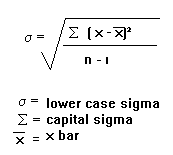


How do i go about working this out?
 

Dave

Joined Nov 17, 2003
6,969
Hi Thinker,

The sum of (x - x')^2 should be the same for both questions; however in the first question it is 181.33 and in the second question it is 181.24 - check this because although you have used a slightly different method, the answer should be the same.

The second standard deviation equation (the one with the -1) is a different method for calculating SD from considerations of Information Theory - the only thing that is different from the previous question is that you must use n-1 as opposed to n, and n-1 = 23

So looking at your second answer it should be sqrt(181.24/23).

Dave
 

Thread Starter

Thinker

Joined Jan 9, 2007
62
Hey dave for the second question it doesn't have a n-1.....it just has an n.

I'll go through the first SD question later and get back to you.
 

Dave

Joined Nov 17, 2003
6,969
Hey dave for the second question it doesn't have a n-1.....it just has an n.
Sorry, I seem to have misinterpretted your question.

In essence its the same question, however the first question asked for it to be done in a tabulated form, and the second question is merely a check. If this is the case, then your answer is correct.

You still need to do the check on which is correct for the sum of (x - x')^2 and I would suggest that you add the requisite columns to your first answer as per this post. The more columns the better!

I'll go through the first SD question later and get back to you.
No problem.

Dave
 

Thread Starter

Thinker

Joined Jan 9, 2007
62
Okay no problem Dave.

I'll go an check the first equation out with that method you gave me (though i don't fully understand but i'll like to have a crack at it anyways).

I'll back to you later on the day, what time are you going to go offline?
 

Dave

Joined Nov 17, 2003
6,969
Okay no problem Dave.

I'll go an check the first equation out with that method you gave me (though i don't fully understand but i'll like to have a crack at it anyways).

I'll back to you later on the day, what time are you going to go offline?
Your method in your first answer is correct, just make sure you tabulate every calculation - this is what the question is asking you to do.

For example, where you have 15x3 = 45, 11x1 = 11 etc - tabulate this under a new column x*f, so your first 3 columns will be:

x | f | x*f

There is no strict correct method, but by taking this approach you give yourself the best chance to get the most marks.

Any further questions or queries about what I have said, feel free to post up, don't struggle with it.

Dave
 

Thread Starter

Thinker

Joined Jan 9, 2007
62
Your method in your first answer is correct, just make sure you tabulate every calculation - this is what the question is asking you to do.

For example, where you have 15x3 = 45, 11x1 = 11 etc - tabulate this under a new column x*f, so your first 3 columns will be:

x | f | x*f

There is no strict correct method, but by taking this approach you give yourself the best chance to get the most marks.

Any further questions or queries about what I have said, feel free to post up, don't struggle with it.

Dave
Hey Dave i see what you mean now. You want me to out it in table format because the way i original done it was all over the place!

Yeah, i know what you mean mate. :)
 

Thread Starter

Thinker

Joined Jan 9, 2007
62
I got one last question on this math assigment.

On the paper they said i had to find four statistical terms and explain them, which i done. These were Qualitative, Quantitative, Continuous and Discrete.

I've explained them here:

Qualitative
This is a type of data where information that can be described in words. For example the colour of a car or the name of cars.

Quantitative
This is a type of data where information that can be measured or counted. For the weight of footballers or the number of people who attened a football match, which are all presented in numbers.

Continuous
These are variables that can take any value within a given range. For example speed, areas or height.

Discrete
These are variables that can only take certain values. For example the number of pupils in a class or the size of clothes they wear.


I just need to find out the applications of these, which i don't have a clue about!

Any help on this?
 

Dave

Joined Nov 17, 2003
6,969
Hey i've done the SD on table format, but i ain't at college to scan the paper so i'll show how i done it on here:

x | freq | (x-x') | (x-x')^2
15 | 3 | 45 | 1.667 | 8.34

Is that alright?
Apart from (x-x')^2 = (1.667)^2 = 2.778889.

freq*(x-x')^2 = 8.34

I get with the extra columns:

x | freq | x*freq | (x-x') | (x-x')^2 | freq*(x-x')^2
15 | 3 | 45 | 1.667 | 2.778889 | 8.34

You missed the x*freq column header, but you're definately on the right track. Remember, tabulate everything. When you finish, scan it in and upload it, I'll check through the calcs to make sure you've got the answers right.

Dave
 

Thread Starter

Thinker

Joined Jan 9, 2007
62
Damn! I was assuming the last cloumn was the "freq*(x-x')^2"

Okay, i'll correct it and i'll scan it first thing in the morning.

p.s. - there's another question on the last page of page 3
 

Dave

Joined Nov 17, 2003
6,969
Qualitative data is often used in assessments where opinions and ideas are required. You are trying to ascertain what people think or feel about something, and by its very nature qualitative data is often difficult to make concrete conclusions from. For example, market research: why do you want to use AMD processors as opposed to Intel processors.

Quantitative data is often used in analytical assessments where you are trying to quantify a set of variables to ascertain some information. The data may not be conclusive in terms of your conclusion, but the data is obvious to those that read it. For example: what is the typical memory usage for an EM modelling application - you may get conclusive data, but no conclusive answer on the typical memory usage.

Continous data will have applications in most analogue fields: analog electronic circuit design, AC circuits etc.

Discrete data will have applications in most digital fields: digital signal processing, digital logic circuit design etc.

Be aware that it is often the case, particularly in modern electronics, to have a crossover between usage of contiuous and dicrete data. There are limitless amounts of examples, just take your pick.

Dave
 

Thread Starter

Thinker

Joined Jan 9, 2007
62
Hey Dave i'm going to hand in my assignment at 1:45pm today. So i think everything looks right (hopefully with the questions above).

Anyways, see ya later.
 

Dave

Joined Nov 17, 2003
6,969
Hi Thinker,

Apologies I couldn't look at it before you handed it in, however it looks like you have got it spot on.

Dave
 

Thread Starter

Thinker

Joined Jan 9, 2007
62
No worries Dave,

My teacher marked it in front of me and i went from a Referral to a Merit! :)

Thanks for the help! ;)
 

Dave

Joined Nov 17, 2003
6,969
No worries Dave,

My teacher marked it in front of me and i went from a Referral to a Merit! :)

Thanks for the help! ;)
Well done! Certainly is an improvement. Was there anything we discussed in this thread that wasn't correct? If so, I'm interested in hearing which bits were a problem.

Dave
 

Thread Starter

Thinker

Joined Jan 9, 2007
62
111110
001101
010111
-------

1100010 <= Note this now has an extra bit because of the carries from above.
This part of the question was wrong.

I think the answer was something like 1001010. Couldn't remember what it was on the answer sheet, but apart from that everything was right.

Another thing he didn't even look at the table format of the SD question, all he looked at was the answer. Kept on marking the question quickly of his answer sheet!
 

Dave

Joined Nov 17, 2003
6,969
This part of the question was wrong.

I think the answer was something like 1001010. Couldn't remember what it was on the answer sheet, but apart from that everything was right.

Another thing he didn't even look at the table format of the SD question, all he looked at was the answer. Kept on marking the question quickly of his answer sheet!
Although you're possibly not that interested, I would ask your tutor to give you a worked answer to this question and then explain it to me. If you recall, we didn't understand what the 'blanks' (i.e. '-') were for, and I am really interested in knowing since we clearly misunderstood what they were.

Dave
 
Top