Nothing like learning math online

Thread Starter

WBahn

Joined Mar 31, 2012
32,702
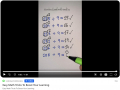
I was looking for information about something unrelated and this video popped up on the side. It wouldn't let me copy a link to it, so I'm posting the final frame and will explain the rest of it.
1759906224316.png

There is no voice in the video at all. It starts with just the blue text pre-written and then shows the person going down line by line circling the first two digits of each number, writing '+2' above the last digit, then writing the sum of the first two digits and two to the right of the equals sign, followed by adding the check mark. For the last one, it just draws a question mark and that's the end of the video.

The title says that it is showing you an easy math trick to boos your learning.

So... just what is the trick and just what is it you are supposed to have learned?

Is it that to divide any number by 9 we ignore the last digit and add 2 to the rest of them to get the quotient?

So, is 139 / 9 equal to 15?

Why not? You are just doing the exact same thing that they are doing?

Okay, so maybe the "trick" insists that you first establish that the number is evenly divisible by 9, presumably by adding up the digits progressively until you get 9 (with the trivial exception of the original number being zero).

Fine -- not even hinted at in the video, but fine.

So what about 72 / 9 ?

Using their trick, that would mean that the answer must be 7+ 2 = 9. Obviously that's not correct.

Okay, perhaps we are supposed to infer, somehow, that the number we add is equal to the number of digits that were circled (i.e., one less than the total number of digits). Again, no hint that this might be part of the boosted learning that we are getting, but fine.

Let's try 243 / 9.

Using their trick, that would mean that the answer must be 24 + 2 = 26. But that's not right, since the answer is 27.

Okay, maybe we are supposed to somehow infer that first digit has to be 1???

So, how about 189 / 2 ?

There is nothing that would seem to indicate that this is not consistent with all of their examples, so the answer must be 18 + 2 = 20, right?

So... just exactly what is the actual "trick" here, including all of the special conditions that must be true in order for it to work?

Just how is this supposed to boost anyone's learning regarding anything?
 

MrChips

Joined Oct 2, 2009
34,626
You can do some interesting math with 9 and 11 because those two numbers are only 1 away from 10.

10 - 1 = 9
10 + 1 = 11

For example,
9 x 15 = (10 - 1) x 15 = 150 - 15 = 130 + 5 = 140 - 5

Try,
11 x 10 = 110
11 x 11 = 121
11 x 12 = 132
11 x 13 = 143
11 x 14 = ?
 

atferrari

Joined Jan 6, 2004
5,001
Just how is this supposed to boost anyone's learning regarding anything?
Other than getting used to catch arbitrary proceedures, I do not see any true benefit in those excercises.

There are many short videos generated by "math teachers" explaining division, multiplication or even square root operations, applying tricks that later you realize, do work with a limited number of cases. Just a waste of time.
 

Thread Starter

WBahn

Joined Mar 31, 2012
32,702
You can do some interesting math with 9 and 11 because those two numbers are only 1 away from 10.

10 - 1 = 9
10 + 1 = 11

For example,
9 x 15 = (10 - 1) x 15 = 150 - 15 = 130 + 5 = 140 - 5

Try,
11 x 10 = 110
11 x 11 = 121
11 x 12 = 132
11 x 13 = 143
11 x 14 = ?
So...

11 x 19 = what? 1109 ?
 

Thread Starter

WBahn

Joined Mar 31, 2012
32,702
Other than getting used to catch arbitrary proceedures, I do not see any true benefit in those excercises.

There are many short videos generated by "math teachers" explaining division, multiplication or even square root operations, applying tricks that later you realize, do work with a limited number of cases. Just a waste of time.
I don't have any fundamental problem with showing people, especially students, 'tricks', but if the assertion is that you are helping them actually learn anything about math, then the emphasis should be on understanding why those tricks work and, using that understanding, understand the limits of where they stop working. It is THAT level of understanding that constitutes actual learning, as it provides a way of thinking about math in ways that let you apply the concepts in many more ways long after the specific 'trick' is long forgotten.

For instance, many people have seen the trick of "throwing out nines" to check if a sum has an error. If the numbers and the resulting sum don't pass the check, then it is wrong. But if they do pass the check, it might still be wrong. It used to be a standard method taught in grade school, but most students today aren't even shown it at all. But very few people were actually shown what the basis for it is and why it works, because that level of understanding works requires being able to understand the fundamentals of positional number systems at a level beyond which most people are taught, and so it is presented as a rule that just has to be memorized.. But, if you do understand its basis at that level, then you can generalize it allowing you to devise rules for "throwing out" other things, which allow you to devise much more powerful checks, because now you have multiple checks and the sum has to pass all of them in order to be correct -- if it fails any one of them it is wrong. While a wrong answer can still pass all the checks, no matter how many there are, the probability of that happening go down rapidly with the number of independent checks that can be used.

Another place a deeper understanding was useful is in determining if a one number is divisible by another. Most people were taught ad hoc rules, such as if the number end in 0 or 5, then it is divisible by 5, or if the number consisting of the last three digits is divisible by 8, then it is divisible by 8. If you ask someone why these two rules work, most (not all) can figure out and explain the divisible-by-5 rule and surprisingly few can figure out the divisible-by-8 rule. Many people (though that fraction is continually getting smaller) can regurgitate that if you add up the digits and if the result is divisible by 3 then the number is divisible by 3, while if it is divisible by 9 then the number is divisibly by 9, but they have no hope of figuring out why either of these rules work, let alone explaining why the number isn't guaranteed to be divisible by 7 if the sum of the digits is divisibly by 7. But, if they do understand things will enough to explain this, then they can come up with similar rules for determining if a number is divisibly by an arbitrary divisor, such as 7 or 13.
 

Thread Starter

WBahn

Joined Mar 31, 2012
32,702
Follow the same pattern.
What comes after 19?
11 x 19 = 209
But you didn't really establish what the pattern was. It was just presented as a 'trick' and requires the person seeing it to figure out the 'pattern', but there are many rules that produce the same pattern, and since all of the examples provided manipulate individual digits, there is a high likelihood that they only look for rules that manipulate individual digits and not see the underlying algorithm that would let them understand what to do with numbers in which the digits interact.

The most obvious pattern from the examples provided is as that the first digit in the result is the first digit in the number (being multiplied by 11), while the last digit is the last digit in the number and between these, you place the sum of the first and last digit. Since none of the examples provided involve sums greater than ten, it's far from obvious that the person will be able to figure out what to do in that case, since they aren't being shown why this pattern exists in the first place.

{A}{B} is a two digit number (e.g., 23 => A=2, B=3)

11 x {A}{B} = {D}{E}{F} where D=A, E = A+B, F = B

So, for someone that is just being shown this as a 'trick', it is not obvious what to do if (A+B) turns out to be greater than 10.

But if the 'trick' is presented from it's mathematical underpinnings, not only is that deeper structure apparent, but it exposes them to a way of thinking about arithmetic manipulations more creatively, allowing them to apply it to more general situations as needed.

11 * {A}{B} = (10+1) * (10A + B) = 100A + 10(A+B) + B

Therefore, IF A+B < 10, then

100A + 10(A+B) + B = {A}{A+B}{B}

Otherwise, a more general result is

11 * {A}{B} = 100A + 10(A+B) + B = 10[10A+(A+B)] + B = {10A + (A+B)}{B}

They are also now in a position to explore how this extends to multiplying 11 by numbers with 3 or more digits.
 

panic mode

Joined Oct 10, 2011
4,864
i see the same type of videos of "shortcuts" in math and find them annoying for the same reason. even when they do have pattern that seem to work, it applies to such small set of values that lookup table (memorizing results) is no more effort than keeping track of the "pattern". bunch of baloney...
 
Top