Mandatory USB C Charge Ports Now In Effect In The UK

DC_Kid

Joined Feb 25, 2008
1,242
Right now I have several chargers I can use with phone, power pack, etc. I should not have to buy another charger for some years to come now.
ESR PD, which is mostly if not all USB-C for portable chargers, is all you need. The other end of the cable makes no diff.

If I am just out buying a charger, then as a consumer I would choose the PD type, because it can charge everything I have, and my cables make no diff. If I use one cable 100x in a week , or 5 cables just 20x per week, the one single cable will fail way sooner than my others, which means into the trash it goes because it gets used too much. Same priciple applies to wall warts, the more they are used (heating cycles) the sooner they fail.

The problem is not how many different cables you have, it's how soon they fail and replaced.
 

Jon Chandler

Joined Jun 12, 2008
1,631
Same priciple applies to wall warts, the more they are used (heating cycles) the sooner they fail.
I have used many chargers on a daily basis for years. I've never had any failures. NOT ONE.

And you make the point that cables eventually fail. True statement. But a failed cable in the trash pales in comparison to proprietary chargers needlessly in the trash any time you upgrade a device.
 

Thread Starter

MrAl

Joined Jun 17, 2014
13,775
ESR PD, which is mostly if not all USB-C for portable chargers, is all you need. The other end of the cable makes no diff.

If I am just out buying a charger, then as a consumer I would choose the PD type, because it can charge everything I have, and my cables make no diff. If I use one cable 100x in a week , or 5 cables just 20x per week, the one single cable will fail way sooner than my others, which means into the trash it goes because it gets used too much. Same priciple applies to wall warts, the more they are used (heating cycles) the sooner they fail.

The problem is not how many different cables you have, it's how soon they fail and replaced.
I am not going to say you are wrong about any of that, but in 30 years or more I've only had one or two wall warts that were bad.
I opened one up and found that one of the transformer's (the old style) wire windings was open, the thinner primary winding.
I had probably 60 wall warts in total over that time period not all used all the time though because I got some from other people that didn't want them anymore. I did test them all though to measure the voltages. Most of them were of the older style though with just a transformer and rectifiers.

I also only had one or two wires go bad that I used a lot. That's out of a lot of wires but not sure how many I had in total.
There has been an interesting improvement in wires in the past few years though. That has been the cables that have a braided nonconductive outer cable shield. They are much more durable. The only thing I don't like about them is that they seem to be stiffer than the older flexible plastic type.

Connectors can go bad, that might be a big issue. That's why I highly recommend the magnetic type connectors for charging phones and other devices too. There is no real friction involved so nothing to wear out. You do have to clean them once in a while though. When you go to charge, you bring the magnetic cable end close to the magnetic plug you have plugged into the phone permanently. The cable end snaps right to the plug in the phone and that makes the contact. If you get a good brand they last a long time. I recommend the higher end types that do 100 watts or better. Since they also do data they work very much like a regular connector. You can get cables and adapters for cables with USB C, USB Micro, USB Mini, and Lightning connectors. That means that if you put the required plug into every device you have, you can use ONE SINGLE cable to charge EVERY SINGLE device you have. Pretty cool huh? Of course you probably want more than one cable so you can charge two or more at the same time.
The advantages are, if you want to, you can use just one single cable for everything and one single wall wart for everything.
Right now I can pull the connector off of the device I am charging now, and snap it onto another device and start charging that device immediately, and all that without wearing down any single connector even a little bit. The magnetic cables I have are also wrapped with the braided outer layer too so they should last a very long time.
They come in sets of two to four cables and associated magnetic plug connectors. You can buy extra magnetic plug connectors for other devices. I think today I would be lost without them.
 

DC_Kid

Joined Feb 25, 2008
1,242
I am not going to say you are wrong about any of that, but in 30 years or more I've only had one or two wall warts that were bad.
I have used many chargers on a daily basis for years. I've never had any failures. NOT ONE.
So then what's the e-waste issue? If the warts of any kind/shape/style last for decades, then how does making them all ESR PD USB-C port reduce e-waste?

I guess now I am confused as to what exactly the problem is. It's been stated too many cables and too many warts are getting into landfill, then I heard it's a "charging between devices" argument.

And let me re-state it, does not matter how long the items last, all of it ends up in the trash. If things fail 30yrs later then I guess all the stuff bought in 1995 is now making it's way to the landfill. In year 2005 a bunch more stuff was bought and we should expect all that to be in landfill by 2035. The more complex the stuff becomes the more pollutants get into the landfills.

I just don't see how a mandate to USB-C solves an e-waste problem, or any problem for that matter.

you can use ONE SINGLE cable to charge EVERY SINGLE device you have. Pretty cool huh?
You have certainly heard of insertion cycle specs, yes? The specs (IEC 62680-1-3 as example) do indicate a lot of insertions, but using just one cable you can easily approach the fail point and need to get another cable way sooner than having 4 cables. I wonder how many cable and port makers are getting their stuff certified to the specs, my guess very little. The other risk is, one damaged cable head can damage many devices. And, when your 1 cable fails you are stuck without a cable for any device, not that you can't run down to local pharmacy and get a new C-C cable for $20.
https://news.ycombinator.com/item?id=12198483

I do often connect a device to my computer using a cable, and at the same time connect another device to a wart for charging. Not gonna be easy to do that if the idea is to own one cable.

Since they also do data they work very much like a regular connector. You can get cables and adapters for cables with USB C, USB Micro, USB Mini, and Lightning connectors.
Not all C cables are data cables, some will state "charge only". The charge-only cables are way less expensive than the good data cables. Almost all devices that are charge-only devices will have a cheap charge-only cable.
I don't need any adapter for an i-phone, the cable is C-Lightning, it connects the device directly to the power source C port.

Did I miss it in the mandate, but it did not say the sale of devices post-mandate should not have a cable in the packaging?
Maybe there are some studies to look at that were used to create the mandate? Are they available online anywhere?
 
Last edited:

Jon Chandler

Joined Jun 12, 2008
1,631
then what's the e-waste issue? If the warts of any kind/shape/style last for decades, then how does making them all ESR PD USB-C port reduce e-waste?
Are you wilfully ignorant or just contrarian? As has been explained in this thread numerous times, the goal is to standardize on one type of charger/power supply for a range of products. If every product you buy comes with a proprietary (i.e., unique, non-standard) power supply, when that device is upgraded or dies, its power supply, which would probably function for many years to come, goes in the trash because it's no longer needed or useful.*

Before USB connectors became common, every phone had a proprietary house charger and possibly a car charger that wouldn't fit the next phone upgrade – often phones from the same manufacturer were not compatible. The situation changed when 5 volt USB chargers became the norm. Upgrading a phone didn't negate the worth of the old chargers.

USB-C and USB-C PD are a step in the path to make chargers universal. Most new phones don't include chargers, based on the likelihood that the buyer probably has suitable chargers from a previous phone. No charger included because it's probably not needed (and an included charger is not free – including a charger will increase the cost of the product.

USB-C PD supports higher current draw items like laptops... and is compatible with all USB-charged devices that don't exceed the power rating of the supply – a phone may require 15 watts; there's no need to have a 60 watt+ supply.

Regarding "the stupidity of multiple voltages from one connector, "Quick Charge" has existed for phones since 2014. It supplied between 5 and 15 volts (as I recall) after negotiating with the device being power. If there's no negotiation, the charger provides only 5 volts. It's worked well and reliably with no reports of phones bursting into flames (Samsung Note 7 phones did have a problem with bursting into flames – this was a design problem with the battery, not caused by the charger). The Quick Charge protocol has been adopted by and incorporated into the USB-C-PD specifications.

USB-C PD is the law. So live with it.


* Discarded "wall warts" and USB chargers are perfect for powering a variety of projects. Personally, none of them are waste.
 

DC_Kid

Joined Feb 25, 2008
1,242
Are you wilfully ignorant or just contrarian? As has been explained in this thread numerous times, the goal is to standardize on one type of charger/power supply for a range of products. If every product you buy comes with a proprietary (i.e., unique, non-standard) power supply, when that device is upgraded or dies, its power supply, which would probably function for many years to come, goes in the trash because it's no longer needed or useful.*

Before USB connectors became common, every phone had a proprietary house charger and possibly a car charger that wouldn't fit the next phone upgrade – often phones from the same manufacturer were not compatible. The situation changed when 5 volt USB chargers became the norm. Upgrading a phone didn't negate the worth of the old chargers.
I already understand the statements made. I not understanding your account of things.

Everything I see today, and for past many years, is USB-A or USB-C (or a combo of) on the wart charger. Cables are USB-A or USB-C on one end, and whatever on the other end.

Some devices like i-pad had it's own cable attached to a inline psu. Is it these very few devices you want to be like the rest so that just one cable can be used, and that somehow fixes e-waste problem?

I see "your" 1-cable solution as a non problem solving shift from "4 cables that get little use each" to "1 cable that gets all the use". And no matter how you slice the bread, the bread is still the same weight, it all gets eaten at some point.
 

DC_Kid

Joined Feb 25, 2008
1,242
Most new phones don't include chargers, based on the likelihood that the buyer probably has suitable chargers from a previous phone.
If someone bought a wart charger in last ~10yrs, what charging ports would it have? 99.9% probability it's A, C, or A+C ? I have an old charger for an old camera that has USB-mini on the charger, but it's old, and making a mandate-standard today does not magically mean all the old stuff vaporaizes and never sees the landfill. And actually, since it is old and not so common any longer, I hanging onto to it carefully so that I can extend the lifetime that I can have and use it. If the charger dies then I find a way to convert the cable to a more common item.

The new phones may not come with a charger (common), but comes with a cable, usually a single charge+data cable, and 99.9% of those are A or C on the charger side of the cable.

I hear all the arguments, none of it making sense to me how it solves an e-waste or energy problem.
If you import 10tons of the stuff, 10tons will get into the trash. If you slow down the rate into the trash, the makers just reduce quality so you have to buy it more often.
 
Last edited:

Jon Chandler

Joined Jun 12, 2008
1,631
The cable is a small e-waste problem compared to throwing full functional power supplies into the e-waste stream with every upgrade.

The USB-C PD mandate also applies to other devices like laptop power supplies. In recent times, virtually every laptop supply provided 19 volts. All of them tied to a particular brand or even model of laptop by incompatible connectors and ID chips for your protection. The mandate eliminates this e-waste and exorbitant costs for a spare charger or a replacement when its cable/connector fails.
 
If someone bought a wart charger in last ~10yrs, what charging ports would it have? 99.9% probability it's A, C, or A+C ? I have an old charger for an old camera that has USB-mini on the charger, but it's old, and making a mandate-standard today does not magically mean all the old stuff vaporaizes and never sees the landfill. And actually, since it is old and not so common any longer, I hanging onto to it carefully so that I can extend the lifetime that I can have and use it. If the charger dies then I find a way to convert the cable to a more common item.

The new phones may not come with a charger (common), but comes with a cable, usually a single charge+data cable, and 99.9% of those are A or C on the charger side of the cable.

I hear all the arguments, none of it making sense to me how it solves an e-waste or energy problem.
If you import 10tons of the stuff, 10tons will get into the trash. If you slow down the rate into the trash, the makers just reduce quality so you have to buy it more often.
I bought a new phone and a modem this year and they each came with a cable and a brick. They are also compatible with my older bricks. The only things that are not compatible are my devices which have Micro USB (thank the Lord that's phased out).

And like you, I repurpose just above everything I get my hands on. Sometimes I use the regulated 5V supply and other times I use the cable as rope which works quite well for all kinds of stuff.

I don't know how you can say these improvements are not contributing to the solution of e-waste. It's quite rare that I actually end up throwing out any kind of electronics. The stuff I do get rid of is motherboards and similar proprietary hardware that has no chance of interfacing with other electronics.

Almost no one cared for my sentiments on evolution but I think the topic in question is well framed in the context of survival of the most fit. USB is just that, through iteration it has risen to the top and is the go-to for most consumer electronics. Like everything else in Nature, it's not perfect and has many flaws. But those flaws are slowly being ironed out.

My favorite quote from Captain Picard relates nicely to my point if you'll humor me: "Your honor, a courtroom is a crucible. In it we burn away irrelevancies until we are left with a pure product - the truth, for all time.". Progress is definitely being made but there is still a long way to go.
 

Ian0

Joined Aug 7, 2020
13,230
We need to accept that despite its problems, we're stuck with USB-C for the moment, but there have been 7 variants of USB since it was introduced in 1996, so it's most likely we're only stuck with it for four years. Is that some new meaning of the word "universal" that I was not previously aware of?
So perhaps what we should discuss is how we should make a better one.
Here's my twopenceworth:
I like the way USB-C is put together, at least you don't have to straighten it out with pliers after standing on it, like USB-A
If we just have data and power we can eliminate most of the extra pins and get back to four, which seemed to work well for 20 years. Perhaps an extra data pair to make it full duplex. I've never connected anything with USB where the speed of the interface has been the limiting factor.
That would leave room for much bigger power pins, and keep the temperature rise down.
If we make every device be able to take 12V*, then there's no need for all this voltage negotiation nonsense. We can make all the cables the same, and make them all take 5A, then there's no waste and no frustration caused by buying the wrong cable - after all, it's meant to be Universal! Fewer cores, and no electronic components in the cable make them easy to recycle.
So that we don't have to make all the power supplies 60W*, then a supply with a 5V output would be a 5W supply and a supply with a 12V* output would be a 60W* supply. The power supplies only have to output ONE voltage so they can be made more efficient, limiting waste.

*Or whatever higher voltage/power is most suitable.
 

DC_Kid

Joined Feb 25, 2008
1,242
but I think the topic in question is well framed in the context of survival of the most fit. USB is just that
That's an interesting statement.
USB has nothing to do with charging, it was designed as a comm port. Later the genious folks decided to add more pins in various physical formats for power and faster comms, all done under the "USB" umbrella.

It's almost the same as cassette tapes where Memorex and TDK battled for the newest types, best dynamic range tape, etc etc. Is it live or is it Memorex? Nobody could really even hear the diff, but the newer tapes were better when looked at by lab test equipment.

One type of port that can do comms and power xfer is good idea (**or is it, see below), forcing one port vs another makes no sense. The free market is already adopting C port. I was just in a store and saw and small cheap batt lamp, had a C port on the side. I also saw a plug-in candle warmer, the tag said on it "Earth Friendly". I suspect it's Earth friendly because you don't have to burn candle wick, while at the same time chewing up utility power, I assume they think making power is no-impact or that your power is 100% from wind/solar/water.

** if I start with says a 4pin port that can do comms and power, and then morph that into a 24pin port, the new cable is more complex and has more metal and plastics in it. Again, I don't think we should look at the problem in #-of-cables terms, we must look at it in terms of tons of materials (copper, tin, plastic, organics), etc. 10tons sold, 10tons will go into the trash, it will happen soon, or later, but junk sold = junk in trash.

After all that, why do we need warts that do "PD"? Just make them a PSU (switching type) to 48vdc, and have every device convert down as needed. We have had this for decades now, computing PSU's are mostly 120/240vac 50-60Hz input, early ones had a selector, new ones are auto. Wait a sec, 48vdc, isnt that the telecom std for decades, and now -48vdc is becoming the new thing.

If we make every device be able to take 12V*, then there's no need for all this voltage negotiation nonsense. We can make all the cables the same, and make them all take 5A, then there's no waste and no frustration caused by buying the wrong cable - after all, it's meant to be Universal! Fewer cores, and no electronic components in the cable make them easy to recycle.
Devices can easily accomodate 48vdc via small SMD dc-dc converters (the compute devices already use dc-dc converters), or in worst way, just resistor to waste some power.


How about this nifty idea, every new electrical receptacle and power strip sold must have at least one C port that is 48vdc 5amp. Then as time goes on the need for power warts goes away. Voila, wart e-waste eliminated.
 
Last edited:

Thread Starter

MrAl

Joined Jun 17, 2014
13,775
So then what's the e-waste issue? If the warts of any kind/shape/style last for decades, then how does making them all ESR PD USB-C port reduce e-waste?

I guess now I am confused as to what exactly the problem is. It's been stated too many cables and too many warts are getting into landfill, then I heard it's a "charging between devices" argument.

And let me re-state it, does not matter how long the items last, all of it ends up in the trash. If things fail 30yrs later then I guess all the stuff bought in 1995 is now making it's way to the landfill. In year 2005 a bunch more stuff was bought and we should expect all that to be in landfill by 2035. The more complex the stuff becomes the more pollutants get into the landfills.

I just don't see how a mandate to USB-C solves an e-waste problem, or any problem for that matter.


You have certainly heard of insertion cycle specs, yes? The specs (IEC 62680-1-3 as example) do indicate a lot of insertions, but using just one cable you can easily approach the fail point and need to get another cable way sooner than having 4 cables. I wonder how many cable and port makers are getting their stuff certified to the specs, my guess very little. The other risk is, one damaged cable head can damage many devices. And, when your 1 cable fails you are stuck without a cable for any device, not that you can't run down to local pharmacy and get a new C-C cable for $20.
https://news.ycombinator.com/item?id=12198483

I do often connect a device to my computer using a cable, and at the same time connect another device to a wart for charging. Not gonna be easy to do that if the idea is to own one cable.


Not all C cables are data cables, some will state "charge only". The charge-only cables are way less expensive than the good data cables. Almost all devices that are charge-only devices will have a cheap charge-only cable.
I don't need any adapter for an i-phone, the cable is C-Lightning, it connects the device directly to the power source C port.

Did I miss it in the mandate, but it did not say the sale of devices post-mandate should not have a cable in the packaging?
Maybe there are some studies to look at that were used to create the mandate? Are they available online anywhere?
You seem to be correlating things that are not to be correlated. You don't go to the store and count apples in order to find out how many oranges they are selling. There's no correlation between the two.

Just because you have a wall wart that lasts for 20 years that does not mean you will still use it.
It was found that when people buy phones they were all coming with a charging brick (wall wart). Then when they bought a new phone, it could come with a new charging brick and they would throw the old one away. The old one became e-waste.

That's not to say that I throw all of mine out, although I did throw a lot of them out about a year ago because I had accumulated so dang many over the years, and took donations from people I know too. They all worked, but nothing to plug them into because none of them had a connector I could use for any of my stuff.

It's not about wires or how long a connector lasts, it's about the wall warts being discarded. Nothing else.
If there are other things to consider that's just the way it goes, but there is still the wall wart waste issue.
Now manufacturers stopped shipping wall warts with their phones.

Is all this actually going to help? Only time will tell for sure. We have to wait for the response, which would be the people buying the stuff and throwing the stuff out. It's too soon to tell. I can tell you one thing though and that is that I probably won't have to buy another wall wart for 10 years :)
 

Thread Starter

MrAl

Joined Jun 17, 2014
13,775
Unless someone changes the standard in 3 years’ time. . .
Yeah I guess :)

It's funny, the byproducts of human life. We are not symbiotic with the earth like the animals and plants are. We tend to mess everything up that we touch while the animals tend to coexist with each other, and are wiped out when it no longer works for their group. Could it be that 'higher' intelligence is the problem. That must mean we will become extinct eventually unless we learn to recycle everything. Evolution will examine us and find us lacking, and therefore get rid of us, in a manner of speaking.
Survival of the fittest, but what exactly does the fittest mean. If we are not fit to coexist with everything else, something will run out, then we're gone.
That's of course if you believe in evolution explicitly.
 

DC_Kid

Joined Feb 25, 2008
1,242
I have not tried it yet, but if you have two warts and you take a C-C cable and connect one wart to the other, do you get a show
Just because you have a wall wart that lasts for 20 years that does not mean you will still use it.
It was found that when people buy phones they were all coming with a charging brick (wall wart). Then when they bought a new phone, it could come with a new charging brick and they would throw the old one away. The old one became e-waste.
That's an idea in alignment with "not understanding human nature". It does depend on phone make-model, but when I buy something very pricey compared to same products in same market, say iPhone #30 vs a TCL android, I will indeed get a new charger for that new pricey item.

I think perhaps the "fix" should be to force sellers of e-products to not bundle a charger with the rechargeable device/product and make it an option for buyer to do an add-on to the purchase for a new charger if so desired, but since many people already have a charger most would perhaps choose not to pay for the add-on. **Caveat on this, see below.

That however has nothing to do with trying to force USB-C on both sides and in the middle (charger, device, cable). App-ill Lightning port plugs directly into USB-C, as example.

Anyone ever try plugging in two USB-C PD warts and then take the Cmale-to-Cmale cable and plug that cable into both warts? Hmmm, is it a "show" or does the implemented PD spec in the warts (which may be different warts) just ignore the odd connection PD to PD? The C pinout does make it so that the pins end up being Vbus to Vbus, but how does PD handle it? Side note, I was not aware that the C spec forbids C cable extensions and adapters, meaning cables and adapters should never have female ends on them. I did however recently buy C female to A male adapter.

** If the idea is to make people hold only a C port wart for way longer, you then are forcing old technology to linger. As example, what if comes along PD spec v4.8 where they up it to 50vdc 7amp, or perhaps 60vdc 5amp, because that helps reduce power losses, and, new devices might become more power hungry. You then have a population stuck on old PD warts because they refuse to buy new, because everything just plugs into the older USB-C warts.

Again, I don't see the solution in the mandate.
 
Last edited:

DC_Kid

Joined Feb 25, 2008
1,242
Unless someone changes the standard in 3 years’ time. . .
USB has had how many iterations already. USB-C has had many iterations already, we can only assume from hisory that C spec will once again change, and, we should expect some newer port to come along. Hence why the silly mandate seems to be a fruitless rinse-&-repeat exercise that does not address the problems as stated.
 

Ian0

Joined Aug 7, 2020
13,230
Devices can easily accomodate 48vdc via small SMD dc-dc converters (the compute devices already use dc-dc converters), or in worst way, just resistor to waste some power.
48V is a good idea. It can use the same devices as POE
How about this nifty idea, every new electrical receptacle and power strip sold must have at least one C port that is 48vdc 5amp. Then as time goes on the need for power warts goes away. Voila, wart e-waste eliminated.
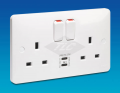
Mains sockets with USB-C have already arrived here:
1736187418194.png
But the power supplies have to run all the time. Plug the wall-wart into the socket and you can turn it off when it is not in use.

How about a microswitch to disable the power supply completely when there is no lead plugged in?
Of course, you could leave one end plugged into the power supply, but then you could get the other end caught in the vacuum cleaner.
 

DC_Kid

Joined Feb 25, 2008
1,242
With SMD IC's these days, you don't need mechanical switches, the port can sense if something was plugged in then turn on the PD. Mechanical switches will perhaps always be on, and they fail. Stay with silicon.

27w PD is dismal though, but it does help eliminate warts.
PD 48v 5amp should be in all those mains receptacles.
 

Thread Starter

MrAl

Joined Jun 17, 2014
13,775
I have not tried it yet, but if you have two warts and you take a C-C cable and connect one wart to the other, do you get a show

That's an idea in alignment with "not understanding human nature". It does depend on phone make-model, but when I buy something very pricey compared to same products in same market, say iPhone #30 vs a TCL android, I will indeed get a new charger for that new pricey item.

I think perhaps the "fix" should be to force sellers of e-products to not bundle a charger with the rechargeable device/product and make it an option for buyer to do an add-on to the purchase for a new charger if so desired, but since many people already have a charger most would perhaps choose not to pay for the add-on. **Caveat on this, see below.

That however has nothing to do with trying to force USB-C on both sides and in the middle (charger, device, cable). App-ill Lightning port plugs directly into USB-C, as example.

Anyone ever try plugging in two USB-C PD warts and then take the Cmale-to-Cmale cable and plug that cable into both warts? Hmmm, is it a "show" or does the implemented PD spec in the warts (which may be different warts) just ignore the odd connection PD to PD? The C pinout does make it so that the pins end up being Vbus to Vbus, but how does PD handle it? Side note, I was not aware that the C spec forbids C cable extensions and adapters, meaning cables and adapters should never have female ends on them. I did however recently buy C female to A male adapter.

** If the idea is to make people hold only a C port wart for way longer, you then are forcing old technology to linger. As example, what if comes along PD spec v4.8 where they up it to 50vdc 7amp, or perhaps 60vdc 5amp, because that helps reduce power losses, and, new devices might become more power hungry. You then have a population stuck on old PD warts because they refuse to buy new, because everything just plugs into the older USB-C warts.

Again, I don't see the solution in the mandate.
Hi,

I am not sure why you are saying all this and repeating what we already talked about.

In your first statement, you are saying that you would have to buy a new wall wart for the pricy item. But if you already have a wall wart that does 5v, 6v, 7v, 8v, 9v, ... 48v, and it has a USB C connector and the devices all have USB C connectors, why would you have to buy a new wall wart?

You are still saying USB C "on both sides". Just what does that mean? The standard is ONLY about the USB C connector on the phone. ONLY ON THE PHONE.

So the idea is to have the USB C connector on all the phones eventually, and since wall warts are going from 5v to 48v you shouldn't have to buy a new wall wart anytime soon unless maybe you want a second one for backup.

So to repeat, the USB C connector on all phones, period.

If you need an A to C cable or a C to C cable that's up to you, but I have a feeling they are moving to all C to C cables with the option of an A to C cable on the somewhat lower power wall warts.

We also have the automobile cigar lighter plug to USB A and USB C also, I bought one of those about a year ago. That's for travel
It has both USB A and USB C connectors, the higher power comes from the USB C connector.
 

Jon Chandler

Joined Jun 12, 2008
1,631
If you connect two USB-C PD supplied together with a USB-C to USB-C cable, prepared to ne bored and underwhelmed. What happens? NOTHING. Both identify as a supply and neither as a consumer, so neither supplies power.

It's almost like the designers considered the possible problems.
 
Top