I want to charge and send data sing an usb c connector.

Thread Starter

Karthik3382

Joined Apr 1, 2026
7
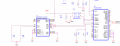
usb 2.0 type c.png
I am using an USB C connector for both charging and data transfer trough this. What would happen if I connect without grounding the cc1 and cc2.My question is i am not using any power delivery IC for negotiation i want to simply get 5V 500mA from the USB is the pull down resistors enough.
 

Thread Starter

Karthik3382

Joined Apr 1, 2026
7
If you don't put the pulldown resistors on the CC pins, if you connect the device to a USB C PD supply, the device will NOT receive power. Add the resistors.
Thankyou for the answer I am not using any power delivery IC and can I get 500mA 5V current draw with these pull down resistors. Also is this circuit good for USB A adapter.
 

Jon Chandler

Joined Jun 12, 2008
1,628
If you're using a USB A supply with an A–C cable, the resistors aren't required. But including the resistors will allow the device to be powered from ANY USB supply.

Leaving out the resistors is a common mistake on many dev boards. Power it with a C–C cable and the board looks dead; power it with an A–C cable and it works fine.

Save yourself the headache of the device not working with some supplies – use the resistors. There is no situation where including the resistors will cause problems.
 
Thankyou for the answer I am not using any power delivery IC and can I get 500mA 5V current draw with these pull down resistors. Also is this circuit good for USB A adapter.
default, USB-C ports provide 5V. To control or request higher voltages (like 9V, 12V, 15V, 20V, or up to 28V), your device must communicate with the power adapter using USB Power Delivery (USB PD) protocols.
 
Your statement is correct. 5K resistors on the CC lines are necessary to get 5 volts.
USB-C ports are designed to stay at 0V until a safe 5V pull-down is registered. This built-in safety feature prevents sensitive devices (like 5V-only headphones or microcontrollers) from accidentally receiving 12V or 20V, which would immediately fry them.

However, the point I was trying to make was without voltage negotiation, only 5 volts is available from a USB C port.
 

Jon Chandler

Joined Jun 12, 2008
1,628
However, the point I was trying to make was without voltage negotiation, only 5 volts is available from a USB C port.
The point I was trying to make in posts #4 and #6 is that leaving the pulldown resistors off when using a USB-C connector is a common mistake made on many dev modules and boards, and devices using USB only for power. Without those resistors, you get nothing.

I wonder how many otherwise perfectly good boards have been tossed out, appearing dead-on-arrival when taking them out of an AliExpress package?

The cure is simple if you are aware of the problem. Either use a non-PD USB-C supply (i.e., 5 volts only) or use a USB-A – USB-C cable and a supply with a USB-A connector.

If you want to use a higher voltage from a USB-C PD module (power only), a USB trigger module can be used. These cost a buck or two and give you the options shown below. Note that higher voltages are available only from higher wattage supplies and wattage ratings may be deceptive – an 80 watt multi-port supply may provide 80 watts TOTAL, but not 60 watts/20 volts to a single port.

Also note: some PD modules will supply 12 volts, but it's no longer part of the standard and most do not.

Screenshot_20260523_104226_Edge.jpg
 
Top