Making a joule thief

DickCappels

Joined Aug 21, 2008
10,661
Well, the paper clip was based on the assumption that all that is needed was a center around which wires can be wound. There are even videos of people with inductors called ``air toroid'', and it worked, but read that it would require more turns than ferrite toroid.

I think the phase inversion you are referring is the direction each pair of wire is going right?
Do you think it's not working because I am using a nut as a toroid, wiring issues, or faulty transistor?
Yes, that is what produces the 180° phase shift that causes the collector signal to become positive feedback to the base.

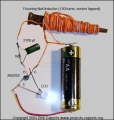
The problem with using steel in these oscillators is that it makes for very low quality inductors at the high frequencies at which the oscillators operate. Two possible solutions are to greatly increase the number of turns so that the oscillator will run at a lower frequency, and sometimes you can get around the problem by boosting the high frequency feedback with a small capacitor across the resistor, and in the photo below.
upload_2017-12-15_18-24-18.png
 

takao21203

Joined Apr 28, 2012
3,702
Well, the paper clip was based on the assumption that all that is needed was a center around which wires can be wound. There are even videos of people with inductors called ``air toroid'', and it worked, but read that it would require more turns than ferrite toroid.

I think the phase inversion you are referring is the direction each pair of wire is going right?
Do you think it's not working because I am using a nut as a toroid, wiring issues, or faulty transistor?
The papar clip is just too thin and small you need like ten or twenty and a few turns wont do it for iron.
Like I said you need 50 or so as a starting point for iron and its pretty bad so you may need to try several hours
 

Thread Starter

Jose Heredia92

Joined Dec 8, 2017
14
Dickcappels said:
Two possible solutions are to greatly increase the number of turns so that the oscillator will run at a lower frequency, and sometimes you can get around the problem by boosting the high frequency feedback with a small capacitor across the resistor, and in the photo below.
What is the other solution?
The papar clip is just too thin and small you need like ten or twenty and a few turns wont do it for iron.
So the iron has to be thick and big, therefore work better (brighter LED)?
 

DickCappels

Joined Aug 21, 2008
10,661
Solution #1 Use a lot of turns. There are 120 turns on that flooring nail and it still didn't oscillate -maybe a couple hundred more would do it.

Solution #2 add a capacitor as shown.

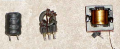
Real solution: carefully crack open the base of a compact florescent lamp and take a ferrite core out of that.
Here is the sort of thing you can expect to find in there:
upload_2017-12-16_0-48-23.png

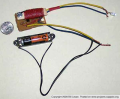
Bill Levan in the United States wound his on a piece of wood. The wood only served as a form. Look at all the turns he had to put on that!
upload_2017-12-16_0-46-10.png

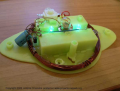
Antonis Chaniotis in Greece was converting a night light to LEDs and wound his inductor around the night light -effectively an air core inductor. He used a lot of copper.

upload_2017-12-16_0-49-19.png

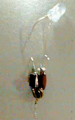
The one below uses a tiny farrite bead and has less than 10 turns on it, but it works.
upload_2017-12-16_0-51-6.png
 

DickCappels

Joined Aug 21, 2008
10,661
The wood coil doesn't have a capacitor.
That is because it has lots of turns and there is no metal core to partially short out the coil. The advantage of ceramic ferrites have over metal cores is that ceramic ferrites are conductive. When the circuit oscillates the magentic field inside the inductor induces eddy currents which have their own mangetic fieldss which looks like a partial short on a transformer winding. Ceramic ferrites, wood, plastic, air and many other kinds of cores do not suffer from eddy loses much or at all.
 

takao21203

Joined Apr 28, 2012
3,702
Dickcappels said:

What is the other solution?

So the iron has to be thick and big, therefore work better (brighter LED)?
you could get it working with 10 or 20 and of course need to be folded out or you get much more losses and a lot of air inbetween as pointed out iron is pretty poor for more than 1 KHz so efficiency will be bad

Ferrite is iron oxide nothing else if you dont like the toroids theres also ferrite bars of all kinds but the toroids are most common theres one in USB cables often. Yet also their parameters are often as such you only get some 10s uH so the design is difficult and you need a lot of turns

You can build LED torch circuits with coils or use a stepup IC such as QX5252 or MCP1640 efficiency will be much better

I have built many Joule Thief circuits but the battery doesnt last as long as with IC the best ones half as much or so.

Theres very small ferrites like 6mm or so youll never get that with iron or air core.

A nail or screw will be better than the nut and youll need kind of 100 turns and experiment a lot and sill efficiency will be bad
 

Thread Starter

Jose Heredia92

Joined Dec 8, 2017
14
I got a ferrite toroid from a cfl and when building the coil around it (13 turns), conecting to the transistor and all it still doesn't work. I conected the multimeter in series with the transistor and the battery and got 0.8 volts. What is going on?
 

takao21203

Joined Apr 28, 2012
3,702
I got a ferrite toroid from a cfl and when building the coil around it (13 turns), conecting to the transistor and all it still doesn't work. I conected the multimeter in series with the transistor and the battery and got 0.8 volts. What is going on?
Could be many things

13 turns is not much also you need approx 1:2 ratio

Maybe 40 turns 25 turns works

Also need to reverse one of the coils, and need correct ECB of transistor so if you dont know transistor ECB you need to swap around one of the coils to try

Finally the LED or transistor could be broken the LED will damage from soldering easily and stop working
It could be a PNP transistor or just not working with low turns, could be power transistor with a low hFE

If you use a known transistor use a 40 to 25 turns (you can try 20 to 30) you should get it working some time
 

DickCappels

Joined Aug 21, 2008
10,661
If you don't have a resistor in series with the base you would probably get 0.8 volts or a dead transistor depending upon how good the battery is.

Can you describe your current circuit, maybe post a schematic or photo?
 

Thread Starter

Jose Heredia92

Joined Dec 8, 2017
14
Does it matter if the second wire touches the first during the winding?
Also does the resistor affects the voltage, or is merely to reduce current? I have a resistor and it reads brown, black, and silver, whatever that value is.
The LED works fine and the transistor works since I can still read values when testing using diode mode. The transistor from the cfl reads 4126PL (upper line) and 6J TCZJ (lower line). Testing with diode mode it is a pnp with 655 at the collector and 754 at the emitter
 

Alec_t

Joined Sep 17, 2013
15,119
Does it matter if the second wire touches the first during the winding?
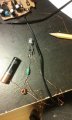
Provided there is insulation (e.g enamel coating) between the two, and no turn is shorting itself or its neighbours, there should be no problem. But all that tangle of wire is inviting trouble. Twisted wire joints like that are unreliable. Time to get your soldering iron out :).
Try a 1k (brown, black, red) base resistor.
 

Thread Starter

Jose Heredia92

Joined Dec 8, 2017
14
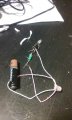
This one is more clear. This has a pink wire and white wire. One end of the pink goes to the resistor, the other pink is tied with one of the white ends to the positive battery terminal, the other goes to the collector. I tried every alternation of pink-white wire, even changing wires with the base and emitter of transistor and still nothing. And I still get the same 0.78V when connecting the multimeter black lead to the negative of the battery and the positive lead to the collector.
 

Attachments

DickCappels

Joined Aug 21, 2008
10,661
Well, you've go a flash -that's a start.

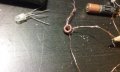
One can usually measure resistors with your multimeter. The resistor in your circuit appears to be an inductor and its inductance might be keeping the circuit from oscillating. As Alec_t suggests, try a 1,000 ohm resistor or anything near that value that you can find.

The resistance affects the output current. The characteristics of the LED will be the dominant factor in determining the output voltage.
 

Thread Starter

Jose Heredia92

Joined Dec 8, 2017
14
I changed the wires in the toroid for telephone wires with only 5 turns and assembled it as before and it finally worked! I managed to lit it with a battery with 1 volt left, but for some reason it does the flash with the other batteries although there are ones that are not discharged. With an AA battery the transistor got hot. Probably I need to get a higher value resistor.
 

Thread Starter

Jose Heredia92

Joined Dec 8, 2017
14
I have a question. When I measure the voltage across the LED when connected to the joule thief I measure 0.6 volts. What does this measurement tells me about the circuit? Also I measured 0.30 A of current draw. I didn't use a resistor in this circuit.
 

Attachments

Top