Making weather station

Thread Starter

ltodd2

Joined Sep 9, 2017
12
Hi,
Im considering making a home weather station that will feed home assistant and a indoor local screen to show outside and indoor temp etc.
The plan is an esp using lora outdoor, with the usual sensors, lux, temp, humidity, pressure, wind, rain and lightning. It will be powered from 3.7v lipo and solar cell to charge. It will deep sleep for 5-10 mins, wake, take measurements and send data and back to sleep. Certain events like lightning will wake it.
Im at the point of sorting parts and would like some advice on the following please.

  1. looking at solar though an ina219 and into cn3791 solar charger. 3.7V lipo connected to 3.3v regulator to power everything. still deciding on esp but think most at max 500ma on the inbuilt regulator and how efficient are they. A rough guess is it will use 360ma max but thats just some quick workings. so is a regulator overkill and let the esp power everything?
  2. If use a regulator most are just the reg ic and you have to build your own circuit, im ok at electronics but not had to go to this level before which brings me to the next point.
  3. build it on simple strip board etc or make a pcb. head says if need to make own regulator etc and a few other small components like diodes, resistors etc make a pcb but that will also be a first. would use modules where possible like the esp32, lora radio, ina219 etc.

Am i just over thinking some of this and there is a simpler way? any suggestions please.
 

Ya’akov

Joined Jan 27, 2019
10,226
Welcome to AAC.

I would research commercial options to see how they do the telemetry.

Unless you are dealing with a great distance, LoRa is unnecessarily complex and operation on 315, 433, 815, or 2400MHz with a simpler scheme probably makes more sense. Since you have decided on an ESP32, operating at 2.4GHz using the ESP-NOW protocol might be attractive.

Concerning power—Lithium cells have poor performance at low temperatures. If your winters are cold, consider a different chemistry like NiMH for better cold capacity and longer service life. It will also simplify solar charging since NiMH can be trickle charged continuously without problems.

If you don't have experience making weatherproof projects, it is a good idea to research that as well. Electronics outdoors encounter a very hostile environment including diurnal temperature cycling, seasonal temperature extremes, precipitation, airborne particulates, insects, wildlife on all shapes and sizes.

Using a NEMA or other commercial weatherproof enclosure with best practices for routing external wires (e.g.: placing penetrations on the bottom or using inverted J glands to protect from ingress of moisture).

Have fun!
 

MrChips

Joined Oct 2, 2009
34,626
  1. build it on simple strip board etc or make a pcb. head says if need to make own regulator etc and a few other small components like diodes, resistors etc make a pcb but that will also be a first. would use modules where possible like the esp32, lora radio, ina219 etc.
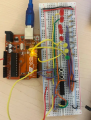
There is another approach. Since this is all learning and experimental, build it on a solderless breadboard which can be housed in a weatherproof box. Then you can make modifications easily. When you are happy with the design, build it on Vero stripboard for a semi-permanent solution. Finally, for the learning experience, make a PCB. You will then be able to verify the PCB against your two working prototypes. We all make mistakes too.

By the way, this makes for an excellent educational project.


1757684470156.png
 

Jerry-Hat-Trick

Joined Aug 31, 2022
775
Maybe another reason not to use a 3.7 lipo battery into a 3.3V regulator is that a linear regulator probably needs at least 1.0V higher input (headroom), i.e. 4.3V. The charge voltage probably goes up to 4.2V so just using a diode to drop 0.6V would not be any good either. As already suggested, a trickle charge into an NiMH battery, would be ideal. Do the maths to detemine the necessary mAh.

Personally, I favour strip board for a robust one-off assembly (unless you are going into production or working with high frequencies) although a solderless breadboard is a great way to test ideas to make sure they work. Once you have established the layout with links (flat on the board) build section by section to test. Nothing worse than trying to fault find a completed assembly which doesn't work.
 
Top