Facebook
 Google
 GitHub
 Linkedin
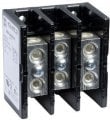
We have test bays at work that use 50A terminal blocks like the one pictured below for quick hookup and disconnect of machines to be tested (208-240VAC, split phase and three phase, up to 40A loads.)
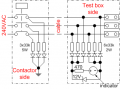
Each terminal block is mounted in a box with a hinged cover and a door-switch such that when the door is open, the switch opens, and that breaks the coil circuit for 50A contactors (in a separate box) which disconnect power from the terminal block.
So, barring any equipment failures, any time the door is open, there's no voltage at the terminals and it's safe to work. Of course, in reality the door switch or the contactor could fail, so the original design also included a neon light across the two hot lines so that you could quickly see whether or not power in the box was really off.
Unfortunately, the neon indicators faded really fast and are essentially invisible now. On top of that, the existing system wouldn't warn you if one contact was welded shut, but the other was open. You could potentially have lethal voltage on line 1, but if line 2 was off, the indicator light would stay dark.
We're revisiting this system now, and I thought maybe we should use two lights per box, one from line 1 to ground, and the other from line 2 to ground. This way if either line is hot, you get a warning light. But I know you're not generally supposed to use the protective earth ground to carry any current. Do you think the current for a small neon (or mains rated LED) light would be ok, or is this a zero tolerance, no exceptions rule? Unfortunately there aren't neutrals in many of the boxes, so I can't use neutrals for the return path.
Alternately, any other ideas for how to provide a more reliable warning/indicator system? Ideally, workers should check the terminals with a meter every time they open a box, but I'm getting no traction on forcing that issue. They want/need some type of warning/indicator that doesn't require the user to grab extra tools.
I'd appreciate any thoughts on both the ground return path and the general warning indicator questions. Thanks!
Each terminal block is mounted in a box with a hinged cover and a door-switch such that when the door is open, the switch opens, and that breaks the coil circuit for 50A contactors (in a separate box) which disconnect power from the terminal block.
So, barring any equipment failures, any time the door is open, there's no voltage at the terminals and it's safe to work. Of course, in reality the door switch or the contactor could fail, so the original design also included a neon light across the two hot lines so that you could quickly see whether or not power in the box was really off.
Unfortunately, the neon indicators faded really fast and are essentially invisible now. On top of that, the existing system wouldn't warn you if one contact was welded shut, but the other was open. You could potentially have lethal voltage on line 1, but if line 2 was off, the indicator light would stay dark.
We're revisiting this system now, and I thought maybe we should use two lights per box, one from line 1 to ground, and the other from line 2 to ground. This way if either line is hot, you get a warning light. But I know you're not generally supposed to use the protective earth ground to carry any current. Do you think the current for a small neon (or mains rated LED) light would be ok, or is this a zero tolerance, no exceptions rule? Unfortunately there aren't neutrals in many of the boxes, so I can't use neutrals for the return path.
Alternately, any other ideas for how to provide a more reliable warning/indicator system? Ideally, workers should check the terminals with a meter every time they open a box, but I'm getting no traction on forcing that issue. They want/need some type of warning/indicator that doesn't require the user to grab extra tools.
I'd appreciate any thoughts on both the ground return path and the general warning indicator questions. Thanks!