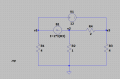
First use the pencil icon to draw all the wires like this: View attachment 295518
Then use the resistor symbol to place the resistors. When you place a component on top of a wire it removes the short across the terminals of the component. When you grab a symbol to place, the Ctrl-R key combination will rotate the symbol and Ctrl-E will flip the symbol side-to-side. View attachment 295520
Place a voltage source on the left-hand side using the letter V or select it from the components menu, which is between the diode symbol and the hand symbol. Also place the current source on the right-hand side. View attachment 295523
Lastly you want to add a behavioral voltage source whose name in the component directory is "bv" View attachment 295524
Once you get this far then we have to show you how to edit the values, construct a simulation command, and run it.
Hi Papabravo!! thank you a lot for helping me with that circuit. I have another circuit right now that I thought I did it right, but I'm having some trouble getting the same answer as the manual version. Could you take a look plz?
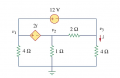
this is the problem, I need to find v1,v2 and v3 with nodal analysis. Here is my way of doing it
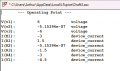
when I run, it gives me this:
but the answer should be: V1=-3V, V2=4.5V and V3=-15V. any ideias?
Always ask if the answer makes sense. You say that the answers SHOULD be V1=-3V, V2=4.5V and V3=-15V. But have you checked to see whether those answers are consistent with the problem?
One of the nice things about most engineering problems is that the correctness of the answers to a problem can usually be verified from the problem itself.
Assume that the given answers are correct. From those answers, calculate the currents in all of the resistors. Then check to see if the constraints imposed by the voltage sources is correct.
As an example, the voltage output by the CCVS is
V_ccvs = (-3 V) - (4.5 V) = -7.5 V
The controlling current is i, which is
i = -15 V / 4 Ω = -3.75 A
The relationship between them is given as
V_ccvs = 2 Ω · i
Is that satisfied? If not, the answer is wrong. If it is, then it still has a chance of being right, but you need to verify that all of the voltage and all of the currents satisfy KVL and KCL. This only takes a minute or so and is something you need to get in the habit of doing religiously.
It appears that "your way of doing it" is NOT doing nodal analysis, as specified by the problem, but rather to through the problem as a simulator and hope that it gives you the answer.
Although it is assigned, resistor voltage polarity vs. current direction is not apparent in LTspice since it is not shown on the schematic resistor symbol.
I modified the resistor .asy symbol file with a dot to indicate that current going into the dot side gives a positive voltage at the dot to resolve that ambiguity.

 Facebook
 Google
 GitHub
 Linkedin