LTAOE Lab 11 voltage reg

Thread Starter

s34n

Joined Jan 1, 2024
20
Probably just a daft question, sorry.

Its about one of the lab courses in Learning the Art of Electronics. Lab 11L.1.2, page 453, on voltage regulators.

The part op-amp LMC6482, going by the data sheet seems to have a max supply voltage of +16V. But the lab talks about testing the circuit from 5-25V to see how it performs.

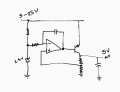
I'm assuming the circuit the authors are expecting the student to make is similar to the one in Figure 11N.10 on page 438 of the book.
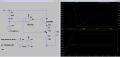
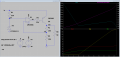
canvas.png

So, if the op-amp is given its own supply of +15V to get around that problem. Would the potential of a higher voltage (>15V) during testing, coming from the transistor and going towards the op-amps output, cause a problem?

Cheers
 

dl324

Joined Mar 30, 2015
18,326
Its about one of the lab courses in Learning the Art of Electronics. Lab 11L.1.2, page 453, on voltage regulators.
Could you post the information for those of us who don't have the book.
So, if the op-amp is given its own supply of +15V to get around that problem. Would the potential of a higher voltage (>15V) during testing, coming from the transistor and going towards the op-amps output, cause a problem?
What does "coming from the transistor" and "going towards the op-amps output" mean?

The configuration you've drawn doesn't make sense. You have an inverting opamp and, presumably, only a 15V power supply.

Also, it will be easier to discuss your circuit more intelligently if you supply component designators and values.
 

Thread Starter

s34n

Joined Jan 1, 2024
20
Hi dl324,

The book asks you to use a list of parts to make a low dropout voltage reg that has an output of 5V. And that will work from a supply voltage of 5 up to 25V.

Using:
LMC6482
Bipolar transistor 2N3906 or a Mosfet BS250P
Voltage reference LM385-2.5
What ever resistor values is up to you.

"coming from the transistor and going towards the op-amps output".
I guess I mean, if the op-amp was given a 15V supply, but the emitter/source of the transistor is on a supply that can go from 5 up to 25V. Is that going cause a problem?

I'm picturing the op-amp not really being in control once the supply voltage to the transistor goes above 15V. If the op-amp can only run from a 15V supply.

And potentially the op-amp output seeing a voltage higher than is max rating being forced on it via the transistor. Or a large voltage drop over the transistor.

Yes an inverting amp.

Sorry about the drawing, using a touch pad and chrome canvas. The four skwiggly things are meant to be resistors, and the others are two capacitors.

Maybe its just a mistake in the book, and it was meant to be 5 to 15V?

Cheers
 

BobTPH

Joined Jun 5, 2013
11,515
If the opamp supply is 15V and the emitter is at 25V, Vbe will be at least -10V so the transistor will be fully on all the time.
 

Irving

Joined Jan 30, 2016
5,112
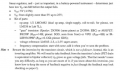
Here's the text from the book (there is no diagram, that's left to the reader)

1706376468288.png
1706376520904.png

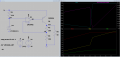
It definitely implies the "other-way-up" as drawn by the TS,. which does work as a LDO... I think this is an example of a teacher not checking their own work - probably was based in an earlier edition on an opamp with higher Vcc rating (LM324 @ 30v maybe?)

1706377813331.png

but goes dramatically out of regulation at Vin > 16+v as expected... bye bye following circuit!

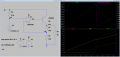
1706378089476.png

and trying to control the 'top-end' blows out its LDO abilities... at least in this simple version...

1706378322403.png
 
Last edited:

crutschow

Joined Mar 14, 2008
38,503
LM324 @ 30v maybe
That assumes the LM324 output goes to the supply rail when sinking current (which it likely will).

Note that the stability of that circuit could be problematic because of the added gain from the transistor inside the loop.
An AC and pulse transient analysis would show whether some external compensation is needed.
 
Last edited:

Thread Starter

s34n

Joined Jan 1, 2024
20
Cheers everyone.

My skwiggle of a drawing is what they give as an example earlier in the book.
Part of that lesson is to first run the circuit without the feedback capacitor and only a 0.1uf ceramic on the output, and it does oscillate.
Then to put the feedback cap on, and stick a 4.7uf electrolytic on the output as well.

Cheers
 
Top