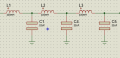
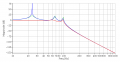
Hi,L1,C1 form an attenuator, as do L2,C4 and L3,C5. So you have three attenuators in series. To make up the lost amplitude you can use an amplifier.
You're right. I over-simplified things.Actually that's not true if the circuit is tuned correctly.
Hi,You're right. I over-simplified things.
What do you mean by saying "to prevent the low power"?Hi all,i design a Low Pass Filter and to prevent the low power,it is LC network.My low pass gives the perfect sin wave but on the board,it loses the amplitude.
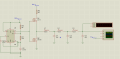
This is my full circutary.At the output what i get is a almost pure sine wave with the Vpp value as much as the switched voltage value which is R2 in the schematic.But when i built the circuit on the board,the signal loses amplitude on the low pass filter stage.Hi,
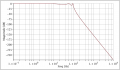
I was assuming the pass band was the main interest, but then again if it is a low pass filter then as Electrician pointed out maybe he was looking at frequencies that naturally cause a decrease in amplitude.
I have a feeling he was thinking about a bandpass filter not a low pass filter so thought something was wrong.
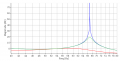
But also keep in mind that theoretically this is not a low pass filter, it's only if it has some resistance in there somewhere that it may becomes a true practical low pass filter. So really to be accurate about what we are talking about we have to know what the ESR of the elements is, and also perhaps the source impedance and load impedance, if any.

notAre those 22uF caps polarised or not?
Hi,This is my full circutary.At the output what i get is a almost pure sine wave with the Vpp value as much as the switched voltage value which is R2 in the schematic.But when i built the circuit on the board,the signal loses amplitude on the low pass filter stage.