LowPass isnot Working

Thread Starter

Alkim Gokcen

Joined Mar 29, 2017
22
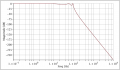
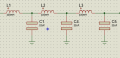
Hi all,i design a Low Pass Filter and to prevent the low power,it is LC network.My low pass gives the perfect sin wave but on the board,it loses the amplitude. How can i solve this porblem.thanks for helping,the low pass is attached at below.
.lfp.png
 

MrAl

Joined Jun 17, 2014
13,702
Hi,

What formulas did you use to design it?
That makes a big difference.

What are the ESR values of each inductor?
Also makes a big difference.
If you dont know, try to measure with an Ohmmeter.

How much load are you attaching to the output?
Also makes big difference.
 

Alec_t

Joined Sep 17, 2013
15,117
L1,C1 form an attenuator, as do L2,C4 and L3,C5. So you have three attenuators in series. To make up the lost amplitude you can use an amplifier.
 

MrAl

Joined Jun 17, 2014
13,702
L1,C1 form an attenuator, as do L2,C4 and L3,C5. So you have three attenuators in series. To make up the lost amplitude you can use an amplifier.
Hi,

Actually that's not true if the circuit is tuned correctly. The main attenuation then comes only from the associated ESR's of the components. In the ideal case, there's no attenuation at all.

I dont think he can use an amplifier for this project due to his project application constraints.
 

The Electrician

Joined Oct 9, 2007
2,986
Hi all,i design a Low Pass Filter and to prevent the low power,it is LC network.My low pass gives the perfect sin wave but on the board,it loses the amplitude.
What do you mean by saying "to prevent the low power"?

What is the purpose of this filter? Is it to remove ripple from the output of a rectifier?

At what frequency does it "lose the amplitude"?

After all, this is a low pass filter. It would be expected to have reduced amplitude at the output for frequencies above the cutoff frequency, wouldn't it? Have you calculated the expected frequency response?
 

RBR1317

Joined Nov 13, 2010
715
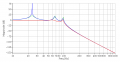
My attempt to calculate the Bode Plot of the filter transfer function shows a significant ripple near the corner frequency. Is this what you mean by "losing the amplitude"?
Screenshot from 2017-05-13 10-49-00.png
 

Attachments

MrAl

Joined Jun 17, 2014
13,702
Hi,

I was assuming the pass band was the main interest, but then again if it is a low pass filter then as Electrician pointed out maybe he was looking at frequencies that naturally cause a decrease in amplitude.

I have a feeling he was thinking about a bandpass filter not a low pass filter so thought something was wrong.

But also keep in mind that theoretically this is not a low pass filter, it's only if it has some resistance in there somewhere that it may becomes a true practical low pass filter. So really to be accurate about what we are talking about we have to know what the ESR of the elements is, and also perhaps the source impedance and load impedance, if any.
 
Last edited:

Thread Starter

Alkim Gokcen

Joined Mar 29, 2017
22
Hi,

I was assuming the pass band was the main interest, but then again if it is a low pass filter then as Electrician pointed out maybe he was looking at frequencies that naturally cause a decrease in amplitude.

I have a feeling he was thinking about a bandpass filter not a low pass filter so thought something was wrong.

But also keep in mind that theoretically this is not a low pass filter, it's only if it has some resistance in there somewhere that it may becomes a true practical low pass filter. So really to be accurate about what we are talking about we have to know what the ESR of the elements is, and also perhaps the source impedance and load impedance, if any.
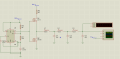
This is my full circutary.At the output what i get is a almost pure sine wave with the Vpp value as much as the switched voltage value which is R2 in the schematic.But when i built the circuit on the board,the signal loses amplitude on the low pass filter stage.
 

Attachments

RBR1317

Joined Nov 13, 2010
715
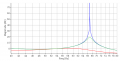
Tried doing a filter magnitude plot for different values of coil resistance & filter load resistance. From the look of your circuit schematic, it would seem that the blue curve should most closely approximate the actual performance.

RED: Coil ESR= 0.1Ω, Load R= 100Ω
BLU: Coil ESR= 0.0Ω, Load R= 1 MΩ
GRN: Coil ESR= 2.0Ω, Load R= 2 KΩ

Assuming that the frequency of the square wave is in the range 50~60 Hz, what is the measured deviation of the filter output from the calculated amplitude of the first Fourier coefficient of the square wave? If you sweep the filter with a sine wave, what does the measured magnitude plot look like?
Screenshot from 2017-05-15 08-00-56.png

Screenshot from 2017-05-14 21-48-24.png
 

Attachments

MrAl

Joined Jun 17, 2014
13,702
This is my full circutary.At the output what i get is a almost pure sine wave with the Vpp value as much as the switched voltage value which is R2 in the schematic.But when i built the circuit on the board,the signal loses amplitude on the low pass filter stage.
Hi,

I assume you get what you want in simulation and in the breadboard you dont get what you want.
What frequency do you have the 555 set for, both simulation and breadboard?
That would help explain this too.

Also, we need to know how much 'loss' you are seeing, is it down to 90 percent, 80 percent, etc.

Also, if you can measure the ESR of the inductors that would help too.

You have 500 ohms on one mosfet, is that what you use on the breadboard too?

WIth ideal L and C you end up with a sine wave oscillator. That would show up better in simulation but not as good in the real circuit because there are those added resistances.
 
Top