Low frequency motion stabilization

Thread Starter

Denesius

Joined Feb 5, 2014
124
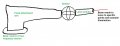
I need a means to cancel continuous low frequency / low amplitude motion (about 5Hz) without interfering with gross movement of a laser at the end of an arm. The device would sit at the end of an extension whose attachment will have the low frequency motion (limited to one plane), but the extension will be moving slowly thru an arc in various directions to maintain alignment with various targets at the end of the beam. Directed motion of the beam is limited to about 45-degrees in any direction. The laser is a light-weight pointer type, perhaps 4 to 5 ounces.
Crude outline is attached.
Digital accelerometers or gyros?
I am not looking for specific solutions or schematics - I would appreciate any ideas or guidance in the direction to take, both for the stabilization and the means to achieve the directed motion.
As an example I thought of using a gimbal system with small RC type servos to dampen out the background motion while allowing the directed motion, but I'm not sure the Futaba servos can handle the dampening of the continuous back-and-forth motion all day long.
Thank you all in advance for any ideas
 

Attachments

BR-549

Joined Sep 22, 2013
4,931
Amplify and invert the 5 Hz signal. Now just add the proper amount of counter Hz to the base.....to counter the original 5 Hz.

5 Hz is slow. The counter adjusted movement of gimbal, might be done with software.

Can you mount base from non moving base? Removing the 5 Hz path is the best solution. Perhaps suspend from ceiling?
 

Thread Starter

Denesius

Joined Feb 5, 2014
124
The base is part of a large rotating/moving machine. I don't have any options as to mounting, or anyway to 'shake the base' to cancel the motion. The dampening has to be at the gimbal.
On the other hand, the inversion of the 5Hz motion is an idea that I can pursue. Would feeding the inverted signal into a pair of servos be a useful option, or is there a better solution? The servos would need to cancel the base motion while moving the pointer in the desired direction.
 

BR-549

Joined Sep 22, 2013
4,931
In that case I would amplify and input the 5Hz vibration into software program. This will be an offset to add to your final control signal.
 

Thread Starter

Denesius

Joined Feb 5, 2014
124
In that case I would amplify and input the 5Hz vibration into software program. This will be an offset to add to your final control signal.
One problem I can foresee: The dampening needs to be at the laser, but the sensor to pickup the 'noise' will be at the base, or in the bottom half of the arm. Will a simple amplification and inversion work, or do I need to contend with alteration in direction/motion? The mounting is rigid, and the arm has significant mass compared to the laser end, so I'm guessing the resonant frequency is well below that of the noise....?
 

BR-549

Joined Sep 22, 2013
4,931
I have no idea. With the information given......only strategy can be given. It ALL depends on ALL the details.

We have to know exactly what you are doing......with all specs and conditions.

Which all remain very un-clear.

The idea is to counter the interference with the control signal. And we don't know what type of control you are using.

It's hard to answer such an open, general and un-defined problem.
 

crutschow

Joined Mar 14, 2008
38,506
Basically you will have a feedback control loop, which will likely require compensation of the feedback signal to achieve a stable system with little overshoot in its response.
That can be done with a traditional analog PID loop (using either analog circuits or simulated with a microprocessor) or with digital Fuzzy logic using a microprocessor.

If the motion is limited to one plane, than an accelerometer should be sufficient for feedback.
 
Top