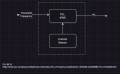
F/V/I
V to I is voltage to current.
0 to 20mA is a very common V to I uses cheap module.
An LM331 uses very few parts, it outputs to the V/I module.
The power supply of that sort might be 15V. The voltage is high, sometimes called overhead.
Whatever the directions say, that is what you need. Cut the current range in half, why get complicated?
An LM2917/LM2907 frequency to voltage IC can do it over a moderate frequency range. But if that is adequate is unknown. What range does the application require??? Is this for a tachometer or speed measuring system??
Search the works of BOB PEASE to find a F to V circuit with a much greater range.
The voltage to current conversion could use an opamp and transistor plus a resistor, but as the current range is not mentioned I can't suggest any details.
The LM2907 has "±0.3% Linearity", so it's linearity seems perfect. But, I need to avoid interference with audio and RF, so my target f range is 100 kHz to 400 kHz. The LM2907 looks to have a sub-kHz freq range, so i think that won't do.
The LM2907 has "±0.3% Linearity", so it's linearity seems perfect. But, I need to avoid interference with audio and RF, so my target f range is 100 kHz to 400 kHz. The LM2907 looks to have a sub-kHz freq range, so i think that won't do.
The LM2907 has "±0.3% Linearity", so it's linearity seems perfect. But, I need to avoid interference with audio and RF, so my target f range is 100 kHz to 400 kHz. The LM2907 looks to have a sub-kHz freq range, so i think that won't do.
OK, NOW, FINALLY, we learn the actual frequency range. And once again I suggest reviewing what Mr. PEASE had to say and the circuits he presented.
OR, a sort of simple scheme will be the pulse counting discriminator: Each cycle triggers a monostable to produce a very narrow pulse, and then the pulses pass thru a diode to a filter and the voltage is proportional to the pulse rate.
BUT 300 KHZ change is a very big amount, given how fine the measurement resolution could be. Perhaps some re-thinking is in order.
OK, that the range does not need to be so very wide. And the application description: "This is for isolated communication. I control the source frequency. I need 8-bit frequency resolution (3906 ppm), which i think is 0.39% linearity." is rather vague. That could be as simple as remote control over an audio or RF link, or even control signals added to an audio tape recording. It could even reference data transmission sent over CB radio.
Eight bit resolution implies 256 discreet values, which is quite a lot.
So a more detailed description of the application could lead to some very useful suggestions, since now we understand that this is not a "simple instrumentation application", but some sort of communications scheme.
That seems rather specific to me. I assume it's just a bit of math to figure out which range of the oscillator will give me the desired linearity, based on the full scale linearity of the F/V.
By the way, it may be unnecessary to restrict myself to any particular frequency range. I need to avoid audio and RF interference, but this is going to be a very quiet, low-power signal, so i think it's not a worry. I can shield the cable if necessary. Therefore I could use the lm2917.
All right, and a lower frequency can simply avoid the undesired signal radiation issues that might develop. Accidentally radiated signals can lead to unhappy interaction with the FCC in the US. (I am not aware of where you are located)
The frequency range covered and the number of specific frequencies depends a lot on just what sort of communication and how many separate data bits it requires. Consider that the DTMF system used by the phone companies, and others, delivers sixteen different values with a range of under 2 kilohertz, with 100% accuracy, and fairly rapidly as well.
So another question is how the frequency would be determined. A linear control scheme will need more effort to make it truly linear so that it can be accurate and repeatable.
To compare the current of circuit with a reference, where the reference is encoded in a frequency. The comparison was to be done with a voltage comparator. The current sensor already outputs a voltage. So it's necessary to convert the reference frequency to a voltage in order to compare the two voltages.
Given that a comparator can at best only supply the information "greater than" or "less than", unless that is used to immediately trigger some action, it seems that it could work to actually measure the voltage. So the frequency to voltage conversion needs to be accurate, evidently. And the TS has given us a good explanation of the function without a description of the application. I think I had given a description of a very good F/V scheme, but ai do not see it.
So here it is again: The frequency would trigger a non-retriggerable multivibrator (AKA a "One-Shot") to generate a narrow pulse with each input cycle. The pulses being narrow enough to not be over a 90% duty cycle at the highest frequency. The amplitude of the pulses need to be constant. Then the pulses need to be run into a low-pass filter to convert them into the desired DC level. This is similar to the pulse-counting FM detector scheme No tuned circuits and quite linear and simple to adjust.
Given that a comparator can at best only supply the information "greater than" or "less than", unless that is used to immediately trigger some action, it seems that it could work to actually measure the voltage. So the frequency to voltage conversion needs to be accurate, evidently. And the TS has given us a good explanation of the function without a description of the application. I think I had given a description of a very good F/V scheme, but ai do not see it.
So here it is again: The frequency would trigger a non-retriggerable multivibrator (AKA a "One-Shot") to generate a narrow pulse with each input cycle. The pulses being narrow enough to not be over a 90% duty cycle at the highest frequency. The amplitude of the pulses need to be constant. Then the pulses need to be run into a low-pass filter to convert them into the desired DC level. This is similar to the pulse-counting FM detector scheme No tuned circuits and quite linear and simple to adjust.
The frequency would trigger a non-retriggerable multivibrator (AKA a "One-Shot") to generate a narrow pulse with each input cycle. The pulses being narrow enough to not be over a 90% duty cycle at the highest frequency. The amplitude of the pulses need to be constant. Then the pulses need to be run into a low-pass filter to convert them into the desired DC level. This is similar to the pulse-counting FM detector scheme No tuned circuits and quite linear and simple to adjust.
A PLL might work, but it could be less accurate and more effort to optimize. And more subject to drift. And probably cost a bit more. and it may not be as linear over the full range.
A PLL might work, but it could be less accurate and more effort to optimize. And more subject to drift. And probably cost a bit more. and it may not be as linear over the full range.

 Facebook
 Google
 GitHub
 Linkedin