One-transistor DC voltage doubler (Realistic low-cost phono preamp)

Thread Starter

oh_uh_okay

Joined Aug 24, 2025
48
This is the schematic from a 1980 Radio Shack $20 phono pre-amp (sold 1979-89 ??) . It was quite popular and made for RS in Japan by some other manuf. It is still quite prized in the budget vintage audio community.
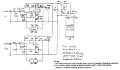
schematic 41-2101A.PNG

The single-transistor voltage doubler seems a bit unique.

How might one officially describe this doubler in a textbook? Charge pump? Etc.
Also note that the design uses the same 2SC1327 Panasonic NPN Silicon Small Signal Transistor for all transistors in the ckt.
The small AC xformer brings the line VAC down to about 12VAC. From there, the design requires about 30VDC in the amp stage.
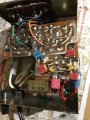
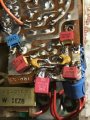
I've modded the existing ckt, in situ, quite a bit with extra bypass, snubbers, better caps in the signal path, etc. I don't want to mod in anything that can't be quickly, easily reversed. Any more potential to be had?
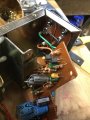
30E68353-1E35-48D6-969B-B0E0EC85323E.jpg
1361B280-A71C-4B6E-95CC-E50CBB40AAC8.jpg
65B15359-EC13-42D7-ACCF-0D8E786CAC66.jpg
 

Ian0

Joined Aug 7, 2020
13,112
The circuit is at least a decade older than that.
But I don't see a single transistor voltage doubler.
I see a pair of two-transistor audio preamps, and I see two half-wave rectifiers followed by an active smoothing circuit.
 

Ian0

Joined Aug 7, 2020
13,112
Is that (Tr5) a capacitance multiplier? I vagely remember a circuit like that for getting the filtering effect of a large capacitor using a small one.
That's the term I couldn't remember! It's a low-pass filter with an emitter follower.
 

Thread Starter

oh_uh_okay

Joined Aug 24, 2025
48
[ capacitance multiplier ] That's the term I couldn't remember!
Good to have this clarified.
I assume it is rare. And it is used here because of low cost and low-parts count (to fit into that compact design)???

Speaking of design, the 2SC1327 Panasonic NPN Silicon Small Signal Transistors are no longer available, and new-old stock replacements are a bit pricey in the ebay market.

Suggest a BETTER, MODERN DROP-IN SUBSTITUTE for:

  • the one-transistor power stage
  • the two-transistor amp/gain stage
 

Ian0

Joined Aug 7, 2020
13,112
Suggest a BETTER, MODERN DROP-IN SUBSTITUTE for:

  • the one-transistor power stage
  • the two-transistor amp/gain stage
  • A regulated ±15V supply using a full wave rectifier and 7815/7915 voltage regulators
  • An op-amp based circuit using a NE5532 (see Doug Self Small Signal Audio Design)
 

Thread Starter

oh_uh_okay

Joined Aug 24, 2025
48
Look up NE5532 RIAA phono preamp.
Modules that contain the complete circuit are available on Amazon and other sites.
Please re-read and ABSORB the comment I made earlier:
I've modded the existing ckt, in situ, quite a bit with extra bypass, snubbers, better caps in the signal path, etc. I don't want to mod in anything that can't be quickly, easily reversed. Any more potential to be had?
 

Ian0

Joined Aug 7, 2020
13,112
Please re-read and ABSORB the comment I made earlier:
I've modded the existing ckt, in situ, quite a bit with extra bypass, snubbers, better caps in the signal path, etc. I don't want to mod in anything that can't be quickly, easily reversed. Any more potential to be had?
So what do you want to do, MODIFY it or SUBSTITUTE it? Make up your mind. Then we'd be able to give you an answer you won't whinge about.
Snubbers go on power circuits, not on preamps. What caps did you put in the signal path? Some of them in the photo look like tantalums or multilayer ceramics which are dreadful for audio. Seems to be plenty of potential for making it worse.
 

Thread Starter

oh_uh_okay

Joined Aug 24, 2025
48
. What caps did you put in the signal path? Some of them in the photo look like tantalums or multilayer ceramics which are dreadful for audio..
The ceramics are OEM stock. I'm experimenting with replacing them at the moment, with film.
The tants are my substitutions for original polarized 'lytics. I want as many solids in the signal path as possible. And tants allow for that at orig "high" polarized uF values. Where is your evidence that " tantalums .... are dreadful for audio"?
 
Last edited:

Ian0

Joined Aug 7, 2020
13,112
The ceramics are OEM stock. I'm experimenting with replacing them at the moment, with film.
The tants are my substitutions for original polarized 'lytics. I want as many solids in the signal path as possible. And tants allow for that at orig "high" polarized uF values. Where is your evidence that " tantalums .... are dreadful for audio"?
Cyril Bateman, the seminal work on the subject.
https://linearaudio.net/sites/linea...0 to 100uF caps and 100 Hz measurements_0.pdfIMG_2043.jpeg
 

Ian0

Joined Aug 7, 2020
13,112
Your best choice would be to replace the input and output electrolytic with film capacitors (the input could be lower value, say 1uF) and leave the electrolytics in the bias and power supply alone.
<1nF capacitors could be NPO ceramic, >1nF polypropylene, or polyester as a second choice.

If you are particularly interested in transistor preamps, then the 3-transistor version by Peter Walker of Quad is better because there is enough open loop gain to keep the RIAA response accurate at low frequency.
 

schmitt trigger

Joined Jul 12, 2010
2,053
Not bad -- but more of a"buzz" --- that is quite dependent on 'table and cart. that feeds it.
Mr. Carson’s lab, who is an extremely knowledgeable individual, has a video where he shows that adding small ceramic caps across the rectifier diodes, will soften their reverse recovery time which causes a line-synchronous buzzing.
Here it is:


Thread Starter

oh_uh_okay

Joined Aug 24, 2025
48
About use of tants in phono preamp, and maybe preamps in general. And notably in the signal path (or near it).
Van Alstine uses them in his designs.
He does not publish much about his "acclaimed" designs to protect IP. But I do own some of his gear, and have worked on his DIY projects. See:
https://avahifi.com/pages/audio-basics-newsletters
(you'll need to download the zip file and open the PDF to, eg, Nov 1986, Dynaco SCA-80 project). Tants. as replacements to orig. 'lytics are noted. For phono stage, input cap must be polarized because it part of the feedback loop.
Personally, I have never been subjectively unpleased with good-quality tants.
Also see:
https://www.diyaudio.com/community/threads/tantalum-capacitors-in-signal-path.56015/
https://pinkfishmedia.net/forum/threads/tantalum-capacitors-in-the-signal-path.301575/
 

Ian0

Joined Aug 7, 2020
13,112
I see plenty of people speculating, and stating what they claim to have heard with their golden ears, but I see no-one debunking Bateman's work and providing facts to the contrary, even though this thread is several years after Bateman published. In my opinion, Bateman's results stand.
 
Top