Looking for ways to expand a design from single use to multi-use

Thread Starter

phillipsoasis

Joined Aug 22, 2022
170
I have a design for a rocket launcher that controls one igniter. Current for the igniter is ~3-5A for about 500 msec.
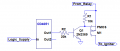
Here is the igniter circuit concept:
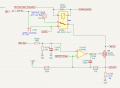
Screenshot from 2024-10-28 22-48-09.png

I now need to expand the design to control up to 64 igniters. Still working out the levels (i.e. min set of igniters, average set of igniters).

Option 1 - replicate the cicuit above for each igniter. Seems to be too expensive in parts (~$8-$10) and pcb real estate (relays take up a lot of room).

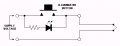
Option 2 - use a high side switch (eg TPS27SA08) for each igniter, and just one relay, DAC, Op-amp, and MOSFET for all igniters
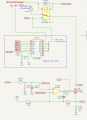
Screenshot from 2024-10-28 22-57-04.png

Each TPS27SA08 costs about $3 in single unit quantities. A more cost effective solution, but still expensive when looking at 64 igniters. The design does not scale that well given all the GPIO pins needed, too There are high side switches that can drive up to 4 loads, so that helps with the cost and number of GPIO pins. TI has a dual high side current switch that is controlled from an SPI bus (TPS2HCS10-Q1) which helps with pcb space as well as GPIO pins needed, but it is not in production yet.

I have been looking at a way to just replicate the MOSFET for each igniter using an analog multiplexer such as a CD4051B (~$0.40), but I can't figure out how to connect the igniters to the different MOSFETs without replicating the relay, which defeats the purpose of lower cost and less pcb real estate.

I thought I would ask the brain trust here if there is a different design that scales a little better than these two options.
 

Thread Starter

phillipsoasis

Joined Aug 22, 2022
170
Can Vin really go to 20V as you show a 12V test bulb?

That affects some of the circuit options I'm looking at.
The voltage source is a Li-Ion battery pack ("portable power station") sold on Amazon for camping. The one I have says 12V out, but it starts at 15V with a full charge and ends at 10V after a lot of use. The igniters need at least 9V. I have not characterized lots of "portable power stations" to see if they exceed 15V on a full charge. Vin = 12-15V is probably more realistic.
 

crutschow

Joined Mar 14, 2008
38,419
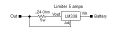
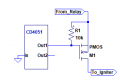
Okay, below is my thought on using the CD4051 mux to control a high-side P-MOSFET to the igniters (similar to using the TPS27SA08 switch), as long as the voltage never exceeds 18V (the CD4051 max).
You could also use the CD4015 16-line decoder in place of the 8-channel CD4051 to cut the number of IC's in half.

Edit: There are problems with that circuit I need to change.

1730218663677.png
 
Last edited:

crutschow

Joined Mar 14, 2008
38,419
Okay, below is the circuit modified to operate from logic-level signals:
The alternate is to use the CD4014 (not CD4015) 16-line decoder.

1730222546853.png
 

Thread Starter

phillipsoasis

Joined Aug 22, 2022
170
Okay, below is the circuit modified to operate from logic-level signals:
The alternate is to use the CD4014 (not CD4015) 16-line decoder.

View attachment 334648
Is this what you are suggesting? The PMOS is throwing me off because the gate control is the reverse of the NMOS that I am using. Thanks for helping me step out of the box on this by putting the igniter on the source side of the circuit.

Also, I am not controlling the MOSFET from a logic level (i.e. on or off), but from an analog signal to the gate to control the amount of current in the igniter using the gate voltage.

The one feature I am missing is in the original one igniter design, the test lamp allows me to test the entire igniter circuit, including the MOSFET. What I have drawn does not test the actual MOSFET for each igniter, just all the parts up to that point. However, I do not want to add a test lamp per igniter, just one test lamp to test each and every igniter circuit as if I am launching the rocket.

I can have the igniter connected, and if the rocket does not fire, I can activate the test lamp to start figuring out why the igniter did not fire. If the test lamp works, then I know current is flowing through the MOSFET, so probably a lead fell off the igniter, or the igniter is defective. If the test lamp does not work, then I can approach the rocket with a bit more confidence that it won't ignite when I go to handle the leads on the igniter because the igniter probably did not receive any current when I pressed the launch button.
 

Attachments

Last edited:

AnalogKid

Joined Aug 1, 2013
12,088
Just to be clear, do you want to launch all 64 rockets at the same time through a single power switch circuit, or launch all 64 at the same time through individual power switches, or be able to launch them individually through some kind of addressing method?

Also, is it mandatory that one end of the igniters are grounded, requiring a pull up to a non-logic voltage rail, or can one end of the igniters be tied to that rail, and the other end grounded through an n-channel FET? This could really simplify things. DN1 would now be both the current limiter and the power switch.

ak
 

sghioto

Joined Dec 31, 2017
8,634
The one feature I am missing is in the original one igniter design, the test lamp allows me to test the entire igniter circuit, including the MOSFET. What I have drawn does not test the actual MOSFET for each igniter, just all the parts up to that point. However, I do not want to add a test lamp per igniter, just one test lamp to test each and every igniter circuit as if I am launching the rocket.
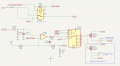
For what's it's worth this configuration will allow checking each mosfet individually using a single lamp and relay.
Also provides confirming the continuity of each igniter through switch Sw1 which all commercial launch systems provide for.
1730239446026.png
 

MisterBill2

Joined Jan 23, 2018
27,323
I have a design for a rocket launcher that controls one igniter. Current for the igniter is ~3-5A for about 500 msec.
Here is the igniter circuit concept:
View attachment 334612

I now need to expand the design to control up to 64 igniters. Still working out the levels (i.e. min set of igniters, average set of igniters).

Option 1 - replicate the cicuit above for each igniter. Seems to be too expensive in parts (~$8-$10) and pcb real estate (relays take up a lot of room).

Option 2 - use a high side switch (eg TPS27SA08) for each igniter, and just one relay, DAC, Op-amp, and MOSFET for all igniters
View attachment 334613

Each TPS27SA08 costs about $3 in single unit quantities. A more cost effective solution, but still expensive when looking at 64 igniters. The design does not scale that well given all the GPIO pins needed, too There are high side switches that can drive up to 4 loads, so that helps with the cost and number of GPIO pins. TI has a dual high side current switch that is controlled from an SPI bus (TPS2HCS10-Q1) which helps with pcb space as well as GPIO pins needed, but it is not in production yet.

I have been looking at a way to just replicate the MOSFET for each igniter using an analog multiplexer such as a CD4051B (~$0.40), but I can't figure out how to connect the igniters to the different MOSFETs without replicating the relay, which defeats the purpose of lower cost and less pcb real estate.

I thought I would ask the brain trust here if there is a different design that scales a little better than these two options.
Firs a few questions: Is that "up to 64 igniters" at exactly the same time?? How "exactly the same"or up to 64 in sequence?? or some combination? How critical is the timing?? And, how similar will they all be?? And what about the verification of each connection??
 

Thread Starter

phillipsoasis

Joined Aug 22, 2022
170
Firs a few questions: Is that "up to 64 igniters" at exactly the same time?? How "exactly the same"or up to 64 in sequence?? or some combination? How critical is the timing?? And, how similar will they all be?? And what about the verification of each connection??
As I responded earlier: the rockets are launched one at a time. The launch stand holds up to 64 rockets, but each one is launched manually one at a time. Usually, the next rocket does not launch until the previous rocket lands - say 5min+ between launches. If there is a misfire, the we go on to the next rocket in say a 1-3 minutes.
 

Thread Starter

phillipsoasis

Joined Aug 22, 2022
170
For what's it's worth this configuration will allow checking each mosfet individually using a single lamp and relay.
Also provides confirming the continuity of each igniter through switch Sw1 which all commercial launch systems provide for.
View attachment 334662
Nice idea with the DPDT relay. I will have to think about that.

I do not want to limit the current to a fixed amount for all igniters. I want to control the current, so I can say for igniter A I want X current and for igniter B I want Y current. However, the limit is better than the old style igniter versions of just shorting the igniter across the battery terminals and hope the igniter breaks before the battery gets too angry.

Why the diodes?
 

sghioto

Joined Dec 31, 2017
8,634
I do not want to limit the current to a fixed amount for all igniters. I want to control the current, so I can say for igniter A I want X current and for igniter B I want Y current.
I respect your idea but why exactly is that needed as long as the current is limited at 5 amps.
What type igniters are you using that require different currents?
How many different current limits are needed?
 
Last edited:
Top