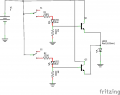
You won't get much voltage out of the transistors with that connection since the voltage across the bottom resistors is only about 1.5V from the 9V battery when on, and the transistor emitter will be about 0.7V below that.
Why not just use a diode from each switch to LED3?
That will give you the OR function.
You won't get much voltage out of the transistors with that connection since the voltage across the bottom resistors is only about 1.5V from the 9V battery when on, and the transistor emitter will be about 0.7V below that.
Why not just use a diode from each switch to LED3?
That will give you the OR function.
The main goal is to turn the LED on, the second goal is to make logic gates using transistors and all logic gates should be based on a simple NAND gate.
The main goal is to turn the LED on, the second goal is to make logic gates using transistors and all logic gates should be based on a simple NAND gate.
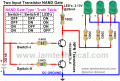
this is the NAND template that i try to implement in the logic gates. It does not directly have to be a NAND but you only should be able to see the basic structure
The main goal is to turn the LED on, the second goal is to make logic gates using transistors and all logic gates should be based on a simple NAND gate.
The main goal is to turn the LED on, the second goal is to make logic gates using transistors and all logic gates should be based on a simple NAND gate.

 Facebook
 Google
 GitHub
 Linkedin