Facebook
 Google
 GitHub
 Linkedin

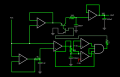
I've designed this circuit as an attempt to make a radio receiver that can receive AM signals and turn them into DC voltage levels based on the amplitude of the carrier wave.
To explain it simply: the two op amps at the bottom right act kind of like a differentiator, with the capacitor acting as a time delay. This "block" outputs an on signal whenever the slope of the wave is downward, which is very soon after it peaks.
This signal goes into the two comparators ahead of them which work as a timer, giving the circuit time to sample the amplitude and then stop before it gets too low to be useful.
During this window, that AND gate gets activated and triggers the sample and hold circuit you see at the top. The capacitor samples it (the resistor seemed to prevent spiking), and then the output op amp has that transistor to help smooth it a bit more.
My primary concern is that I don't think the BJTs used to control the sample and hold circuit would actually work. I tried using an n channel MOSFET like in most sample and hold circuits but, on this simulator anyways, the MOSFET didn't block reverse current, so the capacitor would always charge to a negative voltage when the radio wave went negative. I'm also unsure of whether the values for the capacitor would work as well as they did here. I'm using falstad which isn't exactly known for its accuracy.
Note that the antenna was amplifier by the simulator and only had one frequency, hence the absence of filters and amplifiers. I'll add those in the actual circuit.
I plan to use TL072s for the op amps.
Anyone with expertise weighing in would be a big help.