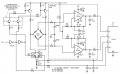
Load cell offset drift cancellation circuit

Thread Starter

cmartinez

Joined Jan 17, 2007
8,759
I've just made the appropriate changes, and the strange noise is gone... it probably had to do with the P2 trimpot having been connected to -12V in my previous version. And a difference in forward voltage between the two diodes might've caused some sort of interference... just a wild guess...
 

Thread Starter

cmartinez

Joined Jan 17, 2007
8,759
You found it. Page 7, bottom right. There is no input current except the leakage.

There is no intentional input current, therefore there is no equivalent resistance. The leakage is a constant (dependent on temperature, not voltage) so it has no similarity to a resistor.
So that leakage is part of the natural, physical limitations of that decoupling input cap, then... am I right?
 

Thread Starter

cmartinez

Joined Jan 17, 2007
8,759
Yes, I did, but I'm stumped as to the cause of that noise you observed, or the source of that 0.5V offset.
And now I'm only left with the mystery of that 0.5V offset... gonna measure and scope the thing some more, maybe I'm missing something here...
 

Thread Starter

cmartinez

Joined Jan 17, 2007
8,759
I think I'm beggining to understand... if I short circuit the IA's inputs, I read a clean, perfect 3V at its output.
So the missing 0.5V has to come from either the load cell itself, or from the circuitry that's switching it between +5V and -5V
 

Thread Starter

cmartinez

Joined Jan 17, 2007
8,759
I don't think so. The leakage is through the silicon substrate of the chip. That's why I say it's temperature dependent.
in other words... things are so close and in physical contact inside that chip, that some sort of leakage is happening?
 

Thread Starter

cmartinez

Joined Jan 17, 2007
8,759
Thanks. I think I first saw the term "Correlated double sampling" used for CCD cameras and never knew what it meant.
I'm still struggling to understand it. Gonna read the AN more carefully... see if I can make heads from tails of it...
 

OBW0549

Joined Mar 2, 2015
3,566
Thanks. I think I first saw the term "Correlated double sampling" used for CCD cameras and never knew what it meant.
From an afternoon's Google-surfing, it appears the two biggest application areas are for imaging (especially CMOS imaging arrays, which are a lot noisier than CCDs) and in MEMS accelerometers.
 

OBW0549

Joined Mar 2, 2015
3,566
I'm still struggling to understand it. Gonna read the AN more carefully... see if I can make heads from tails of it...
Correlated double-sampling is exactly what you were planning on doing when we discussed driving your strain gage with a ± 5V 400 Hz square wave signal in this thread. No more, no less.
 

Thread Starter

cmartinez

Joined Jan 17, 2007
8,759
Correlated double-sampling is exactly what you were planning on doing when we discussed driving your strain gage with a ± 5V 400 Hz square wave signal in this thread. No more, no less.
And that's what I've already done with my latest design. But the AN you posted states that

"The use of correlated double sampling, a close cousin of AC excitation, circumvents most of the problems associated with the use of a low noise bipolar amplifier..."

So if the load cell is not being excited with AC, how is it being done then?
 

OBW0549

Joined Mar 2, 2015
3,566
And that's what I've already done with my latest design. But the AN you posted states that

"The use of correlated double sampling, a close cousin of AC excitation, circumvents most of the problems associated with the use of a low noise bipolar amplifier..."

So if the load cell is not being excited with AC, how is it being done then?
I think you may be misinterpreting the meaning of that sentence; both square-wave drive with synchronized sampling (as in this AN), and the older AC sine-wave drive techniques (using an analog multiplier for demodulation, as in your top post in this thread) achieve the same thing-- circumventing, among other things, limitations imposed by opamp 1/f noise. The two techniques are equivalent, and have the same aim.

In other words, we're talking about square-wave AC drive vs. sine-wave AC drive, not AC drive vs. non-AC drive.
 

Thread Starter

cmartinez

Joined Jan 17, 2007
8,759
I ran across this Design Note from Linear Technology today and it made me think of this thread. What relevance it has at this point I've no idea, but I did find it interesting.
OB, thank you for posting that excellent DN. I've already studied it carefully, and have a few questions... see if you can help me out here

Capture.JPG

  • Does the 10V source need to be of the high quality, boosted reference-type? Or would a simple LM317 work? The reason I ask is that, since the reference for the ADC is being derived from R1 (and thus the circuit is monitoring the current through the bridge, and not its voltage) I'm under the impression that slight variations and drifts from that source will barely affect the results.
  • Can the LTC2411 be powered from a 7805? My guess is that yes, it can, since it's what happens at the REF pins what matters. Assuming I place proper decoupling caps between its power pins, of course (say, a 0.1 µF X7R and a 2.2 µF tantalum, for instance).
  • Could you recommend a substitute for the LT1219? I can't seem to find it in any of the main vendors out there (Mouser, Newark... Digikey has them but at more than $10 bucks each, and have only a few left in inventory).
  • I think I understand what the not gates (the 74HC04) are doing. They are commutating the two gates in the Q1 chip (which is controlled through the POL input), and therefore are drawing current through the Wheatstone bridge alternately from two different directions. My question is, what are Q4 and Q5 supposed to be doing? The DN says that they're there as level shifters. But since their gates are permanently connected to a 5V source, I fail to see what their function is, since it's the 74HC04 that's doing the commutation.

I'm definitely going to build this thing and test it. Then I'll compare it with what I've got. I've studied the specs for the LTC2411 and immediately fell in love with the sucker... it's 24 bits, priced as a 16-bit chip. with a small profile and a very easy to implement SPI interface. And it's a very sturdy chip, capable of withstanding up to 300°C (572°F) while soldering. God knows how many SMT ADCs I've spoiled due to my slowness and lack of expertise when I try to mount them on a PCB.
 

OBW0549

Joined Mar 2, 2015
3,566
Does the 10V source need to be of the high quality, boosted reference-type? Or would a simple LM317 work? The reason I ask is that, since the reference for the ADC is being derived from R1 (and thus the circuit is monitoring the current through the bridge, and not its voltage) I'm under the impression that slight variations and drifts from that source will barely affect the results.
I think your reasoning is correct. If I were making this, though, I think I would opt for operating the bridge off the 5V supply (with the modifications as noted on the schematic) and ditch the 10V supply altogether.

Can the LTC2411 be powered from a 7805? My guess is that yes, it can, since it's what happens at the REF pins what matters. Assuming I place proper decoupling caps between its power pins, of course (say, a 0.1 µF X7R and a 2.2 µF tantalum, for instance).
Correct again.

Could you recommend a substitute for the LT1219? I can't seem to find it in any of the main vendors out there (Mouser, Newark... Digikey has them but at more than $10 bucks each, and have only a few left in inventory).
I can't think of a direct substitute for the LT1219 that wouldn't require modifying the circuit a bit (namely, by omitting C1 and C2, which most opamps won't tolerate). One part I have a lot of experience with that might serve well would be an LT1490A dual opamp. If the bridge were operated off the 5V supply, I'd use a MAX44246 dual.

I think I understand what the not gates (the 74HC04) are doing. They are commutating the two gates in the Q1 chip (which is controlled through the POL input), and therefore are drawing current through the Wheatstone bridge alternately from two different directions. My question is, what are Q4 and Q5 supposed to be doing? The DN says that they're there as level shifters. But since their gates are permanently connected to a 5V source, I fail to see what their function is, since it's the 74HC04 that's doing the commutation.
They're level shifters, operating in the common-base configuration rather than common-emitter, which you're probably more accustomed to seeing.

I'm definitely going to build this thing and test it. Then I'll compare it with what I've got. I've studied the specs for the LTC2411 and immediately fell in love with the sucker... it's 24 bits, priced as a 16-bit chip. with a small profile and a very easy to implement SPI interface. And it's a very sturdy chip, capable of withstanding up to 300°C (572°F) while soldering. God knows how many SMT ADCs I've spoiled due to my slowness and lack of expertise when I try to mount them on a PCB.
I've been using the LTC24xx series of sigma-delta converters for years, with good results, and they're easy to use.
 

Thread Starter

cmartinez

Joined Jan 17, 2007
8,759
If the bridge were operated off the 5V supply, I'd use a MAX44246 dual
The 5V operation does indeed seem more attractive, especially after noticing that the MAX44246 has an auto-zero feature.
  • Why the MAX44246 for 5V operation, since its datasheet says that it can operate at up to 36V?
  • Wouldn't resolution suffer due to lower voltage excitation?
  • If resolution did suffer due to the 5V excitation, could this be fixed by adjusting the value of R1?
  • The DN says that Q4 and Q5 should be omitted for 5V operation. That would leave the circuit with a pair of 2.7K and 100Ω resistors in series. Could the 100Ω resistors be omitted as well, since the difference would be less than 4%?
 

OBW0549

Joined Mar 2, 2015
3,566
Why the MAX44246 for 5V operation, since its datasheet says that it can operate at up to 36V?
I was thinking that it would be good overall to operate the bridge, the opamps and the ADC all from the same supply. That, and I simply like the MAX44246. It got my ass out of a serious jam, once. :D

Wouldn't resolution suffer due to lower voltage excitation?
Yes, but I can't see that making a crucial difference here.

If resolution did suffer due to the 5V excitation, could this be fixed by adjusting the value of R1?
Not sure. Probably not...

The DN says that Q4 and Q5 should be omitted for 5V operation. That would leave the circuit with a pair of 2.7K and 100Ω resistors in series. Could the 100Ω resistors be omitted as well, since the difference would be less than 4%?
Yes, I'd just omit them.
 

Thread Starter

cmartinez

Joined Jan 17, 2007
8,759
I was thinking that it would be good overall to operate the bridge, the opamps and the ADC all from the same supply. That, and I simply like the MAX44246. It got my ass out of a serious jam, once. :D
Alright... time to go shopping then... :D

Many thanks!
 

Thread Starter

cmartinez

Joined Jan 17, 2007
8,759
I ran across this Design Note from Linear Technology today and it made me think of this thread. What relevance it has at this point I've no idea, but I did find it interesting.
So I got the parts and everything... and I was going to start drawing and fabricating the PCB when something caught my attention. The LTC2411 is capable of delivering only 7.5 measurements per second, and since the system works by calculating the difference between two measurements, the expected data rate is only a little more than 3 mps... And to me that's a real downer, and it buggers me... enormously.

Anyway, I'd rather have a fast, accurate 16 bit system, than a slow, ultra-accurate 24-bit one. So I did some searching for high speed, 16-bit ADC's, and came up with two possibly suitable candidates: the AD7684 and the ADS8317

One is capable of 100K mps, and the other one 250K mps.... Truth being told, their throughputs are so high that I don't really care which one of them I end up using.... My huge and humongous doubt is, could they would work with the circuit shown in post #94?

My gut tells me that NO, they won't work with exactly the same circuit, since the original ADC has differential reference inputs. But maybe, just maybe they might work, since -Ref is connected to ground through a 100 resistor in that circuit anyway... If that's the case, then almost certainly the value of R1 would have to be adjusted...

What do you think?
 

OBW0549

Joined Mar 2, 2015
3,566
They would work, just omit the connection for the REF- terminal.

Another ADC you might look at is the LTC2440; it's a 24-bit converter, like the LTC2411, whereas the AD7684 and ADS8317 are 16-bit. And it has a differential reference input.
 
Top