Load-cell bridge: big zero drift on 9 V, and when I power it from Arduino 5 V it overheats – what am I doing wrong?

Thread Starter

Vldkk

Joined Dec 13, 2025
7
Hello,
I have a load-cell bridge from a scale. The sensor is powered by a 9 V battery, the amplifier is powered from Arduino 5 V, and Arduino reads the amp output (A6) and sends data to PC.
Problem: zero drifts a lot. I think it’s because the 9 V battery and Arduino 5 V change differently (not synchronized) over time, so the ratio Vsig/Vref in Arduino ADC changes and zero drifts. Example numbers I measured: raw bridge ≈ 0.04–0.05 V, amp out ≈ 3.6–3.7 V, Arduino 5 V ≈ 4.82–4.92 V.
I tried to power the sensor from Arduino 5 V and the system started to overheat. Also, if the sensor stay on and I plug/unplug Arduino, it overheats too.
Why does it overheat when I feed 5 V to the old 9 V input?
How should I wire this correctly so zero drift goes away?
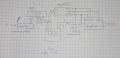
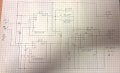
Schematic attached (my redraw)
Zap.jpg
 

bertus

Joined Apr 5, 2008
22,882
Hello,

Do you have a datasheet of the loadcell?
What does the datasheet say about the exitation voltage of the loadcell?

Bertus
 

Thread Starter

Vldkk

Joined Dec 13, 2025
7
What component exactly overheats?
The opamps, the resistors, the Arduino itself, exactly what?
The part that overheated was the jumper wire I used to feed +5 V into the board’s old +9 V battery pads, i stopped immediately
What component exactly overheats?
The opamps, the resistors, the Arduino itself, exactly what?
The part that overheated was the jumper wire I used to feed +5 V into the board’s old +9 V battery pads and arduino with weight electronics stopped to work , I immediately disconnected it. After I reverted all wiring back to the original setup, everything works again.
 

ericgibbs

Joined Jan 29, 2010
21,390
hi Vldkk,
You should power the bridge and the Arduino with the same 5V supply, in that way any change in supply voltage will be compensated for, due to the ratiometric ADC connections in the MCU.
E
 

Reloadron

Joined Jan 15, 2015
7,852
When powering (excitation) a load cell the excitation voltage needs to be as stable as possible. Monitor your excitation voltage and if there is drift, your measurement plane will drift.

Ron
 

Thread Starter

Vldkk

Joined Dec 13, 2025
7
Here is my setup schematic. I have a dual-channel stand to measure torque and thrust. Each channel uses a load-cell bridge from a kitchen scale with its original display board (I drew only one channel for clarity) and an amplifier made by another person.
1765647421303.png
 

ericgibbs

Joined Jan 29, 2010
21,390
hi Vk,
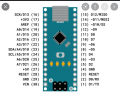
On a Arduino PCB the +Vin is for the Vsupply that should be between 8V and 12V. The 5V should not be used as an input for Voltages greater than 5V.
That is why it overheats when you apply 9V.

E
EG 1030.png
 

MisterBill2

Joined Jan 23, 2018
27,159
Draw the circuit including the load cell bridge and it will be obvious, and I hope you have not burned out the load cell bridge!!
The excitation of the bridge is top to bottom, the output is across the two corners. The arduino analog input has one side to common ground!So with one side corner grounded the supply is across 0nly one side of the bridge.
Read about bridge circuits and the inputs they must be used with. AND a load cell needs a regulated DC supply.AND an instrument amplifier.
I used load cell sensors for many years, so I am aware of the requirements.
 

Reloadron

Joined Jan 15, 2015
7,852
My schematic is unclear, i disconnected 9v and tried to power scale electronics with arduino 5v
Since you are using an Arduino uC you may want to add a HX711 to your scheme. There are a dozen or more examples online. This will afford you a stable excitation voltage and 24 bit data. Simple and modular. Wish I knew sooner that you were using an Arduino or any uC for that matter.

Ron
 

Irving

Joined Jan 30, 2016
4,996
I'll second the HX711, its by far the easiest and safest way to interface a loadcell to any MCU. Takes care of the differential nature of a loadcell and provides an accurate and stable excitation voltage. I use several with 100g, 1kg, 5kg and 4 x 100kg cells in various projects. Be sure to get the 'better' boards as shown in @Reloadron 's post above with decent input filtering and the 10Hz/80Hz read rate option - there's another version with fewer components (no filtering/fixed 10Hz)
 
Last edited:

MisterBill2

Joined Jan 23, 2018
27,159
I am thinking that the circuit in post #1 is using two instrument amps as op-amps. THAT SCHEME is doomed to not work right.
AND the circuit in post#13 does not resemble the circuit shown in post #1. So there needs to be some additional explanation about what is intended, and about what the circuits shown are intended to do. It confuses me greatly.
 
Top