No.
At least I think not.
I may be wrong so I'm looking at the data sheet.
But you will need a micro somewhere to have the data in a format the phone etc. can read, so why not just have an ESP32 serving a WiFi web page?
No.
At least I think not.
I may be wrong so I'm looking at the data sheet.
But you will need a micro somewhere to have the data in a format the phone etc. can read, so why not just have an ESP32 serving a WiFi web page?
You may be able to use an ESP8266-01 and that is possibly smaller than the transmitter linked in post #7.
What are you trying to measure with the HX711?
Some more details may help.
Initially I don't want to use the HX711. i want to feed the signal of the load cells into an intrumentation amp and feed that to a VCO. I'm using an AD620 amp but can't figure how to input the cell signal.
I can't say about the load cell - it's from a kitchen scales. It works fine with the HX711. After trying 2 different instrumentation amps I've come to the conclusion the signal is just too weak to use analogue. 3 other LC's from ebay also worked wonderfully with the HX711 but too weak for the AD620 or INA125P.
Hi. I know pretty well nothing about electronics. I connected this load cell to this instrumentation amplifier and expected to see some response from my meter when I put pressure on the load cell. I get nothing at all. Am I doing something wrong? What input instead of the load cell could I use to test the amplifier? Many thanks.
OK from the beginning. Read Eric's fine post with the data from your load cell. Focus on excitation voltage and sensitivity. These load cells typically output (the green and white leads) 2mv/volt meaning at full scale the output will be 0.002 volt per volt of excitation. Just for example if your load cell full scale is 5 Kg and your excitation voltage is 10 volts your output with 10 kg applied will be 10 * .002 or 20 mV. Really low level. so we amplify that. you have an analog signal proportional to applied force. You amplify it and do the math. Everything here is analog. Before I forget your excitation voltage should be rock stable and again 10 VDC is typical.
The HX 711 is a different animal all together. The HX 711 will provide stable excitation voltage to your load cell. The HX 711 will convert your analog load cell signal to a digital signal. The HX711 uses a two wire interface (Clock and Data) for communication. Any microcontroller’s GPIO pins should work and numerous libraries have been written making it easy to read data from the HX711. So now you have a digital signal.
Be it analog or digital road taken you need a display to read either your amplifier or digital signal. Your choice on that note. Soldering is not all that difficult, it's a skill and like any skill takes some practice. This is where an old printed circuit scrap board comes in handy. The old joke of the bigger the blob the better the job does not work.
You choose what you want and how you plan to calibrate it.
Is there an instrumentation amp that can amplify a 1mV input (or maybe even less) and output volts? i haven't found one. i'm feeding the output into a VCO. edit: sorry the INA125P is doing it's job. I now need work on a more sensitive 555 circuit.
First, instrumentation amplifiers can easily provide gains of 500 or even 1000. Second, the installation of load cells is not quite as simple as it seems. It is important to not put a load on the cell that is not part of the force you are trying to measure.
I think digital is good, it is not digital vs analog. The fact is AD620 has plenty of gain. When I increase R6 there is a full mV.
Measuring a 0.001 Ohm resistor with DMM, where is the problem, no constant current, no way to scale and zero relative offset.
If you repurpose an AD620 module as a load cell controller there is modification whereas the HX711 designed for MCU / strain gauge.
The datasheet says it is used in weigh scales. Things change, the variety of Arduino compatible components has improved,
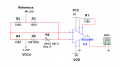
The 350R strain gauge shown below on the left. (R6 gives resistance change like a very slight flex of the strain gauge )
On the right is the AD620, R1 is a gain set resistor, simple. The MCU is easier and well suited to compensate for null zero.
My simulator is a better toy because it does not change on a hot day.
Is there an instrumentation amp that can amplify a 1mV input (or maybe even less) and output volts? i haven't found one. i'm feeding the output into a VCO. edit: sorry the INA125P is doing it's job. I now need work on a more sensitive 555 circuit.
I see a VCO as a Voltage Controlled Oscillator. Should that be the case with a VCO you get a frequency out which is proportional to the force applied to your load cell. That what you want or is your VCO something else. I have a scale which uses a VCO using Voltage to Frequency or VCO.
Thanks for all the replies folks. I've got the INA125 feeding into a very simple 555 circuit - all working fine. Next I'll spend some time refining the output of the 555 - maybe a nice clear sinewave would be good.
I saw something on youtube but maybe I'll choose something other than a 555. I'd like a VCO that makes a nice sinewave off between 1 and 5 volts. Any suggestions? Ta.

 Facebook
 Google
 GitHub
 Linkedin