LM358 Acting Strangely

Thread Starter

Cucumber

Joined Apr 21, 2023
4
I am working on a circuit that requires three LM358s (https://www.ti.com/product/LM358). I was seeing some strange behavior immediately out of the first op-amp, but I figured it could not be broken. I have set an LM358 alone. I gave it +-15 V supply and tied all inputs to ground. Both outputs, however, do not read 0 V when compared to ground. They read nearly 15 V. I have checked the pinout excessively. I have checked to make sure the connections are all solid and not touching. Does anyone know how these amplifiers could be spitting out a DC offset when both inputs are tied to ground?
 

Hymie

Joined Mar 30, 2018
1,347
The typical open loop gain of an LM358 is of the order of 100,000 – without any feedback limiting this to a useful value, even with both inputs tied at the same voltage, imperfections in the IC will result in the output being at one or other rail.
 

crutschow

Joined Mar 14, 2008
38,503
Does anyone know how these amplifiers could be spitting out a DC offset when both inputs are tied to ground?
If you indeed tied both op amp inputs directly to ground, the you will seen the few mV of input offset times the nominal 140,000 open loop voltage gain of the op amp, so it's not surprising that the output is saturated.
It would seem you don't know how op amps operate.

Tell us what you are trying to do with the op amps.
 

Thread Starter

Cucumber

Joined Apr 21, 2023
4
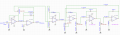
Hello, I have found my main issue. Here is the ultimate parametric equalizer bell I am attempting to implement.
Capture.PNG

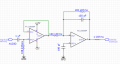
I am currently working with the initial section of the circuit.
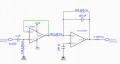
test.png

In both instances, the first op-amp works fine but the second op-amp is outputting with a large DC offset (about 6 V) when I input a .5 V sine (300 Hz). I did not anticipate this and I am not sure what to test.
 
Last edited:

MrChips

Joined Oct 2, 2009
34,807
Happy to know that you found your problem.

Next time, try to remember these three configurations for testing and using op-amps.
Op-amps need negative feedback in order to stabilize the output.

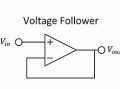
1) Voltage follower or unity gain buffer, gain = 1

1682127671853.png

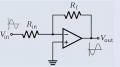
2) Inverting amplifier, gain = -Rf/Rin

1682127866799.png


1682127995389.png

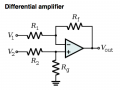
3) Difference Amplifier
Set R1 = R2
Set Rf = Rg

Vout = -Rf/R1 x (V1 - V2)
 

MrChips

Joined Oct 2, 2009
34,807
I am currently working with the initial section of the circuit.
1682128475129.png
In both instances, the first op-amp works fine but the second op-amp is outputting with a large DC offset (about 6 V) when I input a .5 V sine (300 Hz). I did not anticipate this and I am not sure what to test.
Of course, pin-5, IN2+ has no DC reference voltage.
Connect 100k ohms from pin-5 to GND.
 
Top