LM317 only outputs 1.0V

Thread Starter

a10t2

Joined Apr 23, 2010
10
Greetings all; I've been lurking forever but never had a question that wasn't answered in a previous thread. ;)

I've put together the basic LM317 circuit from the datasheet. The only difference is that I have 1 uF caps for both the input and output filters (didn't have any 0.1 uF on hand). At this point I've tried a second LM317, with the same result. I've also tried 100 ohm and 220 ohm values for R1, just in case. The pot I'm using for R2 checks out, a couple ohm at one end, 2.3 kohm at the other. It's on a breadboard, and I've moved all the components in case it was a short.

At output I'm getting almost exactly 1.0V (fluctuating between about 0.98 and 1.00 V). I'm assuming that's because my hacked-together power supply (just a bridge rectifier) fluctuates between about 11.4 and 11.9 VDC. Sweeping the pot has no effect on the output voltage. Replacing the pot with a fixed resistor has no effect, no matter what the value of the resistor is.

Is this a known failure mode for the LM317? I kind of doubt I got two bad ones right off the bat (they were both new), and I don't have a local source for components, so I'd rather not order more until other explanations have been eliminated.

Thanks in advance for any suggestions.
 

SgtWookie

Joined Jul 17, 2007
22,230
Sounds like you have the LM317 connected backwards.

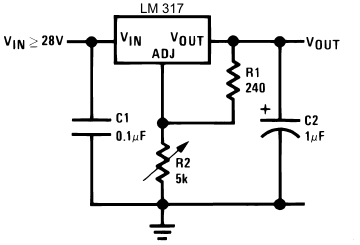
Compare your connections to this image:


If you have other than the LM317T (TO-220 package), then look in the datasheet to determine your regulator's pins.

[eta]
Use the 220 Ohm resistor for R1, as that will give you an appropriate Vout adjustment range for your pot.

That also means your output voltage may be somewhat higher and not within guaranteed regulation until you have at least a 5mA load on the output.
 

Attachments

Last edited:

Thread Starter

a10t2

Joined Apr 23, 2010
10
It is the TO-220, and I was working off of that same pinout. Is there any risk of damaging the regulator if I try other combinations of pins? It didn't occur to me that there might be a manufacturer doing a different layout.

I switched from the 220 to 100 ohm just to see if I had an LM317 that was a little out of spec. 1.25/220 = 5.7 mA, but that shouldn't be an issue, right?

The output voltage is the same with or without a load. I'm trying to power a 0.15A motor, FWIW.

The schematic is identical to this except for the values:
R1 = 220 ohm
R2 = 2.5 kohm
C1 = 1 uF
Vin = ~12V
 

kingdano

Joined Apr 14, 2010
377
Please look at the Vin value which is specified on the input pin in the diagram - and then note that you are using 12VDC.

The diagram suggests 28 VDC at a minimum - i am not an LM317 expert - but i would start there.


To answer your question - yes - there is a lot of danger in damaging the device by trying random pinouts - i would be very surprised if a manufacturer went rogue and chose a new pinout for the device - better to just try to up your input voltage to > 28VDC.
 

retched

Joined Dec 5, 2009
5,207
What SgtWookie was asking you was "Is your IC the LM317T ?"

If you have a 317QRS It may have a different pin out.

Read the chip carefully and be sure you are getting the proper datasheet.

There are low-power versions and high-current versions of many different ICs All with the same prefix. Be sure yours is the LM317T If it is not, we may be talking about a different IC.

The schematic you are showing would be wired with the LM317T looking at the back side of the chip, pins pointing down.
 

AlexR

Joined Jan 16, 2008
732
The resistor you quote would set the regulated voltage output at 15.6Volt. Since your actual input voltage is less than the desired output the regulator has gone into dropout and turned itself off.
You need to re-calculate your resistor values for whatever output you need bearing in mind that the output voltage must be at least 2volt less than the input voltage.
 

Thread Starter

a10t2

Joined Apr 23, 2010
10
What SgtWookie was asking you was "Is your IC the LM317T ?"
Sorry. Yes, it is the LM317T. "Motorola LM317T QAA035"

The schematic you are showing would be wired with the LM317T looking at the back side of the chip, pins pointing down.
I'm not sure what you mean by that. The pinout specifically says front view, and I wired the regulator using that assumption. The schematic has the ADJ pin in the center, which is wrong in either orientation.
 

Thread Starter

a10t2

Joined Apr 23, 2010
10
The resistor you quote would set the regulated voltage output at 15.6Volt. Since your actual input voltage is less than the desired output the regulator has gone into dropout and turned itself off.
That was my first thought as well. But I've also tried, for example, a 1 kohm resistor in place of the pot. Which should be:

1.25(1 + 1000/220) = 6.9V

And I'm still getting 1.0V at output.
 

retched

Joined Dec 5, 2009
5,207
Oh, jeez. What in the world am I looking at.

Some diagrams show the input, and not the proper pin-out. So if is says ADJ pin, you look on your datasheet and hook it to the adj pin on YOUR part. This way, you can use it with any arrangement.
 

SgtWookie

Joined Jul 17, 2007
22,230
kingdano, our OP does not need that much input voltage. With R2 set to maximum resistance, our OP should be able to get approximately Vin-1.7v to Vin-2.5v out, providing that the load is not so great that it's pulling too much current.

Heat sinking is required.

AlexR,
Since your actual input voltage is less than the desired output the regulator has gone into dropout and turned itself off.
That's not correct. If R2 was adjusted to max resistance, Vout would be Vin-Vdrop, or around 11.5v-1.7v, or 9.8v.
 

Thread Starter

a10t2

Joined Apr 23, 2010
10
kingdano, our OP does not need that much input voltage. With R2 set to maximum resistance, our OP should be able to get approximately Vin-1.7v to Vin-2.5v out, providing that the load is not so great that it's pulling too much current.
Random thought: what would happen in the opposite case, if R2 = 0? Wouldn't you get right around 1.2 V?

I don't see how that could be happening unless there was an internal short in the LM317T though.

Heat sinking is required.
I do have a suitable heatsink on the one I'm planning on using - the other isn't sinked but has only been in the circuit for a few seconds at a time.
 

SgtWookie

Joined Jul 17, 2007
22,230
If R2 was shorted, you would see around 1.2v to 1.3v inclusive on the output, nominally 1.25v.

Note that Vout is connected to the center terminal AND to the tab. If the heat sink is grounded or otherwise electrically connected to something, the tab must be electrically isolated from the heat sink. You can get TO-220 mounting kits that have a thermally conductive, electrically insulative sheet that goes between the tab and the heatsink, and stepped washers to insulate the mounting screw from the tab.
 

Thread Starter

a10t2

Joined Apr 23, 2010
10
Good point; I forgot to mention that I used a supposedly insulating thermal paste. I'm reading an open circuit between the heat sink and the center terminal.

I borrowed a regulated 12V power supply from another project just to make troubleshooting easier. For some reason, after moving things around some more, I'm now getting exactly 10.3 V. Still no effect from changing R2 though. :confused:
 

kingdano

Joined Apr 14, 2010
377
kingdano, our OP does not need that much input voltage. With R2 set to maximum resistance, our OP should be able to get approximately Vin-1.7v to Vin-2.5v out, providing that the load is not so great that it's pulling too much current.

i am pretty sure that the LM317 device prefers to have at least 5VDC of headroom above the output voltage at all times.

with a Vin of 10.3V i would not be surprised to see output issues.

perhaps to test this, you could configure the output for 5VDC and see what happens then.


edit:
3V ≤ (VIN − VOUT) ≤ 40V

this is from the datasheet regarding reference voltage - the device only guarantees an output of 1.25V with that condition met.
 

SgtWookie

Joined Jul 17, 2007
22,230
3V ≤ (VIN − VOUT) ≤ 40V

this is from the datasheet regarding reference voltage - the device only guarantees an output of 1.25V with that condition met.
That is for the reference voltage, not the output voltage.

If you grounded the ADJ terminal, and connected a 120 Ohm resistor between VOUT and GND (thus also the ADJ terminal) you should measure 1.2v to 1.3v inclusive, nominally 1.25v, at the VOUT terminal. Under these conditions, Vout will be equal to Vref.
 

kingdano

Joined Apr 14, 2010
377
That is for the reference voltage, not the output voltage.

If you grounded the ADJ terminal, and connected a 120 Ohm resistor between VOUT and GND (thus also the ADJ terminal) you should measure 1.2v to 1.3v inclusive, nominally 1.25v, at the VOUT terminal. Under these conditions, Vout will be equal to Vref.
Yes,

and if you didnt have the proper headroom your Vref may be 1.0V instead of 1.25V.

this was my point.
 

SgtWookie

Joined Jul 17, 2007
22,230
Yes,

and if you didnt have the proper headroom your Vref may be 1.0V instead of 1.25V.

this was my point.
If Vin=3v, and Vref is the max of 1.3v, then 3v - 1.3v = 1.7v, which is the minimum required headroom for that test.

Depending on the temp of the regulator and the current flow, Vdrop may be as high as 2.5v.

Please have a look at the "Dropout Voltage" chart on page 6 of the 2010 version of National Semiconductor's datasheet for the LM117/LM317A/LM317 family of adjustable positive regulators.
 
Top