LM2695 power supply design

Thread Starter

Alex Fagard

Joined Nov 27, 2016
8
Hey there. I'm developing a power supply board for my robot. I require a 5v and 6v rail with 1A and 4A max respectively. After some consideration I've decided to go with an LM2695-ADJ switching regulator to give me the 6v rail, and then that feeds into a 5v LDO giving me my logic power.

Generally I used the examples in the LM2695 documentation to make the circuit, and followed the step by step for selecting components. Some components no longer existed, so I had to make some changes with newer ones. For caps I followed the selection guidelines of 1.3 x the voltage, and an RMS of 1/2 the max amperage. With the inductor technically I only need one output stage 560uf cap, but I put the option in for two. The input cap didn't really have a guideline to follow so I just chose a 100uf cap with the appropriate ratings.

I'm not sure what wattage R2 & R4 should be rated for.
I'm not sure what ohm R3 should be (current limit) as the datasheet for the switching reg is all over the place on this one. As the reg is rated at 5A but can peak to 7A? It's all very confusing for a hobbiest.

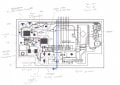
I've made a schematic and marked all the parts down that I'm thinking of using and would like some input to see if I've made any gross mistakes or if any of my components are not correct. Or any other general wisdom


Please note the scanned image has grounds marked with blue. The EDA image has them as rat lines. The whole board will have a ground plane so all those GND nets will be connected that way.

Correction: R2 should be 3.92kohms

Critical parts:
2 x RNS1E101MDN1PH
1 x MSS1210-223MEB
2 x 10SEP560M
1 x MBR735PB
1 x LM2679 ADJSchematic.jpg EDA.png
 

dendad

Joined Feb 20, 2016
4,637
One thing you will need to do is have big copper for the PCB tracks. Also, the layout is pretty critical for stability.
I'd just go with some of these myself..
http://www.ebay.com.au/itm/Mini-3A-...hash=item41cd672c35:m:mesOZOysSOu91Xns6RwXMqQ
These work really well and are pretty tiny, as well as cheap!
Use one for the 5V supply, and maybe 2 for the 6V supply, and feed them to different halves of the load.
Have them all run from the battery, not one into another. There is no need to do that, and 6V to 5V is generally not enough dropout anyway.
 

Thread Starter

Alex Fagard

Joined Nov 27, 2016
8
One thing you will need to do is have big copper for the PCB tracks. Also, the layout is pretty critical for stability.
I'd just go with some of these myself..
http://www.ebay.com.au/itm/Mini-3A-...hash=item41cd672c35:m:mesOZOysSOu91Xns6RwXMqQ
These work really well and are pretty tiny, as well as cheap!
Use one for the 5V supply, and maybe 2 for the 6V supply, and feed them to different halves of the load.
Have them all run from the battery, not one into another. There is no need to do that, and 6V to 5V is generally not enough dropout anyway.
While I appreciate the feedback, I don't think what you are proposing is very efficient. There are minimal losses in my setup (albeit if my circuit is properly designed and I'm not saying that it is), and the LDO only has to dissipate a small amount of power to get to 5V. The 5V reg I chose has a .45v dropout. My 6v rail actually produces 5.95v - .45 and that leaves a .5v span. Why should I suffer more losses by having 3 switching regs?? That being said, indeed, after looking at other implementations I need to increase the traces.
 

Dodgydave

Joined Jun 22, 2012
11,395
Hey there. I'm developing a power supply board for my robot. I require a 5v and 6v rail with 1A and 4A max respectively. After some consideration I've decided to go with an LM2695-ADJ switching regulator to give me the 6v rail, and then that feeds into a 5v LDO giving me my logic power.

Generally I used the examples in the LM2695 documentation to make the circuit, and followed the step by step for selecting components. Some components no longer existed, so I had to make some changes with newer ones. For caps I followed the selection guidelines of 1.3 x the voltage, and an RMS of 1/2 the max amperage. With the inductor technically I only need one output stage 560uf cap, but I put the option in for two. The input cap didn't really have a guideline to follow so I just chose a 100uf cap with the appropriate ratings.

I'm not sure what wattage R2 & R4 should be rated for.
I'm not sure what ohm R3 should be (current limit) as the datasheet for the switching reg is all over the place on this one. As the reg is rated at 5A but can peak to 7A? It's all very confusing for a hobbiest.

I've made a schematic and marked all the parts down that I'm thinking of using and would like some input to see if I've made any gross mistakes or if any of my components are not correct. Or any other general wisdom


Please note the scanned image has grounds marked with blue. The EDA image has them as rat lines. The whole board will have a ground plane so all those GND nets will be connected that way.

Correction: R2 should be 3.92kohms

Critical parts:
2 x RNS1E101MDN1PH
1 x MSS1210-223MEB
2 x 10SEP560M
1 x MBR735PB
1 x LM2679 ADJView attachment 135578 View attachment 135579
The Lm2695 is rated at 1.25 amps.
 

dendad

Joined Feb 20, 2016
4,637
There is a great deal to recommend having a supply for the logic and a separate one for the motors.
Those little switchers are pretty efficient. The overall losses probably will be similar having one supply or a number.
And as Dodydave noted, you will not get your 4A from the LM2695-ADJ.
As to your PCB layout, make the power tracks as big as you can fit them. And make sure when you lay it out that the high switching currents do not flow in the voltage sensing lines otherwise you have a good chance of building a high power oscillator.
 

Thread Starter

Alex Fagard

Joined Nov 27, 2016
8
The Lm2695 is rated at 1.25 amps.
There is a great deal to recommend having a supply for the logic and a separate one for the motors.
Those little switchers are pretty efficient. The overall losses probably will be similar having one supply or a number.
And as Dodydave noted, you will not get your 4A from the LM2695-ADJ.
As to your PCB layout, make the power tracks as big as you can fit them. And make sure when you lay it out that the high switching currents do not flow in the voltage sensing lines otherwise you have a good chance of building a high power oscillator.
In the parts list I had the correct regulator, but in the post body and header I wrote the wrong one. All these numbers can get confusing. The regulator I am using is the LM2679-ADJ doh.. And with regards to your last comment, are my switching currents flowing into the voltage sensing lines? The shunt is before the switching currents?
 

Dodgydave

Joined Jun 22, 2012
11,395
In the parts list I had the correct regulator, but in the post body and header I wrote the wrong one. All these numbers can get confusing. The regulator I am using is the LM2679-ADJ doh.. And with regards to your last comment, are my switching currents flowing into the voltage sensing lines? The shunt is before the switching currents?
According to the datasheet Current limit is set by the resistor on pin 7, the formula is 37,125/Resistor = limit Amps.
 

Thread Starter

Alex Fagard

Joined Nov 27, 2016
8
Have a read if this to help you with the layout. It is pretty important. A big trap for first time SMPS designers. I speak from experience ;)

https://www.maximintegrated.com/en/app-notes/index.mvp/id/2997
It basically says not to use a ground plane, and connect analog grounds together, while having a separate ground from the input/output caps and reg. While keeping traces short.
According to the datasheet Current limit is set by the resistor on pin 7, the formula is 37,125/Resistor = limit Amps.
Also according to the datasheet the reg is listed as capable of 7amps... so if you want max amperage out of it do you use 5 or 7amps in the calc?
 
Last edited:
Top