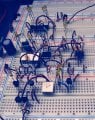
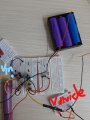
Hi sir, that is just the voltage source to power it up using lithium ion cell. Are the transistors correctly placed or have i misplaced the collector and emitter upside down? It is actually connected just that you cant see
you may also check for the short-circuits of the BE , BC , CE and/or of fly-back diode (if integrated - to some medium and above power and the HV switching transistors)
What are the transistor part numbers? There are 3 different pinouts.
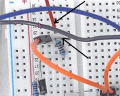
I'm not obsessive about neat breadboarding, but you can pack the components more densely if you form the leads and try to not leave so much wasted space. Something like this:
Using solid #22 wire instead of the jumpers you're using would make tracing connections from the pictures easier.
The boards you're using have tabs for interlocking them.
This caution is a bit late, but worth knowing: In most manufacturer's data sheets there is a disclaimer that the circuit shown is "a functional representation" of the actual circuit on the IC substrate. What that really means is that it is not the actual circuit, and that a lot of the important parts to make it actually meet the specifications are not shown. That is reasonable because why give away their exact design to the competition??
It also means that a copy of that circuit will not perform to a of the specifications. This caution is usually missing from secondary publications.
Hey Eric, it night here in my country haha. I saw this here and I saw comments that "UF4007's reverse recovery time is almost 20 times that of the 1N4148; and it has 4 times the junction capacitance. So yes, the 1N4148 is "faster." Because I am using UF 4007, I believe I get no readings because of the diodes I am using not being 1n4148 . Furthermore, I saw some comments that perhaps using schotty diodes is better because it has no recovery time
Hi sir , I have actually built the circuit and it works well . However, I want to modify your circuit so that it can self-generate a square wave PWM as shown in diagram above. I have tried to follow the diagram to implement it in your circuit but output is weird. I have attached my LT Spice file below , hopefully to have some guidance on this
Sorry, E.G., but knowing that a circuit is not an exact copy version is certainly a very good thing for somebody wanting to earn to know. Not everybody is totaly aware that it is not an exact dupicate of the actual part. And the fact that it operates perfectly in a simulator demonstrates the limitations of simulators.
R1, R3, D3 & D4 won't do much for you, due to the small difference between the diode forward drops and the transistor base emitter forward drops. And, with actual real world discrete components, the results will be unpredictable and depend on the particular components used.
If the diodes are omitted and the resistors connected directly, you will get something like the 10uA current mentioned on the LM393 schematic.
The 10uA current sources are not usually necessary for the circuit to work, unless the temperature is high, or there are some leakage paths through the breadboard.
Yes sir. Thank you. Perhaps, tmr I will built and even label properly all the nodes of the circuit on breadboard. Would be easier to solve connection mistake
Indeed! I do have a problem with the letter "L" on this computer and it often does not work on the first or second hit.
The flaw with many simulators is not providing the same limitations as real components. So you can run several amps through the 1N4148 signal diode with no problems, nor do they suffer reverse over-voltage breakdowns.
hi Bill,
A simulator is used to test/prove a circuit that has been designed by an electronic's design engineer.
It can be used to test the performance of the circuit over a range of conditions and temperatures, also indicate the voltages/currents in a number of Nodes in the circuit.
The way non-users think of simulators, it that the simulator will design the circuit.
Example of a typical 'old chestnut' argument they come up with: So you can run several amps through the 1N4148 signal diode with no problems.
Yes, you can IF you don't know the technical specification of the components you are using in your design.
But that's NOT a shorting coming of the simulator.
So to you and the other perpetual critics of simulators, please learn how to use a simulator and hopefully realize they are a useful tool, providing you know how to design a circuit.
hi Bill,
A simulator is used to test/prove a circuit that has been designed by an electronic's design engineer.
It can be used to test the performance of the circuit over a range of conditions and temperatures, also indicate the voltages/currents in a number of Nodes in the circuit.
The way non-users think of simulators, it that the simulator will design the circuit.
Example of a typical 'old chestnut' argument they come up with: So you can run several amps through the 1N4148 signal diode with no problems.
Yes, you can IF you don't know the technical specification of the components you are using in your design.
But that's NOT a shorting coming of the simulator.
So to you and the other perpetual critics of simulators, please learn how to use a simulator and hopefully realize they are a useful tool, providing you know how to design a circuit.
My point being that most simple simulators will not show the problems if you don't check for them, and that can happen to actual engineers as well as newbies.
So if you do know how to design a circuit then the simulator might be useful, maybe. Certainly they can work for evaluating sensitivity to component variations.
The vital thing is to understand the limitations in advance. That iis why I commented.
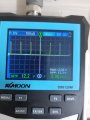
Hi sir, it all works well in my breadboard. Do you wanna see my breadboard circuit? I tested it with oscillioscope. The input i chose a traingle wave which i generate using op-amps at 5kHz
hi Mrsss,
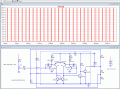
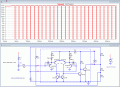
By adding the 1K resistor a 100k Pot, to your square wave circuit, you can have a simple PWM Voutput.
Two sim plots Pot at 1% and Pot at 99%.
hi Mrsss,
By adding the 1K resistor a 100k Pot, to your square wave circuit, you can have a simple PWM Voutput.
Two sim plots Pot at 1% and Pot at 99%.

 Facebook
 Google
 GitHub
 Linkedin

 81 KB Views: 6