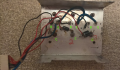
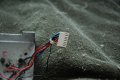
The connector at lower right is chopped off. I need to be able to trace where each wire enters the connector
(to identify the connector pin number) and trace it to the pins/devices on the transistor heat sink.
The Darlington can be replaced with a different manufacture if you want but I would recommend using mosfets.
The mosfets would be in a different package.
OK...I suggest using some PCB cleaner spray (preferred) or rubbing alcohol and clean the boards.
Especially the bottom of the main board so we can clearly identify traces, then repost.
The existing MJ2501 Darlington BJTs are in a TO-3 case. Mosfets don't usually come in that style case.
So the mounting of the mosfets to the heatsink would be different footprint.
However, ST-Microelectronic makes an MJ2501 Darlington transistor that should be a drop in replacement.
I put LED on the schematic as I couldn't find anything to simulate the actual rear lamps - although it would probably be a nice feature to add LEDs to the board. The existing unit powers ordinary incandescent bulbs so needs to handle 10 amps or more per line out.
Not sure of the pattern (not my unit) so we are going to set up a video either on a vehicle or with bulb holders/bulbs and a car battery.
Ah-ha - so the metal container is a heat-sink! I wondered why it was separate to the PCB - is there a way to add a heatsink to the board to neaten it all up? I know that processors use heat sinks and thermal paste, but it didn't dawn on me that a transistor would - learning all the time.
Ah-ha - so the metal container is a heat-sink! I wondered why it was separate to the PCB - is there a way to add a heatsink to the board to neaten it all up? I know that processors use heat sinks and thermal paste, but it didn't dawn on me that a transistor would - learning all the time.
Yes...that metal plate is heat sink. The transistors get hot, so with them mounted to the heat sink, with a thermally conductive paste, the heat is transferred to the heat sink and dissipated. The size of the heat sink can reduced if the right Mosfet is chosen.
I put LED on the schematic as I couldn't find anything to simulate the actual rear lamps - although it would probably be a nice feature to add LEDs to the board. The existing unit powers ordinary incandescent bulbs so needs to handle 10 amps or more per line out.
Not sure of the pattern (not my unit) so we are going to set up a video either on a vehicle or with bulb holders/bulbs and a car battery.
1. Only very new vehicles have LEDs as original - aftermarket ones have resistors to emulate the original lamps, so in either case it will need to handle the output.
2. When the unit is not switched on the lights will still work as intended.
1. Only very new vehicles have LEDs as original - aftermarket ones have resistors to emulate the original lamps, so in either case it will need to handle the output.

 Facebook
 Google
 GitHub
 Linkedin