Length in Inches of each Edge of a Cube

Thread Starter

zulfi100

Joined Jun 7, 2012
656
Hi,

I have got a following problem:
The volume of a cube is 'v' cubic yards, and its surface area is 'a' square feet. If 'v' = 'a' what is the length in inches of each edge?

volume of a cube = e^3
surface area of cube = 6e^2

=

volume of a cube = 'v' cubic yards
= 'v' * 3 feet
= 'v' * 3 * 12 inches
= 36 'v' inches
surface area of a cube = 6 * e^2
'a' = 6 * e ^2
'v' = 6 * e^2

Now volume of cube = 36 * 6 * e ^2 inches
e^3 = 216 e^2 inches
e = 216 inches

But answer is not correct. Some body please guide me.

Zulfi.
 

WBahn

Joined Mar 31, 2012
32,707
Did you check your answer, or just compare it to the provided answer?

If you just compared it to the provided answer, then try checking it.

You claim that e = 216 inches.

What is the surface area, in square feet, of a cube of this size?

What is the volume, in cubic yards, of a cube this size?

Does that satisfy the problem statement?
 

RBR1317

Joined Nov 13, 2010
715
If the 'correct' answer you have is 1944 inches, then the difficulty is you are not properly tracking units. If not 1944, then I obviously don't understand the problem.
 

WBahn

Joined Mar 31, 2012
32,707
If the 'correct' answer you have is 1944 inches, then the difficulty is you are not properly tracking units. If not 1944, then I obviously don't understand the problem.
If that's not the correct answer, then neither of us understand it.
 

MrAl

Joined Jun 17, 2014
13,667
Hi,

Im not sure i understand it right either but i get two results:
either 72 inches or 0 inches.

0 here would be considered trivial while 72 non trivial.

The only question was do they want us to work in all the same units when comparing the volume. I think they do though. The question came up because we are already asked to compare volume to surface area, but usually when we have to do that (such as in animal characteristics) we have to work in the same units or the results may not be meaningful.
 
Last edited:

WBahn

Joined Mar 31, 2012
32,707
Hi,

Im not sure i understand it right either but i get two results:
either 72 inches or 0 inches.

0 here would be considered trivial while 72 non trivial.
An answer of 0 is the trivial case, but is a valid solution.

Let's see about 72 inches.

The length of the side is then either 6 ft or 2 yards.

The volume is 8 cubic yards; so v = 8.

The area of one face is 36 sq ft, so the total surface area is 216 square feet; so a = 216

Hence it would seem that 72 inches is not a solution.
 

MrAl

Joined Jun 17, 2014
13,667
An answer of 0 is the trivial case, but is a valid solution.

Let's see about 72 inches.

The length of the side is then either 6 ft or 2 yards.

The volume is 8 cubic yards; so v = 8.

The area of one face is 36 sq ft, so the total surface area is 216 square feet; so a = 216

Hence it would seem that 72 inches is not a solution.
Hi,

Yes but arent you voiding what i said in my last post about comparing units of the same type?
If that's true, then i agree, but what i did was convert to the same units and then:
8 cubic yards equals 216 cubic feet which also has 216 square feet for a cube.

I did not want to compare cubic yards to square feet because it's somewhat meaningless to do so in a real life absolute sense and there are applications that do things like compare different dimensional quantities but not different units (although in a comparative sense is different of course), although in a problem like this we never know for sure until we see the supposed correct answer. Perhaps you can explain your result of 1944 inches as i think that's what you implied.
 
Last edited:

Thread Starter

zulfi100

Joined Jun 7, 2012
656
Hi,
Answer in the book is 1944 inches.

volume of a cube = 'v' cubic yards
= 'v' * (3) ^ 3 cubic feet
= 'v' * 27 cubic feet
....
...

Is the above correct?

Zulfi.
 

LesJones

Joined Jan 8, 2017
4,511
zulfi100,
What you state in post #8 is correct.

MrAl,
We cannot say that V = A as the units are different but we can say that number V = Number A
If we call the volume in cubic feet Vf then we can replace V with Vf/27
We can then write an equation for both volume and area in terms of L (Side lenght) The volume side of the equation we replace V by Vf/27
I can't go further withot giving the full answer.

Les.
 

MrAl

Joined Jun 17, 2014
13,667
zulfi100,
What you state in post #8 is correct.

MrAl,
We cannot say that V = A as the units are different but we can say that number V = Number A
If we call the volume in cubic feet Vf then we can replace V with Vf/27
We can then write an equation for both volume and area in terms of L (Side lenght) The volume side of the equation we replace V by Vf/27
I can't go further withot giving the full answer.

Les.
Hi,

Ok so i guess what you are saying then is that it's ok to compare cubic yards to cubic feet. If that's what they really want then we have to do it that way. In real life though usually we stick to the same base units so that we can use math for other secondary calculations. An example would be comparing the muscle mass of an animal to it's weight.
 

WBahn

Joined Mar 31, 2012
32,707
Hi,

Yes but arent you voiding what i said in my last post about comparing units of the same type?
If that's true, then i agree, but what i did was convert to the same units and then:
8 cubic yards equals 216 cubic feet which also has 216 square feet for a cube.

I did not want to compare cubic yards to square feet because it's somewhat meaningless to do so in a real life absolute sense and there are applications that do things like compare different dimensional quantities but not different units (although in a comparative sense is different of course), although in a problem like this we never know for sure until we see the supposed correct answer. Perhaps you can explain your result of 1944 inches as i think that's what you implied.
Actually, it is you who are comparing things of different units. You are trying to equate 216 cubic feet and 216 square feet. But these are no more nor no less comparable than cubic millimeters and light years.

In the problem, they are NOT comparing volume to area. They are comparing 'v' and 'a', which, as defined in the problem, are both pure numbers -- they have NO units whatsoever. The associated units in both cases are explicitly separate.

They did NOT say that the volume was 'v'. If they had, then 'v' would have been a quantity that carried units of volume because volume is a quantity that has two components, a pure number giving a scaling factor and a dimension establishing the unit scale. But they said that the volume was " 'v' cubic yards ". Volume still has two components, the pure number is 'v' and the dimension is "cubic yards". Similarly, the area is a pure number 'a' combined with a unit of "square feet".

Believe me -- that's the first thing I checked when I saw the problem. I was actually surprised that they treated units correctly, though I wonder if it was by happenstance.

Let's change the problem, so as not to give it away but show how to work a problem like it while properly tracking units.

Let's have and area that is 'a' square yards and a perimeter that is 'p' feet. What is the length of a side in inches if 'a' = 'p'?

In terms of the length of a side, L (and notice that L carries units of length), the area, A, and perimeter, P, (both of which carry units) are.

A = L² = 'a'·yd²
P = 4L = 'p'·ft

since 'a' = 'p':

4L = 'a'·ft

solving for 'a':

'a' = 4L/ft

L² = (4L/ft)(yd²)
L = (4·yd²)/(ft) * (3 ft / 1 yd)² * (12 in / 1 ft)
L = 4·3²·12 in = 432 in

Notice how, by properly tracking units all the way, L evaluates to a length consisting of a pure number (432) and a dimension (inches).

L is also equal to 36 ft or 12 yd.

The area is 144 yd², so 'a' = 144.
The perimeter is 144 ft, so 'p' = 144.

As required, 'a' = 'p'.
 

WBahn

Joined Mar 31, 2012
32,707
zulfi100,
What you state in post #8 is correct.

MrAl,
We cannot say that V = A as the units are different but we can say that number V = Number A
If we call the volume in cubic feet Vf then we can replace V with Vf/27
We can then write an equation for both volume and area in terms of L (Side lenght) The volume side of the equation we replace V by Vf/27
I can't go further withot giving the full answer.

Les.
The problem is making no claim that a volume equals an area. None whatsovever.

They give an expression for volume ('v' cubic yards) and an expression for area ('a' square feet). They are NOT equating volume and area, they are equating 'v' and 'a', which are each just a part of a particular expression.
 

WBahn

Joined Mar 31, 2012
32,707
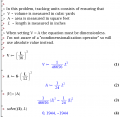
In summary, for posterity:
View attachment 133250
Very few electronic packages properly track units, and even the ones that do might require playing some tricks to get them to properly handle a problem like this.

The proper way to deal with a problem like this actually draws on the same approach for correctly scaling graphs.

The graph scale on most graphs is purely numerical. This is commonly dealt with in the axis title by saying something like "height (cm)". But this is actually wrong. The "height" is a dimensioned quantity and so this label is actually multiplying the height by 1 cm, making it a quantity having dimensions of area. The proper way to title the axis is "height/cm". By dividing the height by 1 cm, it is reduced to a dimensionless number, matching the dimensionless values on the axis.

I guess it's been long enough for us to just deal with the solved problem.

So here we have

\(
v \; = \; \frac{e^3}{yd^3}
\,
a \; = \; \frac{6e^2}{ft^2}
\)

The quantities v and a are now dimensionless and can be equated per the problem's requirement.

\(
v \; = \; a
\,
\frac{e^3}{yd^3} \; = \; \frac{6e^2}{ft^2}
\,
e \; = \; \frac{6 \, yd^3}{ft^2}
\)

We see that we have a quantity that has dimensions of length (length^3) divided by (length^2). Now we just convert them to whatever unit we want to express our answer in.

\(
e \; = \; \( \frac{6 \, yd^3}{ft^2} \) \( \frac{3 \, ft}{1 \, yd} \)^2 \( \frac{36 \, in}{1 \, yd} \)
\,
e \; = \; 6 \cdot 3^2 \cdot 36 \, in \; = \; 1944 \, in
\)
 

MrAl

Joined Jun 17, 2014
13,667
Actually, it is you who are comparing things of different units. You are trying to equate 216 cubic feet and 216 square feet. But these are no more nor no less comparable than cubic millimeters and light years.

In the problem, they are NOT comparing volume to area. They are comparing 'v' and 'a', which, as defined in the problem, are both pure numbers -- they have NO units whatsoever. The associated units in both cases are explicitly separate.

They did NOT say that the volume was 'v'. If they had, then 'v' would have been a quantity that carried units of volume because volume is a quantity that has two components, a pure number giving a scaling factor and a dimension establishing the unit scale. But they said that the volume was " 'v' cubic yards ". Volume still has two components, the pure number is 'v' and the dimension is "cubic yards". Similarly, the area is a pure number 'a' combined with a unit of "square feet".

Believe me -- that's the first thing I checked when I saw the problem. I was actually surprised that they treated units correctly, though I wonder if it was by happenstance.

Let's change the problem, so as not to give it away but show how to work a problem like it while properly tracking units.

Let's have and area that is 'a' square yards and a perimeter that is 'p' feet. What is the length of a side in inches if 'a' = 'p'?

In terms of the length of a side, L (and notice that L carries units of length), the area, A, and perimeter, P, (both of which carry units) are.

A = L² = 'a'·yd²
P = 4L = 'p'·ft

since 'a' = 'p':

4L = 'a'·ft

solving for 'a':

'a' = 4L/ft

L² = (4L/ft)(yd²)
L = (4·yd²)/(ft) * (3 ft / 1 yd)² * (12 in / 1 ft)
L = 4·3²·12 in = 432 in

Notice how, by properly tracking units all the way, L evaluates to a length consisting of a pure number (432) and a dimension (inches).

L is also equal to 36 ft or 12 yd.

The area is 144 yd², so 'a' = 144.
The perimeter is 144 ft, so 'p' = 144.

As required, 'a' = 'p'.

Hello again,

I dont have any problem equating two numbers, i even made that clear in one or two of my previous posts.

What i did have a problem with was the physical units. If we look at real life problems we always have to convert to the same units before we solve the problem. The math just doesnt work if we dont...the real life math though not a textbook problem math.

I am sure there are many examples out there but a simple one is this...
John travels 100 miles to his destination.
Joe travels 100 killometers to his destination.
Who traveled the farthest or did they both travel the same distance?

Another example:
A sphere has a surface area x and volume y.
What is the ratio of volume to surface area?
This is a good example because if we use different units for surface and volume we'll get a ratio that nobody else gets because we never use different base units.

The only way we can use the same base units is comparatively and that means that everybody has to agree that we are going to use say square meters for volume and square inches for surface area.
That is a possibility that i did say existed already, but is not what we usually have to do.

What else is interesting is i dont think we can say with absolute certainty that this same exact problem can not come up with the exact same wording and have the result be 72 inches instead of 1944 inches. That's in a class where the teacher has taught the students to make all the units the same before doing the problem. That's because so many problems just dont work in the math unless the units are the same.

Calculate the volume of a box given sides A=10 inches, B=20 inches, and C=2 yards.
Are we supposed to calculate 10*20*2 yard inches? :)
No. We could first convert to the SAME units before we even start. If we dont we end up with a mix of units.

You said i did not pay attention to the units, but i was the only one that did apparently, unless you call a 'dimensionless constant' as having some kind of units. Are 'no' units actually some sort of units? I dont think so.

These kind of dilemmas will always come up on forums like this because we often dont have the background information needed to ascertain the context, which in this case, has to do with the units that SHOULD be used, if any. I also never said that 1944 was outright wrong, i just said that 72 (if i did that right) was the more likely correct result because of the units.

Also BTW, "a trivial solution" already implies that that particular solution is valid that's why it is called a solution in the first place, it just does not usually get used because it often does not provide any meaningful result.

Some of this stuff is border line pure philosophical again because we dont have the underlying context at the beginning of the problem. This means there will ALWAYS be more than one viewpoint that we can take. It's not until we learn the true background info that we can be sure, somewhat, that the answer is correct, which BTW does not guarantee the result given is really correct anyway.
Quick example that many people like to joke about:
What is 1+1?
Some will argue it MUST be "2", while others will argue it MUST be "10".
The true answer can only come after we know what base system is being used.

It gets even more confusing when we look at some real life situations where all the information is on the table yet we still cant be sure. A philosophical 'hole' in the ground is one example, but even more interesting is the true age of the Sphinx which has estimates that vary depending on who is dong the estimate.
 

Thread Starter

zulfi100

Joined Jun 7, 2012
656
Hi,
Wbhan, thanks for your work. Good technique for converting into a dimentionless quantity. Initially, it was strange for me also that how 'c' cubic yards = 'a' square feet but as a number its possible. But I did not think that before equating the two values with units, we must get rid of their units in order to express them as numbers.
<The problem is making no claim that a volume equals an area. None whatsovever.>
They found the volume & called it 'v' & then area & called it 'a' and then they are saying that v = a & you showed me how can we equate them.

God bless you all.
Zulfi.
 
Last edited:

WBahn

Joined Mar 31, 2012
32,707
Hello again,

I dont have any problem equating two numbers, i even made that clear in one or two of my previous posts.

What i did have a problem with was the physical units. If we look at real life problems we always have to convert to the same units before we solve the problem. The math just doesnt work if we dont...the real life math though not a textbook problem math.

I am sure there are many examples out there but a simple one is this...
John travels 100 miles to his destination.
Joe travels 100 killometers to his destination.
Who traveled the farthest or did they both travel the same distance?
Just take the ratio of the two.

r = 100 miles / 100 kilometers

That ratio is dimensionless since it is a ratio of distance to distance. If the ratio is larger than 1, John traveled further. If it is less than 1, Joe traveled further. If it is 1, they traveled the same distance.

In this case,

r = 100 miles / 100 kilometers ~= 1.609

So John traveled further.

Another example:
A sphere has a surface area x and volume y.
What is the ratio of volume to surface area?
This is a good example because if we use different units for surface and volume we'll get a ratio that nobody else gets because we never use different base units.
But you seem to be thinking that cubic feet and square feet are somehow the same unit. They aren't. One is a unit of volume and the other is a unit of area.

The ratio of volume to surface area has units of length.

Let's pick a sphere that has a radius of 1 meter.

John finds that the volume is 4189 liters and a surface area of 135.3 square feet. The ratio of volume to area is therefore 30.96 liter/ft².

Joe finds that the volume is 147.9 ft^3 and a surface area of 4.189 m². The ratio of volume to area is therefore 35.31 ft^3/m².

Guess what? These two quantities are exactly equal (sans round off error). Convert them to any unit of length you want. You will find that the ratio is one-third of the radius.

The units are PART of the quantity.

6 ft is exactly the same as 2 yards is exactly the same as 72 inches is exactly the same as 182.88 cm.

You do NOT compare 6 to 2 to 72 to 182.88. Those are ALL just numbers and NONE of them are equal to any of the others.

But 6 ft is a quantity of length and that quantity of length is exactly the same as 182.88 cm.

What else is interesting is i dont think we can say with absolute certainty that this same exact problem can not come up with the exact same wording and have the result be 72 inches instead of 1944 inches.
Please, by all means give it a shot.

Calculate the volume of a box given sides A=10 inches, B=20 inches, and C=2 yards.
Are we supposed to calculate 10*20*2 yard inches? :)
Not unless you think that volume has units of area.

Now, if you want to do it correctly and get 400 yd·in², then that is a perfectly valid value for the volume of the box.

No. We could first convert to the SAME units before we even start. If we dont we end up with a mix of units.
So? What's wrong with mixed units. Ever hear of the volume of water in a lake or reservoir expressed in acre-feet?

You said i did not pay attention to the units, but i was the only one that did apparently, unless you call a 'dimensionless constant' as having some kind of units. Are 'no' units actually some sort of units? I dont think so.
If you had paid attention to units, you would have gotten the correct answer.

These kind of dilemmas will always come up on forums like this because we often dont have the background information needed to ascertain the context, which in this case, has to do with the units that SHOULD be used, if any. I also never said that 1944 was outright wrong, i just said that 72 (if i did that right) was the more likely correct result because of the units.
Your answer was based on the erroneous claim that you can directly equate square feet to cubic feet.

Some of this stuff is border line pure philosophical again because we dont have the underlying context at the beginning of the problem. This means there will ALWAYS be more than one viewpoint that we can take. It's not until we learn the true background info that we can be sure, somewhat, that the answer is correct, which BTW does not guarantee the result given is really correct anyway.
Quick example that many people like to joke about:
What is 1+1?
Some will argue it MUST be "2", while others will argue it MUST be "10".
The true answer can only come after we know what base system is being used.
Utter red herring -- we did not have to guess or infer anything about the system being used. It was explicitly stated in the problem.
 

MrAl

Joined Jun 17, 2014
13,667
Hi again,

"But you seem to be thinking that cubic feet and square feet are somehow the same unit. They aren't. One is a unit of volume and the other is a unit of area."

I never said that. I had said that the BASE units should be the same. That is, feet or inches, inches or meters, etc., but not both. The reason for doing this is so the ratio has REAL meaning not just a dimensionless constant. If we can use any units we want to use we can make a math expression equal all sorts of values.
For example:
3 yards/3 feet = 1
or
3 feet /3 feet =1

which is it?

The one that fits real life most of the time is 3ft/3ft=1.

SURE, we can invoke 3yrds/3ft=1, but that's not as meaningful unless everybody is doing it that way in some scientific measurement forum, which of course is possible.

You seem to think that comparing cubic feet to square feet has no meaning so we NEVER have to pay attention to whether we use feet or yards or inches as the BASE units. In real life it ALWAYS matters, but we do have a choice, and that choice is usually to use the same BASE units (like either feet or inches, but not both).

I am sort of surprised that you dont seem to understand this because you are always mentioning that people should be aware of the units in a problem. If you are going to dismiss all units, then we can calculalte the volume of the earth to be 1 cubic centimeter :)

If you still dont agree sorry but i've said the same thing several times now so it seems like you just dont want to see this point of view. If you dont want to see this point of view you never will. I see yours, and partially agree, but you dont see mine or something.
 

WBahn

Joined Mar 31, 2012
32,707
Hi again,

"But you seem to be thinking that cubic feet and square feet are somehow the same unit. They aren't. One is a unit of volume and the other is a unit of area."

I never said that. I had said that the BASE units should be the same. That is, feet or inches, inches or meters, etc., but not both. The reason for doing this is so the ratio has REAL meaning not just a dimensionless constant. If we can use any units we want to use we can make a math expression equal all sorts of values.
For example:
3 yards/3 feet = 1
or
3 feet /3 feet =1

which is it?
You still clearly don't understand dimensions and dimensioned quantities.

3 yards / 3 feet is NOT equal to 1. It is equal to 1 yard/feet, which is better known as 3.

In order to make the claim that 3 yards/3 feet = 1, you either have to claim that a yard and a foot are the same thing, and thus cancel each other out, or you have to be willing to ignore units, which is the OPPOSITE of being able to claim, somehow, that you are the only one paying attention to them.

The one that fits real life most of the time is 3ft/3ft=1.

SURE, we can invoke 3yrds/3ft=1, but that's not as meaningful unless everybody is doing it that way in some scientific measurement forum, which of course is possible.
No, you can't invoke that because it isn't. Period. In order to invoke it you have to assert that 3 yards = 3 feet. Just multiply both sides of your invoked equality by 3 feet and you will get that inescapable assertion. So unless you are really willing to claim that you can invoke that 3 yards = 3 feet, you can't invoke that 3 yards / 3 feet = 1.
 

MrAl

Joined Jun 17, 2014
13,667
You still clearly don't understand dimensions and dimensioned quantities.

3 yards / 3 feet is NOT equal to 1. It is equal to 1 yard/feet, which is better known as 3.

.
Hello again,

See this illustrates a problem when talking to you sometimes.
You are stating something i never stated, then saying that it is wrong.
In fact, i even already stated that you cant do that, then you come back with a reply that says that it cant be done so i am wrong. I already said that we cant do that.
You must realize that if you say the same thing i said then it cant be wrong unless you are wrong too :)

But maybe it would be better to let this puzzle rest. The answer was confirmed by the OP and i think he/she is satisfied. You played a part in getting the right answer, so you should be happy :)
 
Top