Facebook
 Google
 GitHub
 Linkedin
Hello All,
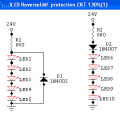
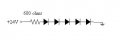
I have Five LEDs in series (3.2V @ 20mils typical) in a circuit as shown in the attached file. The input is ~24VDC, with 680 ohm resistance in series with the LEDs. LED Specs: http://superbrightleds.com/specs/w110-360_specs.htm
What could cause the 2nd and 4th LED's to short? My first thought was that the LEDs were bad. I swapped in a new board. Within a few weeks, the 2nd, 3rd and 4th LEDs shorted. I am using these LED boards on seven other machines, none of which have had this issue. Could the environment effect LEDs?
Something to note: the LED board can be manually turned on, for testing. In this case, the machine it is connected to is actually off. When the machine is running, the input to the LED board drops upwards to 0.5V. Perhaps the LEDs the shorted are more sensitive to this voltage drop than the other LEDs?
Any insight will be appreciated.
I have Five LEDs in series (3.2V @ 20mils typical) in a circuit as shown in the attached file. The input is ~24VDC, with 680 ohm resistance in series with the LEDs. LED Specs: http://superbrightleds.com/specs/w110-360_specs.htm
What could cause the 2nd and 4th LED's to short? My first thought was that the LEDs were bad. I swapped in a new board. Within a few weeks, the 2nd, 3rd and 4th LEDs shorted. I am using these LED boards on seven other machines, none of which have had this issue. Could the environment effect LEDs?
Something to note: the LED board can be manually turned on, for testing. In this case, the machine it is connected to is actually off. When the machine is running, the input to the LED board drops upwards to 0.5V. Perhaps the LEDs the shorted are more sensitive to this voltage drop than the other LEDs?
Any insight will be appreciated.
Attachments
-
 4.1 KB Views: 26