Facebook
 Google
 GitHub
 Linkedin
Good morning, gentlemen, I need your help, considering as an example a Michelson interferometer that has as its only source a single laser diode with a frequency of 900 nm, now if this laser is divided into two arms and is pulsed (PWM), the first arm at a frequency of 40 Hz and the second arm at a frequency of 50 Hz, when the two arms then interfere they produce a pattern that has an optical frequency of 900 nm (always the same) and a pulse beat frequency of 10 Hz. But if instead of the laser diode I wanted to use as a single source an LED diode with the same optical frequency (900 nm) and then pulse it (PWM) with the same frequency as in the previous example, can the same resulting 10 Hz beat effect be observed or the LED diodes cannot do it because they are incoherent?
Led diode vs laser diode for interference beat - (PWM)
- Thread starter Sabro
- Start date
Scroll to continue with content

At the risk of appearing pedantic: 900nm is the wavelength, that corresponds to a frequency of 333THz.
This is an important distinction when reasoning about the physics of electromagnetic radiation and it is actually important not to conflate the two things.
Even though wavelength and frequency are inversely proportional and feel interchangeable, frequency is constant but wavelength varies based on the medium it is propagating through.
This is an important distinction when reasoning about the physics of electromagnetic radiation and it is actually important not to conflate the two things.
Even though wavelength and frequency are inversely proportional and feel interchangeable, frequency is constant but wavelength varies based on the medium it is propagating through.

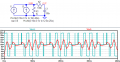
SUM - sum of light intensity from interferometer arms, with incoherent light source.But if instead of the laser diode I wanted to use as a single source an LED diode with the same optical frequency (900 nm) and then pulse it (PWM) with the same frequency as in the previous example, can the same resulting 10 Hz beat effect be observed or the LED diodes cannot do it because they are incoherent?
OUT - integrated by eyes (using night vision).
Last edited:
yes the LED will obviously be collimated with appropriate lenses, so that it has a directional beam like the laser diode, the problem is the incoherence of the LED diode, and that makes me doubt that there could be a beat in the frequency of the pulses of 40 and 50 Hz (so the optical frequency is approximately 333 thz) in your opinion, using a single diode as a source, can I obtain the beats?How would the LED diode be focused to create a beam?
900nm is near-infrared, how do plan on "observing" it?
Yes, thanks for your explanation. Yes, actually, I only talked about wavelength for convenience. Thanks for your clarification. The beam (LED or laser) will still travel through the air and may then encounter liquid media (rainwater tanks). So, in your opinion, if I used an infrared LED diode (a single LED for the interferometer), I could obtain the 40 and 50 Hz subtraction beats, as easily happens with lasers. I have doubts about the inconsistency of LEDs. What do you think?At the risk of appearing pedantic: 900nm is the wavelength, that corresponds to a frequency of 333THz.
This is an important distinction when reasoning about the physics of electromagnetic radiation and it is actually important not to conflate the two things.
Even though wavelength and frequency are inversely proportional and feel interchangeable, frequency is constant but wavelength varies based on the medium it is propagating through.
Danko your answers are too sophisticated for me, thanks for your reply, ok so if I understand correctly, at the "sum" output a modulation of the intensity of the two beams is produced and therefore the difference beat of 10 Hz (50 - 40 Hz) is what I'm looking for given that the source will be unique and that is a single LED diode with an optical frequency of 333 thz (900 nm), and then divided into the two beams of the interferometer, in one arm it will be pulsed at 40 Hz and in the second arm at 50 Hz, so as you already wrote even if the LED source is incoherent I can obtain the same effect that is easily obtained with a laser??SUM - sum of light intensity from interferometer arms, with incoherent light source.
OUT - integrated by eyes (using night vision).
View attachment 359930
With one LED or with two, with or without interferometer, with or without difference in optical properties of arms ways,I know it's a very trivial question, but I'm not sure of my conclusions. So, in your opinion, can I get the same beating effect as lasers by using LED diodes?
you always will have pattern, repeated every 100 ms (10 Hz), as shown on diagram post #4.
Last edited:
Thanks Danko for your reply. Yes, I've recently learned from Wikipedia that in your previous post you were describing an operational amplifier, in which the LED was driven by two currents of different frequencies. In my case, I would need two LEDs to have physical interference, and reading on Wikipedia under the "coherence" entry, it was written that if the source is multi-frequency and incoherent, imprecise or random interference fringes are obtained, so they are obtained but not in a precise way like happens with lasers. So I confirm everything you said in post #4. Okay, so in this case I'll also see why I could buy an LED diode and a laser diode to try.With one LED or with two, with or without interferometer, with or without difference in optical properties of arms ways,
you always will have pattern, repeated every 100 ms (10 Hz), as shown on diagram post #4.

MisterBill2
- Joined Jan 23, 2018
- 28,371
What would be a totally amazing accomplishment would be to sense a ten hertz frequency difference between two light beams, with frequencies close to a frequency of 333THz.
So now I take he liberty of asking about the purpose of this experiment.
My impression is that these less expensive laser diodes do not deliver perfect wavelength stability.
So now I take he liberty of asking about the purpose of this experiment.
My impression is that these less expensive laser diodes do not deliver perfect wavelength stability.
good morning misterbill thanks for your reply, no, the source is unique, and the optical frequency is approximately 333 thz, but in each arm of the interferometer the beams will be pulsed (PWM modulation) so the optical frequency always remains the same, but they are pulsed at a frequency of 40 hz for the first arm and 50 hz for the second arm, so when they interfere at a point X, there will be a PWM modulation beat and not of the optical frequency of 333 thz, so as Danko has already confirmed, do you also think that by following the reasoning you obtain, at the point of interference, a vibration of 333 thz pulsed at 10 hz??What would be a totally amazing accomplishment would be to sense a ten hertz frequency difference between two light beams, with frequencies close to a frequency of 333THz.
So now I take he liberty of asking about the purpose of this experiment.
My impression is that these less expensive laser diodes do not deliver perfect wavelength stability.
In both case the signal is 10Hz @900nm, is this what the Rx is looking for?
If you want LED to be like the laser example, don't power the LED using PWM.
Power the LED constant on at say 1/2 or 1/4 power (using a inline resistor), then use a nFet or the like to bypass the resistor to get full power, you use PWM on the gate of fet. Now you can "shape" the 900nm analog pulse signal using PWM %, 50/50 10Hz, 20/80 10Hz, 80/20 10Hz, etc. Also notice that you can flip the "shaped" signal over, your Rx can be designed to look for the down signal vs the up signal (20/80 vs 80/20, or 10/90 vs 90/10 @10Hz PWM, etc). If the Rx only cares about 10Hz, then the 50/50 PWM shall suffice.
Also note, 40Hz combined with 50Hz 900nm produces true AM 10Hz.
If the question is "can I PLL the 900nm of two LED's", I suspect not, no real way to control how the "ed" part of LED emits. Two "identical" 900nm LED's will have different phase, different amplitude, and different actual frequency, so no real way to get an interfence beat, not even if you took my example and ran one LED at 50/50 40Hz and the other at 50/50 50Hz. Two "identical" fets don't even turn on and off at the same exact time.
If you want LED to be like the laser example, don't power the LED using PWM.
Power the LED constant on at say 1/2 or 1/4 power (using a inline resistor), then use a nFet or the like to bypass the resistor to get full power, you use PWM on the gate of fet. Now you can "shape" the 900nm analog pulse signal using PWM %, 50/50 10Hz, 20/80 10Hz, 80/20 10Hz, etc. Also notice that you can flip the "shaped" signal over, your Rx can be designed to look for the down signal vs the up signal (20/80 vs 80/20, or 10/90 vs 90/10 @10Hz PWM, etc). If the Rx only cares about 10Hz, then the 50/50 PWM shall suffice.
Also note, 40Hz combined with 50Hz 900nm produces true AM 10Hz.
If the question is "can I PLL the 900nm of two LED's", I suspect not, no real way to control how the "ed" part of LED emits. Two "identical" 900nm LED's will have different phase, different amplitude, and different actual frequency, so no real way to get an interfence beat, not even if you took my example and ran one LED at 50/50 40Hz and the other at 50/50 50Hz. Two "identical" fets don't even turn on and off at the same exact time.
Last edited:

A very well equipped lab might have trouble filtering an ordinary led and would opt for a well established light source that would establish a standard.
The mercury yellow doublet has been known to measure interference beats, The pure mercury green is also considered monochromatic, however
these do not rate and known not work for that application. The key is "doublet" so make sure your light source will produce a good beat pattern like the green yellow mercury.
In this post the reference sited uses sodium doublet light source.
MASTER SOX-E 18W BY22d 1SL/12 - MASTER SOX-E | Philips
datasheet, features a BY22d Cap-Base and a Color Temperature of 1800 K. It provides a Luminous Flux ofapprox 100 lm, 57Vdc a true source for observing the sodium doublet
adjusting this to show concentric rings uses a micrometer and very fine adjustment. The lamp itself can be fashioned with sheet metal to block the light with the exception of a small hole.
The heat alone is one of the constraints affecting what is observable.
Derived from equivalence theory, the EM circuit equivalence lends itself to a doublet light source for a Michelson beat experiment that uses the superposition of
two independent alternating current (AC) signal generators operating at two slightly different frequencies
In photonics, the primary RLC components in an AC circuit have the following functional equivalents: Thinking in photonic equivalents and layers takes some adjustment in perspective.
Those who understood how to do all this without the help of computer and graphical analysis was a noteworthy accomplishment.
Python code that some EE / Electro-Optical Engineer use to produce accurate output with sodium doublet.
reference Lab4MichelsonRevF09.pdf
The mercury yellow doublet has been known to measure interference beats, The pure mercury green is also considered monochromatic, however
these do not rate and known not work for that application. The key is "doublet" so make sure your light source will produce a good beat pattern like the green yellow mercury.
In this post the reference sited uses sodium doublet light source.
MASTER SOX-E 18W BY22d 1SL/12 - MASTER SOX-E | Philips
datasheet, features a BY22d Cap-Base and a Color Temperature of 1800 K. It provides a Luminous Flux ofapprox 100 lm, 57Vdc a true source for observing the sodium doublet
adjusting this to show concentric rings uses a micrometer and very fine adjustment. The lamp itself can be fashioned with sheet metal to block the light with the exception of a small hole.
The heat alone is one of the constraints affecting what is observable.
Derived from equivalence theory, the EM circuit equivalence lends itself to a doublet light source for a Michelson beat experiment that uses the superposition of
two independent alternating current (AC) signal generators operating at two slightly different frequencies
In photonics, the primary RLC components in an AC circuit have the following functional equivalents: Thinking in photonic equivalents and layers takes some adjustment in perspective.
Those who understood how to do all this without the help of computer and graphical analysis was a noteworthy accomplishment.
- Resistor (R): The equivalent of resistance in a photonic circuit is optical absorption or scattering losses. A component that absorbs or scatters photons (e.g., a specific material or a deliberately introduced lossy waveguide) dissipates optical energy, much like a resistor dissipates electrical energy as heat.
- Inductor (L): Inductance's equivalent is often related to the kinetic energy of charges or magnetic field storage in the electrical case. In optical systems, the analogy is complex but can be achieved using the inertia of light within specific resonant structures, such as using the time delay or phase accumulation in certain optical cavities or waveguides, or even plasmonic nanoparticles.
- Capacitor (C): Capacitance is the ability to store energy in an electric field. The photonic equivalent involves components that can store optical energy in an electric field form for a short period or introduce a specific phase shift. This is typically achieved using dielectric materials in structures like microcavities or photonic crystal elements.
Python code that some EE / Electro-Optical Engineer use to produce accurate output with sodium doublet.
Code:
[/COLOR][/B]
import numpy as np
import matplotlib.pyplot as plt

def calculate_michelson_beat(lambda1, lambda2, max_path_diff, steps):
    """
    Calculates and plots the Michelson interference beat pattern for a doublet source.

    Args:
        lambda1 (float): The first wavelength in meters (e.g., sodium D1 line).
        lambda2 (float): The second wavelength in meters (e.g., sodium D2 line).
        max_path_diff (float): Maximum optical path difference to simulate (in meters).
        steps (int): Number of points for the simulation.
    """

    # Generate a range of optical path differences (delta_x = 2d)
    delta_x = np.linspace(0, max_path_diff, steps)

    # Assuming equal intensities for both wavelengths (a = 1)
    # The total intensity formula for a doublet is I_total = I * [1 + cos(k1*delta_x) + cos(k2*delta_x) + cos((k1-k2)*delta_x)] (simplified)
    # A more common simplified form for visualization is the envelope function multiplied by a carrier wave.

    # Wavenumbers k = 2*pi / lambda
    k1 = 2 * np.pi / lambda1
    k2 = 2 * np.pi / lambda2

    # Calculate the intensity pattern for each wavelength separately
    I1 = 1 + np.cos(k1 * delta_x)
    I2 = 1 + np.cos(k2 * delta_x)

    # Superpose the intensities (assuming incoherent addition of the two separate patterns)
    I_total = I1 + I2

    # Alternatively, the formula for total intensity for coherent superposition:
    # Here, a = E2/E1 is amplitude ratio. Let's assume a=1 (equal amplitudes)
    # I_total_coherent = 2 * (1 + 1 + 1**2 + 1*np.cos(2*delta_k*delta_x) + (1+1)*(np.cos(k1*delta_x) + 1*np.cos(k2*delta_x))) # This is too complex

    # A simpler, reliable way to visualize the beat is the visibility formula (envelope)
    # Visibility V = |cos(pi * delta_x * (1/lambda1 - 1/lambda2))|
    # The full signal can be seen as an average intensity modulated by the beat frequency.

    # We will use the direct superposition of intensity for clarity in plotting the rapid fringes within the envelope
    # I_total is proportional to:
    intensity_envelope = 2 * (1 + np.cos(np.pi * delta_x * (1/lambda1 - 1/lambda2))) # The slow beat
    intensity_carrier = np.cos(np.pi * delta_x * (1/lambda1 + 1/lambda2))**2 # The fast fringes

    # For simulation, simply summing the individual intensities is common in lab experiments as detectors average over the fast oscillation
    # The visibility (contrast) is what is typically measured.

    # Let's plot the sum of intensities to show the modulation (beat)
    plt.figure(figsize=(10, 6))
    plt.plot(delta_x * 1e6, I_total, label='Superposed Intensity (Simulated Detector Signal)', color='gray')
    plt.plot(delta_x * 1e6, intensity_envelope, label='Beat Envelope (Visibility Variation)', color='red', linestyle='--')
    plt.xlabel('Optical Path Difference $\Delta x$ ($\mu$m)')
    plt.ylabel('Intensity (Arbitrary Units)')
    plt.title('Michelson Interferometer Interference Beat Pattern (Sodium Doublet)')
    plt.legend()
    plt.grid(True)
    plt.show()

    # Calculate the beat distance for precision measurement
    delta_lambda = abs(lambda1 - lambda2)
    beat_distance_theoretical = (lambda1 * lambda2) / (2 * delta_lambda)
    print(f"Theoretical mirror displacement for one beat cycle: {beat_distance_theoretical * 1e6:.2f} µm")

# --- Parameters for Sodium Doublet ---
# Wavelengths in meters
lambda_d1 = 589.59e-9  # D1 line
lambda_d2 = 588.96e-9  # D2 line (often approximated as 589.0 nm and 589.6 nm)
# The actual value for the beat distance (d12 in sources) is related to 2d (OPD) for one full cycle.
# 2d12 = lambda1*lambda2 / (lambda1 - lambda2) --> d12 (mirror movement) is half of that OPD

# Simulation parameters
max_opd = 1.0e-4  # Simulate up to 100 micrometers of path difference
steps = 10000      # High resolution for smooth plot

# Run the simulation
calculate_michelson_beat(lambda_d1, lambda_d2, max_opd, steps)


[B][COLOR=rgb(147, 101, 184)][Code/][/COLOR][/B]
Last edited:
MisterBill2
- Joined Jan 23, 2018
- 28,371
My other question is about"What is the purpose of this exercise??
Dc_kid Thanks for your reply, yes, as you have already confirmed, if you use two LED diodes, you do not get beat interference at 10 Hz (50 Hz - 40 Hz) because the LEDs are out of phase with each other, so you must use only one LED diode, but perhaps you described the case in which the LED is driven by a current that alternates the PWM offsets to be able to turn the LED on and off at 40 and 50 Hz, but I need interference in space, so the single source must be divided into two arms and in the first arm it pulses at 40 Hz while in the second it pulses at 50 Hz, and then in space the beams meet and interfere and produce a beat at 10 Hz, the optical frequency of 333 THz remains unchanged, so what do you think??In both case the signal is 10Hz @900nm, is this what the Rx is looking for?
If you want LED to be like the laser example, don't power the LED using PWM.
Power the LED constant on at say 1/2 or 1/4 power (using a inline resistor), then use a nFet or the like to bypass the resistor to get full power, you use PWM on the gate of fet. Now you can "shape" the 900nm analog pulse signal using PWM %, 50/50 10Hz, 20/80 10Hz, 80/20 10Hz, etc. Also notice that you can flip the "shaped" signal over, your Rx can be designed to look for the down signal vs the up signal (20/80 vs 80/20, or 10/90 vs 90/10 @10Hz PWM, etc). If the Rx only cares about 10Hz, then the 50/50 PWM shall suffice.
Also note, 40Hz combined with 50Hz 900nm produces true AM 10Hz.
If the question is "can I PLL the 900nm of two LED's", I suspect not, no real way to control how the "ed" part of LED emits. Two "identical" 900nm LED's will have different phase, different amplitude, and different actual frequency, so no real way to get an interfence beat, not even if you took my example and ran one LED at 50/50 40Hz and the other at 50/50 50Hz. Two "identical" fets don't even turn on and off at the same exact time.
Thanks for your reply, unfortunately I can't easily get the equipment to use chemical agents, only at the university could I have it, but in my lab I can only use LED diodes, I need interference in space, so the single source must be divided into two arms and in the first arm it pulses at 40 Hz while in the second it pulses at 50 Hz, and then in space the beams meet and interfere and produce a beat at 10 Hz, the optical frequency of 333 THz remains unchanged, that is, therefore I'm only interested in confirming whether the 10 Hz beat resulting from the pulsations of the individual arms can occur, Danko and I have confirmed that this happens, do you confirm this too??A very well equipped lab might have trouble filtering an ordinary led and would opt for a well established light source that would establish a standard.
The mercury yellow doublet has been known to measure interference beats, The pure mercury green is also considered monochromatic, however
these do not rate and known not work for that application. The key is "doublet" so make sure your light source will produce a good beat pattern like the green yellow mercury.
In this post the reference sited uses sodium doublet light source.
MASTER SOX-E 18W BY22d 1SL/12 - MASTER SOX-E | Philips
datasheet, features a BY22d Cap-Base and a Color Temperature of 1800 K. It provides a Luminous Flux ofapprox 100 lm, 57Vdc a true source for observing the sodium doublet
adjusting this to show concentric rings uses a micrometer and very fine adjustment. The lamp itself can be fashioned with sheet metal to block the light with the exception of a small hole.
The heat alone is one of the constraints affecting what is observable.
Derived from equivalence theory, the EM circuit equivalence lends itself to a doublet light source for a Michelson beat experiment that uses the superposition of
two independent alternating current (AC) signal generators operating at two slightly different frequencies
In photonics, the primary RLC components in an AC circuit have the following functional equivalents: Thinking in photonic equivalents and layers takes some adjustment in perspective.
Those who understood how to do all this without the help of computer and graphical analysis was a noteworthy accomplishment.
- Resistor (R): The equivalent of resistance in a photonic circuit is optical absorption or scattering losses. A component that absorbs or scatters photons (e.g., a specific material or a deliberately introduced lossy waveguide) dissipates optical energy, much like a resistor dissipates electrical energy as heat.
- Inductor (L): Inductance's equivalent is often related to the kinetic energy of charges or magnetic field storage in the electrical case. In optical systems, the analogy is complex but can be achieved using the inertia of light within specific resonant structures, such as using the time delay or phase accumulation in certain optical cavities or waveguides, or even plasmonic nanoparticles.
- Capacitor (C): Capacitance is the ability to store energy in an electric field. The photonic equivalent involves components that can store optical energy in an electric field form for a short period or introduce a specific phase shift. This is typically achieved using dielectric materials in structures like microcavities or photonic crystal elements.
Python code that some EE / Electro-Optical Engineer use to produce accurate output with sodium doublet.
reference Lab4MichelsonRevF09.pdfCode:[/COLOR][/B] import numpy as np import matplotlib.pyplot as plt def calculate_michelson_beat(lambda1, lambda2, max_path_diff, steps): """ Calculates and plots the Michelson interference beat pattern for a doublet source. Args: lambda1 (float): The first wavelength in meters (e.g., sodium D1 line). lambda2 (float): The second wavelength in meters (e.g., sodium D2 line). max_path_diff (float): Maximum optical path difference to simulate (in meters). steps (int): Number of points for the simulation. """ # Generate a range of optical path differences (delta_x = 2d) delta_x = np.linspace(0, max_path_diff, steps) # Assuming equal intensities for both wavelengths (a = 1) # The total intensity formula for a doublet is I_total = I * [1 + cos(k1*delta_x) + cos(k2*delta_x) + cos((k1-k2)*delta_x)] (simplified) # A more common simplified form for visualization is the envelope function multiplied by a carrier wave. # Wavenumbers k = 2*pi / lambda k1 = 2 * np.pi / lambda1 k2 = 2 * np.pi / lambda2 # Calculate the intensity pattern for each wavelength separately I1 = 1 + np.cos(k1 * delta_x) I2 = 1 + np.cos(k2 * delta_x) # Superpose the intensities (assuming incoherent addition of the two separate patterns) I_total = I1 + I2 # Alternatively, the formula for total intensity for coherent superposition: # Here, a = E2/E1 is amplitude ratio. Let's assume a=1 (equal amplitudes) # I_total_coherent = 2 * (1 + 1 + 1**2 + 1*np.cos(2*delta_k*delta_x) + (1+1)*(np.cos(k1*delta_x) + 1*np.cos(k2*delta_x))) # This is too complex # A simpler, reliable way to visualize the beat is the visibility formula (envelope) # Visibility V = |cos(pi * delta_x * (1/lambda1 - 1/lambda2))| # The full signal can be seen as an average intensity modulated by the beat frequency. # We will use the direct superposition of intensity for clarity in plotting the rapid fringes within the envelope # I_total is proportional to: intensity_envelope = 2 * (1 + np.cos(np.pi * delta_x * (1/lambda1 - 1/lambda2))) # The slow beat intensity_carrier = np.cos(np.pi * delta_x * (1/lambda1 + 1/lambda2))**2 # The fast fringes # For simulation, simply summing the individual intensities is common in lab experiments as detectors average over the fast oscillation # The visibility (contrast) is what is typically measured. # Let's plot the sum of intensities to show the modulation (beat) plt.figure(figsize=(10, 6)) plt.plot(delta_x * 1e6, I_total, label='Superposed Intensity (Simulated Detector Signal)', color='gray') plt.plot(delta_x * 1e6, intensity_envelope, label='Beat Envelope (Visibility Variation)', color='red', linestyle='--') plt.xlabel('Optical Path Difference $\Delta x$ ($\mu$m)') plt.ylabel('Intensity (Arbitrary Units)') plt.title('Michelson Interferometer Interference Beat Pattern (Sodium Doublet)') plt.legend() plt.grid(True) plt.show() # Calculate the beat distance for precision measurement delta_lambda = abs(lambda1 - lambda2) beat_distance_theoretical = (lambda1 * lambda2) / (2 * delta_lambda) print(f"Theoretical mirror displacement for one beat cycle: {beat_distance_theoretical * 1e6:.2f} µm") # --- Parameters for Sodium Doublet --- # Wavelengths in meters lambda_d1 = 589.59e-9 # D1 line lambda_d2 = 588.96e-9 # D2 line (often approximated as 589.0 nm and 589.6 nm) # The actual value for the beat distance (d12 in sources) is related to 2d (OPD) for one full cycle. # 2d12 = lambda1*lambda2 / (lambda1 - lambda2) --> d12 (mirror movement) is half of that OPD # Simulation parameters max_opd = 1.0e-4 # Simulate up to 100 micrometers of path difference steps = 10000 # High resolution for smooth plot # Run the simulation calculate_michelson_beat(lambda_d1, lambda_d2, max_opd, steps) [B][COLOR=rgb(147, 101, 184)][Code/][/COLOR][/B]
Yes, I need this device to measure the movements of ion concentrations in a rainwater tank, and I need the beating (interference at a point) to be able to choose the point in which to examine, if I used a single beam I could not study a single point because I would not have the spatial precisionMy other question is about"What is the purpose of this exercise??
MisterBill2
- Joined Jan 23, 2018
- 28,371
To produce phase cancellation both frequencies must be present at the same time,and be the same wavelength.. and blinking a light off and on will not shift the frequency.