LED current?

dl324

Joined Mar 30, 2015
18,328
looks like you guys were right.
with the line tying the 2 strings together, 1 side draws .6 amp and the other draws .25 amp.
without the tying line, 1 side draws .51 amp, the other draws .3 amp.
So much for your LEDs (for which we still have no data) being binned by forward voltage, intensity, and wavelength.

How were you measuring the currents?

If you inserted a current meter, you perturbed the circuit and your readings won't be meaningful (unless you inserted similar current meters in both branches simultaneously so they're affected equally). If you measured voltage drops across current limiting/sensing resistors and calculated current, your readings would be "accurate". Just understand that you're dealing with PWM and you won't get any information about peak currents. To do that, you need an oscilloscope and an adequate number of readings.
 

Thread Starter

joewales44

Joined Oct 8, 2017
218
So much for your LEDs (for which we still have no data) being binned by forward voltage, intensity, and wavelength.

How were you measuring the currents?

If you inserted a current meter, you perturbed the circuit and your readings won't be meaningful (unless you inserted similar current meters in both branches simultaneously so they're affected equally). If you measured voltage drops across current limiting/sensing resistors and calculated current, your readings would be "accurate". Just understand that you're dealing with PWM and you won't get any information about peak currents. To do that, you need an oscilloscope and an adequate number of readings.
i inserted 2 meters in series before first LED.
i got almost identical readings when i switched meters back and forth.
i'm anxious to see how much more power and voltage an additional driver will use.
thanks
 

dl324

Joined Mar 30, 2015
18,328
i inserted 2 meters in series before first LED.
i got almost identical readings when i switched meters back and forth.
That means the ratios you measured are okay, but the current measured (which is some sort of average) isn't accurate. When you insert the meter, you insert a resistance. That resistance will reduce the current from what it would have been without the meter. I think I've cautioned you multiple times in this thread that that would happen.

The amount of resistance inserted depends on the meter and the range it's on.

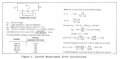
This is how you correct the reading for my Fluke 27:fluke27CurrentCorrection.jpg

I find life to be simpler if I calculate current using a sense resistor vs correcting for the error introduced by a current meter.
 

WBahn

Joined Mar 31, 2012
32,840
So much for your LEDs (for which we still have no data) being binned by forward voltage, intensity, and wavelength.
A factor of two or even three between devices in parallel is not unreasonable if the bins are not very narrow, or if they LEDs are not tightly coupled thermally.
 

WBahn

Joined Mar 31, 2012
32,840
looks like you guys were right.
with the line tying the 2 strings together, 1 side draws .6 amp and the other draws .25 amp.
without the tying line, 1 side draws .51 amp, the other draws .3 amp.
guess i'll be using 2 drivers. i hate to because this requires even more power and cost.
thanks to everyone.
Keep in mind that your current measurements are perturbing the situation. Even if you use two meters at the same time to keep things symmetrical, the very presence of the meter's burden resistance acts as a ballast resistor to balance out the currents in the two branches. So it is very likely that the actual currents are even more imbalanced than the measurements indicate. But the point has been made, so the measurement, despite this flaw, was "good enough".
 

WBahn

Joined Mar 31, 2012
32,840
That means the ratios you measured are okay, but the current measured (which is some sort of average) isn't accurate. When you insert the meter, you insert a resistance. That resistance will reduce the current from what it would have been without the meter. I think I've cautioned you multiple times in this thread that that would happen.

The amount of resistance inserted depends on the meter and the range it's on.

This is how you correct the reading for my Fluke 27:View attachment 300799

I find life to be simpler if I calculate current using a sense resistor vs correcting for the error introduced by a current meter.
The current sense resistor introduces the exact same perturbation. In both cases, the reading itself is valid -- it's just that it's valid for a different circuit that the actual circuit you want to know the current in. So the same correction is needed in either case.

1 W LEDs often have incremental resistances in the 1 Ω region and reducing the voltage across the LED by a quarter volt can cut the current in half (power LEDs tend to operating in a pretty piecewise linear part of their characteristic).

Based on the data in your Figure 5, on the 10 A range the Fluke 27 has a current sense resistor of 50 mΩ, which isn't too bad. But on the 320 mA range it is 5.6 Ω, which would be very significant, even devastating to the measurement, for this circuit.

The best way to measure the current is to use an active circuit to servo the voltage on the circuit side of the sense resistor to the nominal rail (be it the 12 V rail or the 0 V rail, whichever is more convenient). Then the burden resistance has no effect and you can use a larger resistor to get a better measurement.
 

WBahn

Joined Mar 31, 2012
32,840
I think your original concern has dragged you down a rabbit hole, just use your original circuit and forget about the actual current.
Except he still has the balancing issue between parallel LEDs with that circuit. At a few watts per device, these shouldn't be left to chance. Keeping the 1 A total current means nothing will be damaged, but is an arbitrary ratio of current in the LEDs acceptable from a performance standpoint?
 

ElectricSpidey

Joined Dec 2, 2017
3,335
Except he still has the balancing issue between parallel LEDs with that circuit. At a few watts per device, these shouldn't be left to chance. Keeping the 1 A total current means nothing will be damaged, but is an arbitrary ratio of current in the LEDs acceptable from a performance standpoint?
No, the original circuit was 3 LEDs in series. (post #22)
 

WBahn

Joined Mar 31, 2012
32,840
No, the original circuit was 3 LEDs in series. (post #22)
Then the operation would be very marginal at times. He's stated that the source voltage can be as low as 11 V and the LED Vf can be as high as 3.7 V (and I suspect they can actually be higher than that) and then you have the voltage drop across the sense resistor, which is going to be 100 mV on average. At this point you're already in the hole.
 

WBahn

Joined Mar 31, 2012
32,840
that was a mistake.
the circuit has 2 LEDs each in 2 parallel strings
And, asking yet again, could you PLEASE provide a part number or a link to the datasheet for the LEDs you are using? Why do you refuse to provide this information?

If you HAVE provided that information, my apologies and could you please point to the post where it's located?
 

Thread Starter

joewales44

Joined Oct 8, 2017
218
And, asking yet again, could you PLEASE provide a part number or a link to the datasheet for the LEDs you are using? Why do you refuse to provide this information?

If you HAVE provided that information, my apologies and could you please point to the post where it's located?
they are proprietary and rated for 3 watts in 3535 surface mount package.
 
Top