A quick sanity check is to take your power supply and connect it to a resistor (or several resistors in parallel to spread the heat) such that it will draw about 1 A and see what the supply's meter shows.
If it shows about 600 mA, then you know the problem. If it shows 1 A, then it might still be a problem with the supply and/or meter.
One thing that might be causing a problem would be if the supply can't deliver the peak current that the circuit needs. The LED driver works by pumping up the voltage using an inductive kick from the inductor and the result is that you get pulses of current that are well above the 1 A target and that are spaced out so that they average out to 1 A. If the supply can't provide those peak currents, then the driver can't meet the target and it's just doing the best it can.
What voltage is your supply set for and how much current is it supposed to be able to deliver?
Do you have a suitable capacitor across the supply terminals at the driver chip? What size and kind? It needs to be a low-ESR capacitor.
22 posts and still no schematic. A well-drawn schematic will give us a wealth of information and reduce the need to guess or play 20 questions. Give us a break.
22 posts and still no schematic. A well-drawn schematic will give us a wealth of information and reduce the need to guess or play 20 questions. Give us a break.
Try cutting the current significantly to reduce the load on the supply. Say make it a 1 Ω resistor. See if the meter on the supply shows closer to 100 mA or is it still showing significantly less.
Also, do that sanity check on the supply that I suggested.
Another sanity check would be to rig up a 555 circuit with a transistor switch to a load and set it to produce a 50% duty cycle squarewave at about the same frequency as the LED driver. Then see if the meter's reading is consistent with the expected current. If not, lower the frequency to a few hundred Hz and see if the meter now shows a more reasonable reading. If that's the case, then the problem is likely the frequency response of the supply's meter.
More information!
It looks like you have 12Volts of LEDs and a 12V supply. Not going to work.
If that is really true you are not regulating and the LED current is low.
PWM in general; Vin=24V, Vout =12V. The current at 24V will be about 1/2 that at the 12V point. If this is true, you will measure 0.6A at 24V to get 1A at 12V. The duty cycle will be at about 50%. The current resistor reads 0.1V.
If you really are running 12V of LEDs from a 12V supply then, Vin=12V at 0.6A, Vout=11V at 0.6A and the PWM=100% duty cycle. The voltage across 0.1 ohm resistor is 0.06V.
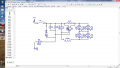
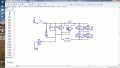
1. if i run the PAM2861 chip at 1 amp output, will each string get 0.5 amp?
2. is it a good idea to connect the strings after the first LED as shown? Someone said it helped balance the current in both strings?
thanks
More information!
It looks like you have 12Volts of LEDs and a 12V supply. Not going to work.
If that is really true you are not regulating and the LED current is low.
PWM in general; Vin=24V, Vout =12V. The current at 24V will be about 1/2 that at the 12V point. If this is true, you will measure 0.6A at 24V to get 1A at 12V. The duty cycle will be at about 50%. The current resistor reads 0.1V.
If you really are running 12V of LEDs from a 12V supply then, Vin=12V at 0.6A, Vout=11V at 0.6A and the PWM=100% duty cycle. The voltage across 0.1 ohm resistor is 0.06V.
It's bad enough that you have parallel strings of LEDs with no ballast resistor for each string. The extra connection exacerbates the problem of unmatched forward voltages.
How bad this is depends on LED specifications (continuous current, peak current, forward voltage spread) and how you're driving them.
Parallel LEDs in inexpensive flashlights is a common practice, but that doesn't mean it's good. I have several where most of the LEDs no longer light.
22 posts and still no schematic. A well-drawn schematic will give us a wealth of information and reduce the need to guess or play 20 questions. Give us a break.
No. I'm saying that your statement that your circuit is exactly like the referenced schematic is incorrect. There are so many exceptions that you should post a schematic of your actual configuration.
EDIT: Moderation merged two threads. The schematic hadn't been posted before my post...

 Facebook
 Google
 GitHub
 Linkedin