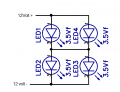
If you could power it from 15V you could put all four in series. (might need a little more, 14.4V out is required.)
If you must use one, just put a 4.7Ω 2W resistor in series with each. That should be pretty safe. I sized it to drop about half the difference between the 12V supply and the 7.2V needed.
He gave a voltage spread of 3.6-3.7V for the forward voltage and I was providing datasheet examples that showed that that wasn't realistic unless he had ones that had forward voltage matching.
Then he said he had LEDs that had been binned for forward voltage, wavelength, and brightness. Which is also unlikely. Binning by brightness is free. Binning by forward voltage would cost more and I've never heard of binning by wavelength. Of course, I hadn't heard about forward voltage binning until a decade ago or so. Maybe that came with the advent of so many inexpensive LED flashlights using LEDs in parallel with no ballast resistors.
He gave a voltage spread of 3.6-3.7V for the forward voltage and I was providing datasheet examples that showed that that wasn't realistic unless he had ones that had forward voltage matching.
Then he said he had LEDs that had been binned for forward voltage, wavelength, and brightness. Which is also unlikely. Binning by brightness is free. Binning by forward voltage would cost more and I've never heard of binning by wavelength. Of course, I hadn't heard about forward voltage binning until a decade ago or so. Maybe that came with the advent of so many inexpensive LED flashlights using LEDs in parallel with no ballast resistors.
If you don't care about variations in brightness, why are you using a driver chip in the first place?
What is it that you are doing with these LEDs? How much can your supply voltage vary by?
Your solution may be nothing more than a series resistor in series with one or two LEDs to make up a string and then enough of those strings in parallel to get the total light output you need.
If you don't care about variations in brightness, why are you using a driver chip in the first place?
What is it that you are doing with these LEDs? How much can your supply voltage vary by?
Your solution may be nothing more than a series resistor in series with one or two LEDs to make up a string and then enough of those strings in parallel to get the total light output you need.
i'm using high power LEDs rated for 1 amp.
these are used on vehicles with 12 volt battery systems and various charging systems.
supply voltage can vary from 11 to 15 volts. that's why i can't use resistors.
i'm using high power LEDs rated for 1 amp.
these are used on vehicles with 12 volt battery systems and various charging systems.
supply voltage can vary from 11 to 15 volts. that's why i can't use resistors.
I do so wish he would give us a part number for these LEDs so that we could look at what they actually are and what the specs actually say. Are these bare LEDs? Do they have current-limiting built into them?
all 4 LEDs are very close to same forward voltage.
they're the same part coming on same reel.
forward voltage is 3.6 to 3.7 volts.
is this close enough that i don't need the resistor?
i don't know how to indicate matched LEDs.
bottom line is - if LEDs are matched and driver chip is producing 1 amp, does each string get 0.5 amp?
thanks
Being next to each other on the same reel does not necessarily mean that they are from the same die or even the same lot of wafers -- but it is pretty likely.
I don't know about your particular LEDs, but if they are not operating in a mode where they have significant linear resistance effects, a change of a one or two hundred millivolts can equate to an order of magnitude difference in current. In addition, unless they are mounted so that they are strongly thermally coupled, the Vf will change significantly if one heats up more than the others.
Bottom line is -- any design that counts on them sharing current equally is a very poor design.
these are used on vehicles with 12 volt battery systems and various charging systems.
supply voltage can vary from 11 to 15 volts. that's why i can't use resistors.
Note that the post I was responding to was specifically talking about just the four LEDs connected as shown directly across a 12 V battery, so no driver chip at all.
And, once again, please provide the part number of the LEDs you are using.
looks like you guys were right.
with the line tying the 2 strings together, 1 side draws .6 amp and the other draws .25 amp.
without the tying line, 1 side draws .51 amp, the other draws .3 amp.
guess i'll be using 2 drivers. i hate to because this requires even more power and cost.
thanks to everyone.

 Facebook
 Google
 GitHub
 Linkedin



 I stand corrected. Misread the post.