Just some general questions about remaking something from the past

Status
Not open for further replies.

Audioguru

Joined Dec 20, 2007
11,248
Audio ICs have a rated "thermal resistance" that shows the heat rise of the chip when the metal tab is held at 25 degrees C. The efficiency is also rated and for a class-AB amplifier IC it is usually about 45% so if the output is 25W then the heating is about 20W.

Audio ICs are usually used with finned heatsinks that also have a rated thermal resistance. The fins release the heat into the ambient air.
A mounting plate makes a poor heatsink. You will not be using the amplifier continuously at full blast. The TDA7396 IC shuts down when it gets too hot. Try it to see.
 

Thread Starter

Berzerker

Joined Jul 29, 2018
623
I got that AG. "x" volume = "x" temperature. The more current supplied to it the hotter it gets. And I posted that when using the mindblower it got so hot you could not touch it. at the same time you have to remember that the speaker is oscillating and producing an action like a fan, pushing then pulling the air around it. with a cover designed to allow the air to move in the right spots it would act just like a fan. the more volume you apply the more draw of the air around it. place the IC in a good spot to receive this air flow = "instant fan". it's going to get hot no matter what type of heatsink is used. when I was designing (back in the day) I learned you have to look at everything while you design it. you can't just throw a bunch of parts together "willy nelly" without knowing what will happen to "this" part when "this" part does something else. of course I was in mechanical design not in electronic. it was a little easier to pick and choose parts for this field. electronic parts were bought ready to use and just installed, hence my level of electronic expertise.

Thanks for posting AG.
 

Audioguru

Joined Dec 20, 2007
11,248
The chip inside a linear amplifier IC gets very hot which causes its metal tab to get hot. The metal tab conducts most of its heat to a heatsink that conducts some of its heat to the ambient air. A fan can be used to bring cool air and blow away the warmed air. A speaker is not a fan since it moves only a small amount back and forth.

The propeller on my model airplane makes an excellent fan when running in one direction. But the motor goes back and forth and plays a tune when its speed controller initialises. When the propeller goes back and forth like a speaker cone then you cannot feel any air movement.

A class-D amplifier IC switches on and off so it does not get hot. Some pretty good class-D amplifier ICs are available.
 

Thread Starter

Berzerker

Joined Jul 29, 2018
623
shortbus said:
A few minutes of searching comes up with this, sure there must be more out there. Before you say no, read the description. https://www.ledsupply.com/led-heats...MIzPP5htqc3gIVT-DICh2USQz8EAQYASABEgIMyPD_BwE
Now that's not a bad idea shortbus. it's a pre-made box and heatsink all in one! my mounting ring could still be bolted on and be far enough away not to get hot. I "WILL" look at this further and add one in my drawings. This may have been enough to pull me out of my slump. it looks cool and if it does get a little too hot a mini-fan can be used to dissipate it. I might need to get off my butt and start looking for alternative ways instead of trying to solve my problems with what I have on hand. they can be cut to size and I might can get away with even a smaller size unit than what I have now.

THANK YOU shortbus!
 

Thread Starter

Berzerker

Joined Jul 29, 2018
623
AG said:
The chip inside a linear amplifier IC gets very hot which causes its metal tab to get hot. The metal tab conducts most of its heat to a heatsink that conducts some of its heat to the ambient air. A fan can be used to bring cool air and blow away the warmed air. A speaker is not a fan since it moves only a small amount back and forth.

The propeller on my model airplane makes an excellent fan when running in one direction. But the motor goes back and forth and plays a tune when its speed controller initialises. When the propeller goes back and forth like a speaker cone then you cannot feel any air movement.

A class-D amplifier IC switches on and off so it does not get hot. Some pretty good class-D amplifier ICs are available
I disagree AG on how much air flow could be made by a speaker moving back and forth. as I said it would rely on how the cover is designed?
think of it this way, you've seen people with a hand fan like they use in church! even with that little motion the wind moves at a rate that it cools you down. now move that at the rate of a speaker and you pretty much got ten times or more that. they place air holes in home stereo enclosed speakers for this reason. have you ever held your hand to one of these holes? don't know about yours but I feel mine just fine.

Now this also can't be the same AG that in earlier post when I asked about class-D IC's went on a rant about how bad they were is it?
I remember posting about how many more watts you could get from them and all I got back was distortion, distortion, distortion.
 

Thread Starter

Berzerker

Joined Jul 29, 2018
623
Shot them an e-mail shortbus to see if they have a datasheet for slot dimensions and such. didn't see one on the website. also noticed it said they were for fish tanks but it also says it can handle up to 100w of heat.
 

Audioguru

Joined Dec 20, 2007
11,248
Many speaker enclosures have a duct or port (usually not a hole) designed to resonate with the size of the enclosure and stiffness of the speaker suspension to add to and deepen the bass response. What you feel is air vibrations or a puff of air for each drum beat. It does not produce cooling for the speaker. Lookup "bass reflex speaker enclosure".

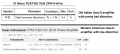
Some class-D amplifiers sound pretty good but others sound awful:
 

Attachments

Thread Starter

Berzerker

Joined Jul 29, 2018
623
Yea but that one is only 25 watts. right now I'm looking at 65 watts for the one I'm building. the original didn't even have that much.
that "puff" of air goes both ways in a push and pull type of movement and not only is the bass part you feel. bass is felt in vibration. as the speaker vibrates is distorts the air around it causing it to move. I think I seen one D-class IC that boasts 80 watts if I remember correct. but as you pointed out how hard it would be to solder. shortbus got me thinking and I'm even looking at flat heatsinks. The one that goes to the converter has some kind of adhesive to hold it on and then there is always gorilla glue or high heat glue to hold it to the speaker.
 

Audioguru

Joined Dec 20, 2007
11,248
The datasheet of your TDA7396 amplifier IC with a 14.4 supply driving a 2 ohm speaker lists low distortion up to 20W. The 1% obvious distortion is with an output of 35W. A graph shows 42W with a 16V supply and 1% obvious distortion and shows 53W with horrible 10% distortion. With full overdrive so that the output is squarewaves with as much power in the distortion as in the low distortion output then the power with a 16V supply into a 2 ohm speaker is about 70 Whats.
 

Thread Starter

Berzerker

Joined Jul 29, 2018
623
I was just quoting the datasheet 65 watts @ 2 ohms. even 42 watts is more than the original. I never thought the mindblower sounded bad when it was cranked up all the way. I was more interested in listening to the music than the distortion. all amps have distortion it just matters how much the louder you get.
 

Audioguru

Joined Dec 20, 2007
11,248
A half-decent hifi amplifier has no audible distortion until it is turned up too high causing clipping. Then you hear the music without any distortion. The TDA7396 amplifier you have produces low distortion up to only 20W into 2 ohms with a 14.4V supply. It might produce low distortion up to 25W into 2 ohms with your boosted 16V supply.

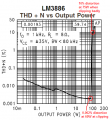
Here is a graph of the very low distortion and noise of an LM3886 hifi amplifier IC. Its distortion is less than its extremely low noise at low levels and when it almost is clipping its distortion is only 0.002% which is much lower than your TDA7396 amplifier IC when it is almost clipping.
Many people can hear 1% distortion and a few people can hear 0.1% distortion.
 

Attachments

Thread Starter

Berzerker

Joined Jul 29, 2018
623
even at 10% distortion that gives you 90% good music at full volume. I've been around those cars that shake the earth and can't understand a word the artist saying. you will hear a couple of words like "I don't" then "BOOOM", then there's a spot there that you know words are but you can't hear them that's even worse to me! when the bass over runs all the other instruments combined to me that's distortion. a little fuzz or crackle in the background I hardly notice. I guess its from growing up with AM radio and you just tune it out.
I meant to ask you AG the pull up resistor that's hook to pin #4 do I need a pad for it?
I know it will be useful if I ever decide to use it in the future but it doesn't attach to anything so why place a pad.
 
Last edited:

shortbus

Joined Sep 30, 2009
10,049
also noticed it said they were for fish tanks
That is one of their uses. but they don't go in the fish tank. They are for the LED lights people use above the tank, like a lid, to mimic the day light, the way the sun goes from dark to light and back again.
 

Thread Starter

Berzerker

Joined Jul 29, 2018
623
shortbus said:
That is one of their uses. but they don't go in the fish tank. They are for the LED lights people use above the tank, like a lid, to mimic the day light, the way the sun goes from dark to light and back again.
Yea I know shortbus. I read the whole page that's where I got the 100W of heat. I liked the configuration of the box, I liked the look of the box. I'm still waiting for an e-mail to see if they have a datasheet on it. you taught me datasheets are important not only for dimensions but all the info you need to make a decision. I haven't stopped looking at them I would just like some more information. then I was pausing and thinking and looked down at the converter sitting beside me and the flat heatsink and said you were right. I picked one heatsink and never really looked at all the others, now I am!
Again Thanks shortbus.
 

Audioguru

Joined Dec 20, 2007
11,248
even at 10% distortion that gives you 90% good music at full volume. I guess its from growing up with AM radio and you just tune it out.
10% distortion sounds awful with real music but is fine with acid rock that is 50% distortion. I hope you mean that "full volume" is just before clipping occurs.
I never listen to muffled AM radio. It removes all high audio frequencies and replaces them with distortion.

I meant to ask you AG the pull up resistor that's hook to pin #4 do I need a pad for it?
I know it will be useful if I ever decide to use it in the future but it doesn't attach to anything so why place a pad.
Pin 4 gives a warning signal that a problem is occurring. The datasheet does not say its maximum allowed current but the high value resistors they show feeding a micro-controller indicate that it cannot drive an LED. You will not use a warning LED on the speaker anyway so you probably will never use pin 4.
 

Thread Starter

Berzerker

Joined Jul 29, 2018
623
AG post #545 said:
Yes, the remote wire from a car radio will turn this amplifier on and off.
Pin 4 is a diagnostics output that can be powered by a 10k resistor from 5V to VS. The block diagram has LTS DISABLE connected to it so it might need the 10k resistor even if you do not use diagnostics.
Now I'm confused..:confused:
Not fussing AG but in my world you can't keep giving different wattages and answers. it is either this or that. you can't say one thing one post and change it later on. and I love acid rock. I don't listen the country cause it's always my girl left me, my dog died, my truck broke down or some sort of drag me down lyrics. I love life and don't care about hearing anything negative in a song. I also like alterative music even at my age i.e. the post about Avenged Seven Fold, Thirty seconds to Mars, Panic at the Disco, Fallout Boy etc.

MrChips said:
Your math is impeccable!:rolleyes:
Why thank you MrChips. although I was being a little sarcastic and was trying to make a point that even though there is distortion not all people pay it that much attention. That's why I mentioned the amps that all you hear is the "bass".
MrChips said:
However, the perception of sound does not work that way!
No I wouldn't like to hear a loud squeal or awkward sound in my music. with all the distortion the original mindblower had I still never paid it that much attention. I thought then and still think now they sounded great.
 
Last edited:

Thread Starter

Berzerker

Joined Jul 29, 2018
623
@shortbus, got the e-mail from makers heatsink finally. the drawing they sent me was awful about dimensions. there were only 5 on the whole print. four had nothing to do with my question. but being great at math as MrChips pointed out....;) I extrapolated the slots are about .740 thousands apart.
 
Last edited:

Audioguru

Joined Dec 20, 2007
11,248
even though there is distortion not all people pay it that much attention. That's why I mentioned the amps that all you hear is the "bass".
Then you have a hearing problem like most electric geeetar players and old people like me (I am 73) and maybe you. I have hearing aids that allow me to hear high audio frequencies like when I was young.
Distortion is added harmonics at high frequencies that you cannot hear but everybody with normal hearing can hear. AM radio has no high frequencies which is why you like it because you do not notice that all the high audio frequencies are missing and replaced with high frequency distortion harmonics that you cannot hear.
Acid rock has a lot of high frequency distortion harmonics that the players and you cannot hear.

I also do not like "hee haw" country music that is for hillbillies.
 
Status
Not open for further replies.
Top