Issue in MOSFET

Irving

Joined Jan 30, 2016
5,123
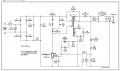
Agreed 2. Been playing with an LTSpice simulation. Its incredibly sensitive to actual inductance values, more often than not, it won't start, or starts after 20mS or so of the MOSFET partly on and burning up.. And when it does run the MOSFET is usually dissipating far more than the output load! Its hugely inefficient most of the time. Not worth wasting time on. Get one of the TNY100 or TNY200 chips - they just work, often with a far lower component count.
1684262372535.png
 

Attachments

schmitt trigger

Joined Jul 12, 2010
2,089
Can any one tell is optocoupler is important for smps circuit ?
The optocoupler provides a path for the feedback loop, while simultaneously isolating the low voltage secondary side from the high voltage primary side.

There are other methods to achieve this function, but an optocoupler is usually the lowest cost.
 

Janis59

Joined Aug 21, 2017
1,894
Danyk.cz is guy whose circuits always are working. The problem must be hidden in details. First on the tongue - cant it be the transformer have been phased that both bobbins is one against other, what is virtual short-circuit?? Try to solder instead of transformer just the incandescent lamp. If then everything happens well, means re-phase windings.
 

Irving

Joined Jan 30, 2016
5,123
We have bought a customised transformer with the attached description....is energy for primary and secondary are same ?
The transformer is probably your problem.... In the original article the transformer ratios were 30:3:5, with 2 x primaries in series. Unfortunately there isn't enough info about the core to work out the inductance. Your transformer is being used with primaries in parallel, but we have no turns info only the inductance at 450uH for the two primary coils in parallel (implying each is 450uH assuming 100% coupling), and a turns ratio of 1 primary to feedback of 11:1 and 1 primary to 2 paralleled secondaries of 7:1, which suggests feedback winding of 3.7uH and output winding(s) of 9.2uH.

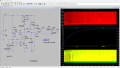
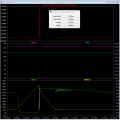
Putting this into a simulation gives the first screenshot below. On the face of it, it appears to work, albeit the output is low at 15v/3A, though the top trace, showing average MOSFET dissipation is ominous. Its only when you look more closely... the second screenshot... that shows the issue... The MOSFET isn't really being turned off, or rather, isn't being held off long enough for the collapse of the magnetic field to reduce the drain current. The snubber seems toi having little effect and the turn-off pulse is not long enough to dissipate the gate charge. Looking at the top trace, and ignoring the tiny turn-on power pulse, the turn-off power pulse is 3.4uS in a 20.6uS cycle and is 1.7kW high. Equating the area under the triangle to a square pulse we can say its an 850W pulse lasting 3.5uS. From the datasheet's transient thermal impedance chart that equates, roughly, to a junction temperature of 55degC above the case temperature. There are various way to calculate the case temperature but I'll use the average wattage of 115W. Assuming a junction temperature of 150degC and an ambient of 30degC that requires a heat-sink of (150-55-30)/115 = 65/115 = ~0.56degC/W, that's a substantial heat-sink (and I'll bet you aren't using any heat-sinking). Clearly you need more energy in the turn off pulse. Increasing the value of the feedback capacitor C2 might help, but will drop the operating frequency below 50kHz. You will probably need to play with the bias resistors R2 and R3. R3/C2 affects the frequency along with the transformer primary inductance. I suspect the snubber resistance is too high as well. D4 doesn't appear to do much.

Given the inefficiency of this circuit, I can't much point in keeping trying.... there are better options. I've attached the ASC and LIB files in case anyone wants to play.

1684420095768.png
1684425693244.png
 

Attachments

Thread Starter

m_np

Joined Mar 13, 2023
17
The transformer is probably your problem.... In the original article the transformer ratios were 30:3:5, with 2 x primaries in series. Unfortunately there isn't enough info about the core to work out the inductance. Your transformer is being used with primaries in parallel, but we have no turns info only the inductance at 450uH for the two primary coils in parallel (implying each is 450uH assuming 100% coupling), and a turns ratio of 1 primary to feedback of 11:1 and 1 primary to 2 paralleled secondaries of 7:1, which suggests feedback winding of 3.7uH and output winding(s) of 9.2uH.

Putting this into a simulation gives the first screenshot below. On the face of it, it appears to work, albeit the output is low at 15v/3A, though the top trace, showing average MOSFET dissipation is ominous. Its only when you look more closely... the second screenshot... that shows the issue... The MOSFET isn't really being turned off, or rather, isn't being held off long enough for the collapse of the magnetic field to reduce the drain current. The snubber seems toi having little effect and the turn-off pulse is not long enough to dissipate the gate charge. Looking at the top trace, and ignoring the tiny turn-on power pulse, the turn-off power pulse is 3.4uS in a 20.6uS cycle and is 1.7kW high. Equating the area under the triangle to a square pulse we can say its an 850W pulse lasting 3.5uS. From the datasheet's transient thermal impedance chart that equates, roughly, to a junction temperature of 55degC above the case temperature. There are various way to calculate the case temperature but I'll use the average wattage of 115W. Assuming a junction temperature of 150degC and an ambient of 30degC that requires a heat-sink of (150-55-30)/115 = 65/115 = ~0.56degC/W, that's a substantial heat-sink (and I'll bet you aren't using any heat-sinking). Clearly you need more energy in the turn off pulse. Increasing the value of the feedback capacitor C2 might help, but will drop the operating frequency below 50kHz. You will probably need to play with the bias resistors R2 and R3. R3/C2 affects the frequency along with the transformer primary inductance. I suspect the snubber resistance is too high as well. D4 doesn't appear to do much.

Given the inefficiency of this circuit, I can't much point in keeping trying.... there are better options. I've attached the ASC and LIB files in case anyone wants to play.

View attachment 294450
View attachment 294465
Could you help us for resolving the circuit? what are changes to be done in the circuit?
 

Irving

Joined Jan 30, 2016
5,123
Could you help us for resolving the circuit? what are changes to be done in the circuit?
There's nothing I could suggest that would justify flogging this dead horse.

Start with a proper SMPS controller from eg TI or Maxim, use their online design tools/simulators, buy a matching transformer for your output requirements from eg Coilcraft or Wurth and you'll have something that's pretty much guaranteed to work first time, will be 85-90% efficient, will have over-voltage & current protection, etc.

Here are 2 reference designs from TI to look at:

160W Primary-Side Regulated Flyback Using UCC28633 Reference Design
https://www.ti.com/tool/PMP30092

50/100-W Flyback reference design for audio applications
https://www.ti.com/tool/PMP21516


I'm not recommending the TNY-design I mentioned in post #21 as 125W is a little high for them...
 
Top