isolation transformer

MisterBill2

Joined Jan 23, 2018
27,522
Once again, the sole purpose of an isolation transformer is ISOLATION. That implies breaking ALL of the connections between the input side and the output side.
Now consider that most, deadly shocks are the result of contact with a single live conductor and "ground", the other side of that voltage source. In an effectively isolated system, then, contact with a single live conductor does not lead to any current flow, since there is no completed circuit. The result is no real shock. Of course, if some unknowing individual breaks the isolation by connecting some part of the isolated system to that ground, a shock will result, because the circuit is no longer isolated.
 

MaxHeadRoom

Joined Jul 18, 2013
30,661
That inherently happens with an autotransformer since one side of the winding is common from input to output.
And you never want to connect neutral to earth ground except at the breaker box.
I was referring to the requirements of a transformer with PRI to SEC isolation.
The OP mentioned a Euro style 240v to 120v transformers, so far we have no exact particulars.
If you have a true isolated transformer then all you need for a grounded neutral is to connect the primary earth conductor to one side of the (e.g. 120v) secondary, from this point, you now have a ground conductor and also a neutral conductor.
Max.
 

crutschow

Joined Mar 14, 2008
38,508
If you have a true isolated transformer then all you need for a grounded neutral is to connect the primary earth conductor to one side of the (e.g. 120v) secondary, from this point, you now have a ground conductor and also a neutral conductor.
I'm confused (or misunderstanding what you are saying).
Isn't the usual purpose of an isolation transformer that the neutral not be grounded?
 

Thread Starter

neospam

Joined Jan 13, 2020
110
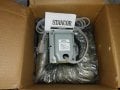
just got me a deal on a Stancor GISD-250. for 20 bucks new. 240v in and 120v out 2.1amp this will work for most stuff currently. Now need to find a deal on a variac.. :)
 

MisterBill2

Joined Jan 23, 2018
27,522
I'm confused (or misunderstanding what you are saying).
Isn't the usual purpose of an isolation transformer that the neutral not be grounded?
Many times the green-wire ground from an audio system must be opened because of HUM problems in the low level circuits. That is an area where a shielded isolation transformer is very useful.
 

Thread Starter

neospam

Joined Jan 13, 2020
110
new here sorry, I seen there are several other threads like this.

starting to collect parts. Got a great deal on a new iso trans 230-115 little over 2amps. 20 bucks :)

When you design a circuit with iso trans and varaic what features can be useful?

no ground from variac to iso transformer - must
direct 120v out plug? (not sure good idea, be 2amp max)
how about a residual-current device?
ground fault receptacle?
switch to make live, maybe a light to show its on?

other useful or safety devices?
 

Attachments

Last edited:

MisterBill2

Joined Jan 23, 2018
27,522
new here sorry, I seen there are several other threads like this.

starting to collect parts. Got a great deal on a new iso trans 230-115 little over 2amps. 20 bucks :)

When you design a circuit with iso trans and varaic what features can be useful?

no ground from variac to iso transformer - must
direct 120v out plug? (not sure good idea, be 2amp max)
how about a residual-current device?
ground fault receptacle?
switch to make live, maybe a light to show its on?

other useful or safety devices?
An AC outlet and a pair of terminals set at the standard spacing will be very handy. An output fuse at the rated brush current will help preserve the Variac in the event of dumb mistakes. An ON/OFF switch at the power input is very useful, and another switch after a set of meter terminals can allow setting the voltage prior to switching the output voltage on. If you are adding an enclosure then a voltmeter and ammeter would be handy additions.
Going all-out would add a bridge rectifier and a filter so that it could also provide a variable DC output. Beyond those possibilities I can't think of what else may be good.
A Ground Fault Interrupter on an isolated output would be totally useless. Think about it: an isolated circuit is intrinsicly NOT tied to ground.
 
Last edited:
My take: pick or choose options)

I made my variac some 50 years ago when I was a teen. 3 A Variac (free), 15 A isolation transformer. $15.00)
Messed up the upper end, didn't fuse the wiper. Isolation was added many years later.

I used the isolation xformer for doing 2 prong polarized TV's where all of the filiments adde dup to the line voltage and audion amplifers where the variac was more important.

No 3 prong isolation and I don;t know how I handled ground.

There is nothing wrong with re-bonding ground to your new neutral after isolation I'll have to look at the schematic of the big sencore unit to see what they did. I ordered a manual/schematic for the heck of it. There maybe a mention of ground lifting.

1. NEMA 3 prong receptacle
2. Binding posts, including ground
3. Voltmeter
4. Ammeter
5. Wattmeter
6. Programmable Electronic fuse
7. Panel mounted wiper fuse. (very important) You MUST fuse the wiper.
8. Rear mounted fuse at rated voltage. (Sencore did this. I did too.)
9. Indicator that the variac is in use even when set to 0V. Sometimes difficult to achieve. I wish I had this option.
My case is tight for options. I was maybe 10-13 years old.
10. Since my isolation xformer was rated at 10 A and my variac at 3A, I can go isolation only.
I used a center-off switch. Not good.
11. Isolation transformer was external. Did not take up bench space.
12, Incorporate a leakage tester. Allows one to probe exposed metal parts.
13. GFCI, RCD or whatever.
14. Incorporate a dim bulb tester. https://antiqueradio.org/dimbulb.htm
15. 120/240 capable.
Using the variac first would allow 0-120 AND 0-240 V.
 
Last edited:

SamR

Joined Mar 19, 2019
5,491
Does the variac come first from the mains or the isolation transformer when using both? The 3-prong cord set goes into the isolators primary. Newer models may have the safety ground tied to the secondaries receptacle ground socket. Should this be cut out or what else can you do for protection?
 
Here is a video about Sencore's big brother.

This video does say that you can cut ground.

As I see it, if you put the variac first and with the proper transformer. you can have two supplies 0-120 and 0-240 with one input.

If you connect the Earth to the secondary new neutral, you have an isolated neutral which is a good thing. Earth is still doing what it's supposed to do - always.

It's not the ground your trying to break, but the neutral connection you want to break.

Dual outputs I never thought through, but the variac on the primary of the isolation xformer makes sense.

You also need to be carefull because some transformers may have a third wire, but it;s for an electrostatic shield.
 
Think about it: an isolated circuit is intrinsicly NOT tied to ground.
I think that is a misconception.

You really don;t want your DUT to have it's case live. A three prong switchmode power supply will easy make ground 60V AC. Ran into this many times and tried to understand it and I do. when ground isn't connected to neutral-2 on the DUT side. I know it's a bad choice of words.
 

MisterBill2

Joined Jan 23, 2018
27,522
Try to get rid of the green-wire induced buzz when the PA amplifier is on the same ground line as a number of triac dimmed lights. With a shared green-wire ground but no common neutral or line, all of the noise was entering via that safety ground line. Opening the green-wire ground connection removed the buzz.
 
Top