Isolation transformer issue?

Thread Starter

bxdobs

Joined May 11, 2014
32
I have been using 2 Hammond 172B 220VAC to 120VAC isolation transformers back to back to provide a 120VAC isolation circuit for years ... these transformers were physically mounted to my work bench making it difficult to work on some projects ... so, the other day I decided to combine these and an auto transformer into a portable test box.

2 Transformers T1 and T2 ... hooked primary (220VAC) of T1 to primary (220VAC) of T2 ... AC Mains 120VAC L and N attached to Secondary of T1 ... issue even though the spec on these devices is 2KV isolation I get the following readings with a Fluke AC RMS meter:

3VAC from T2 Secondary N to T1 Secondary N
80VAC from T2 Secondary N to T1 Secondary L
150VAC from T2 Secondary L to T1 Secondary L

Note: the shields of both T1 and T2 are still connected to chassis ... chassis is NOT connected to Ground/Earth (green/copper of mains) ... there is no electrical connection between primary, secondary or chassis

All 3 transformers are mounted in a Hammond Case which has a steel shell and aluminum front and back panels.

Wondering that because these transformers are now mounted in the same box side by side whether these reading are due to magnetic coupling

Would adding shields to separate the 3 transformers (1 auto and 2 172B) reduce the magnetic coupling or is 60Hz going to couple through the steel case regardless of any shielding.
 

#12

Joined Nov 30, 2010
18,224
I think you're measuring capacitive coupling with a high impedance meter.
Try loading down the voltage with a resistor across your meter leads. About 220k 1/4 watt should show you some new information.
 

Thread Starter

bxdobs

Joined May 11, 2014
32
OK, with 330K across my meter leads I am reading 5 VAC RMS ... so where should I expect this capacitive coupling to be coming from? Would this be a concern for future measurements using a scope on some isolated (unit under test) ... is there any way to decouple this capacitance ie using a Varistor or possibly a 1 Meg Resistor to Chassis from the Isolated L?
 

AlbertHall

Joined Jun 4, 2014
12,625
To eliminate the coupling you can earth one end of the transformer output - though this to some extent undoes the point of isolating in the first place. However as far as connecting a scope goes, the ground clip of the scope probe is generally earthed, so connecting that ground clip will also undo the isolation and you will get no sensible readings with the scope without connecting the ground clip.
 

#12

Joined Nov 30, 2010
18,224
you will get no sensible readings with the scope without connecting the ground lead of the test probe.
I can isolate my scope by lifting the bond pin.;)
with 330K across my meter leads I am reading 5 VAC RMS
Is that 5V in the place where you saw 150v?
the shields of both T1 and T2 are still connected to chassis ... chassis is NOT connected to Ground/Earth
is there any way to decouple this capacitance
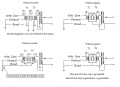
I really worked hard on this drawing, but anybody is welcome to correct me if I missed something.
 

Attachments

Thread Starter

bxdobs

Joined May 11, 2014
32
I can isolate my scope by lifting the bond pin.;)

Is that 5V in the place where you saw 150v?


I really worked hard on this drawing, but anybody is welcome to correct me if I missed something.
Thanx for the drawing ... the bond point from mains is disconnected from this Box so the Chassis is floating which means all the so called grounds are only to the chassis of the box ... all 3 measuring points with the 330K parallel resistance read 5VAC: Ns1-Ns2, Ls1-Ns2, Ls1-Ls2
 

Thread Starter

bxdobs

Joined May 11, 2014
32
Update:

Removed physical Earth/Ground connections to chassis via 2 panel mount AC receptacles (one connects to the auto transformer and the other connects directly to T2 secondary) then reattached Earth/Ground from the MAINS (matching #12's second drawing)

Using a 330K parallel resistor to fluke 77 meter VAC rms mode still reading:

1.5 VAC rms from Mains N to Isolated N
1.5 VAC rms from Mains G to Isolated N
5 VAC rms from Mains L to Isolated L
5 VAC rms from Mains N to Isolate L

Basically not seeing much difference between Isolating the Ground from Isolated Side vs Mains Side of circuit ... thinking other then the capacitive coupling effect, which may result in the introduction of some very low stray ac currents, there doesn't appear to be any other difference between cutting the ground from one side or the other of the isolation circuit

For the past 20+ years, I have used these 2 transformers back to back on my bench with the mains ground disconnected to isolate my 30+ year old Tektronix Scope when working on Power Supplies, Video Monitors and things like X10 power line modules. This was done to protect the Scope and Scope Probes from any potential shorting of the Scope's Ground to MAINS ... in the past I have also used the Auto Transformer to knock down the AC input voltages to some devices under test. While personal safety is one aspect of using isolation, I was more concerned with potentially damaging a Scope that I could not afford to replace. It shouldn't take more then one shocking experience for anyone who works with Electronics to quickly gain a healthy respect for the power of electrons. I have seen first hand what can happen to both tools and people when electrons aren't respected.

Having now put all these 3 Transformers in one box and reading some various online comments ... it would appear that some people keep their test equipment plugged it to the MAINS and use the Isolation Transformers to power units under test ... being I only have 200VA available with the Hammond 172B, that kind of limits the type of units I can test to under 200Watts. The next project I have lined up is with a 600W Power/Invertor Supply which is buried in the bowels of an RV ... this project was the inspiration for making the isolator portable.

Thanks everyone ... I truly appreciate the feedback
 
Top