The continuous (mis)use of the term "ground" no longer surprises me, but occasionally overwhelms me none the less. It is also probably the source of the most confusion to those near the beginning stages of electrical knowledge.
(Some expect this sort of reply from me, but the idea of suppressing or correcting the use of "ground" where it is unnecessary or confusing is not my own.)
Sometimes merely prompting someone struggling to understand the current or voltage in a given circuit to either connect or disconnect some point in that circuit to/from a true, physically verifiable ground can help their "virtual lights come on".
Think about that Johny. Do you have a common "plane"? Common to what? Is it actually isolated? Should it be? From what?
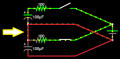
To make this clearer to an old one like me. You started with two capacitors in series, now they are batteries?
You make it sound like you have a variable supply and it will change dependent upon the charge needed so not to damage the battery.
And you want to charge one battery at a time. Why only one, what is the other battery doing while the other is charging? Why not charge them both at the same time, but not in series?
They make a simple inverting regulator. If you input 3.7 vdc you get the -3.7 vdc out. 5.5 = -5.5, etc. here is one from 1.5 vdc up to 5.5V and 200ma for cheap. http://www.ebay.com/itm/LM2662-Swit...153598?hash=item33d4d6697e:g:J5cAAOSw8VJZkvhb
You hook the power supply with the positive to the most positive connection of the series batteries. Put the negative lead to the common connection between the batteries. You also attach the positive power supply connector to the input of the inverting regulator, it's ground connection to the common used by the power supply, and the negative output to the most negative terminal of the series batteries. Instead of isolated grounds, you have a common ground with a positive and negative supply.
To use just 1 switch/cell, i'd have to keep the ground-lead of each cell connected to ground of the charger permanently. Instead of moving the ground from cell to cell as i charge, I would only switch out the hot lead.
If you "keep the ground-lead of each cell connected to ground of the charger permanently" (i.e., the red node) then you short out the bottom capacitor.
You can use circuits, such as flying capacitor circuits and other charge pump circuits, to create either a more positive voltage or a negative voltage (largely the same thing, just a different perspective).
The sim i'm using cannot model battery chargers. I'm substituting caps for the sake of discussion. I understand with batteries there will be resistance that is not included in my rough model using caps.
You make it sound like you have a variable supply and it will change dependent upon the charge needed so not to damage the battery. And you want to charge one battery at a time.
Why not charge them both at the same time, but not in series? ...You hook the power supply with the positive to the most positive connection of the series batteries.
If you "keep the ground-lead of each cell connected to ground of the charger permanently" (i.e., the red node) then you short out the bottom capacitor.

 Facebook
 Google
 GitHub
 Linkedin