Turns out I understood the datasheet wrong, but I also think I did not explain this correctly.
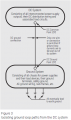
Suppose a power supply has a normally galvanic isolated output. If the manufacturer wanted to allow the user to have the output ground be the same as the input ground, how could this be implemented? Which components could be used as this switch to connect the grounds?
One Big problem is when Ground is used, it is often never indicated as to whether this refers to chassis GND or Earth GND.
Even the earth GND symbol is used indiscriminately.
What you need to ascertain is if earth GND is meant, does this cause any safety hazards, as well as circuit malfunction.
What is grounded ? The output (+) or the (-) ? Any grounding means not isolated. At either the supply output or at the powered device. If isolated, none (+) or the (-) is grounded anywhere.
The ground connection itself, if it is connected to chassis is not isolated either. If connected to mains ground is not isolated either, it is grounded..
The Input (mains?) for the supply has its neutral grounded by the utility. So it is not isolated either.
Isolated ? From what ? Do you mean 'floating' ?
Why the religious fixation of always tying things to "Ground"? Tying one side of any voltage source to a universally common "ground" assures that any contacting the opposite side will get the full voltage applied to themselves. And only one accidental connection to achieve that. With an isolated voltage source, contacting any one point will not complete a circuit and so no shock current will flow. That second connection has been made much less likely by not tying the one side to the universal common.
Over the years, In building electrical control enclosures I have always used the practice where possible of making all supplies common to a Star Point GND which also has the supply Earth conductor terminated.
Many DIY instructions often specify keeping them all separate, I believe this is just to play safe, IOW they do not want the uninitiated to connect to anything that may cause a problem and their equipment gets blamed.
Certainly it is good to avoid causing problems, especially in equipment produced for others, for a price.
Being aware of when a "Star Point" is appropriate and where it is not requires a bit of understanding both what the different circuits are doing and understanding how they are working with each other. That level of insight is often the result of both learning and study.
I have been a member of the CNCzone, for some yrs now, one of the larger forums out there,
There is a high % of DIY',ers that have limited knowledge of electrical/electronics, and at least once or twice a month there is somebody who is having trouble with spurious noise issues.
This takes the form of a limit SW shown being triggered with no striker anywhere close.
This is invariably due to all the system separate sections kept separate. making it prone to random noise issues.
When instructed to try setting up a common Star point earth GND this invariably cures the issue !
There is a place to use start points to avoid noise issues and a place to avoid commoning things as well. It all depends on the situation and the noise source. Mostly, a proper star point is the fix.

 Facebook
 Google
 GitHub
 Linkedin