Isolated Balacing Battery charger

Thread Starter

magudaman

Joined Feb 27, 2012
39
I have a 5 series cell lithium battery pack I want to charge/balance by charging each cell individually while the pack remains in series.

To do this I am using a single cell charger chip MCP7381, 5 of them. Datasheet is here:
http://www.microchip.com/mymicrochip/filehandler.aspx?ddocname=en528273

To keep the circuits from interacting I have 5x MEU1S0505ZC isolated DC/DC converters to feed each charging chip. You can find the data sheet here:
http://power.murata.com/data/power/ncl/kdc_meu1.pdf

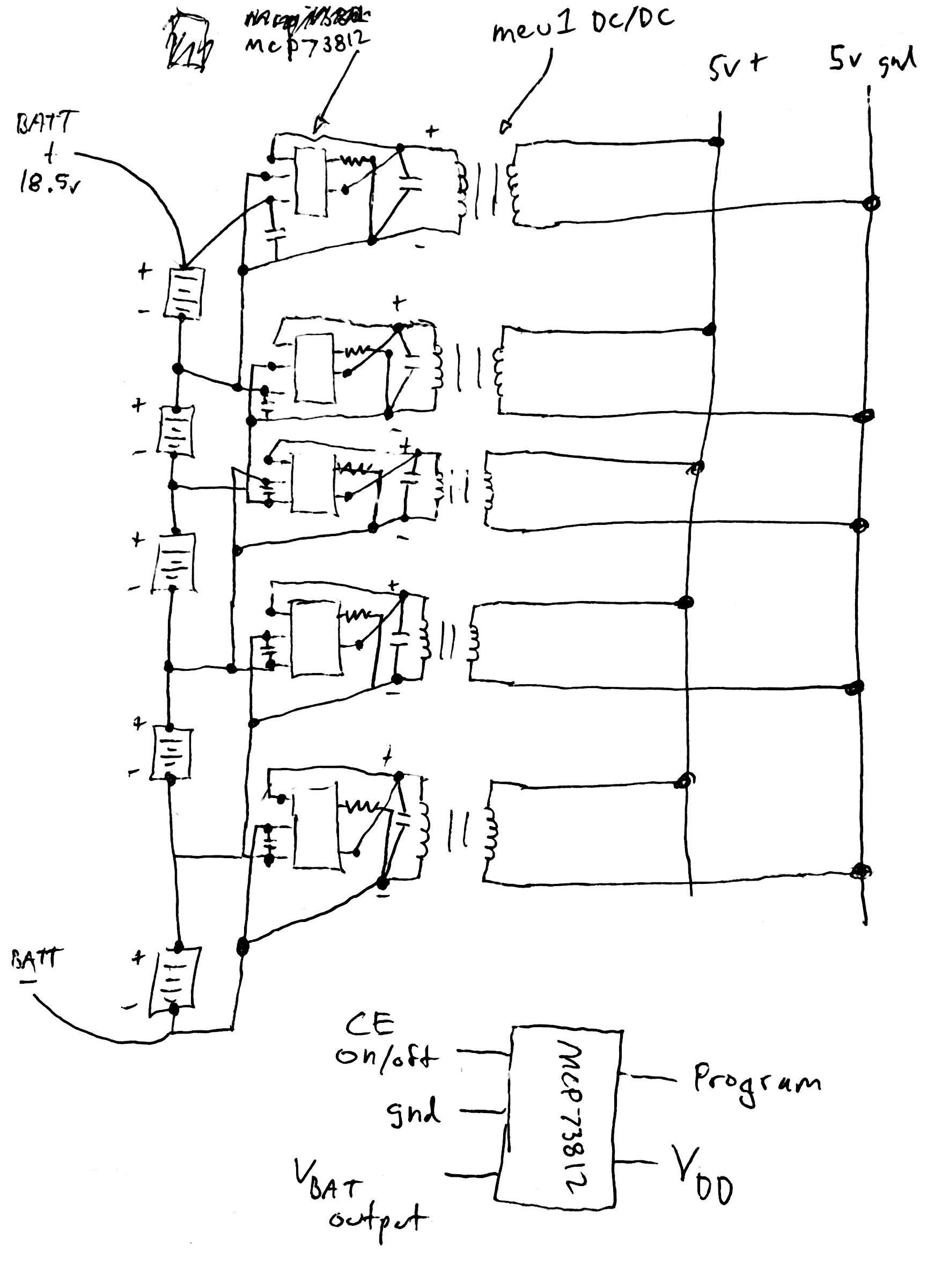
Each charger set has two capacitors, one on the input and one on the output, then a 5.1K resistor to set the charger current at ~200ma

Here is a rough drawing of the circuit:


Here is the completed board I made:


SO I got all soldered up and as I connected to last cell I accidentally made a short which I believe caused a cascading failure but I am not sure. I am worried the short was not the source of my failure and instead I may have had a common mode voltage that may be cooking the charger boards.

Do you see any issues with my circuit drawing?
 
Last edited:

tcmtech

Joined Nov 4, 2013
2,867
That would do it. Schematic symbols are a written language and if the wrong symbol is used the wrong meaning for the circuit is produced.

If you draw it wrong we read it as wrong and thusly can't troubleshoot it effectively. :oops:

I don't follow the rationale for using a complex individually isolated charging method for a basic multi cell battery that a common and far simpler boost converter and charge balancer circuit would do just as well with far less parts involved.
 

Thread Starter

magudaman

Joined Feb 27, 2012
39
That would do it. Schematic symbols are a written language and if the wrong symbol is used the wrong meaning for the circuit is produced.

If you draw it wrong we read it as wrong and thusly can't troubleshoot it effectively. :oops:

I don't follow the rationale for using a complex individually isolated charging method for a basic multi cell battery that a common and far simpler boost converter and charge balancer circuit would do just as well with far less parts involved.
I am looking around but not seeing what I would use for a symbol as isolated DC/DC, maybe just two squares with input on one side, isolation line and output other other side.

I have very limited amount of volumetric space in my application. The smallest boost converters I found did not have constant current mode, just constant voltage, I had to go up in size to find ones that would do constant current. Then the other issue was battery management boards that have balancing functionality are also quite large and setup for higher currents like 30a.

The circuit is not really that many components, each block contains 5 total parts and we have 5 blocks so 25 total components (not counting the DC/DC which are potted). If we counted the parts in the boost converter and balancing BMS I sure that would amount to more parts.
 

ronv

Joined Nov 12, 2008
3,770
I am looking around but not seeing what I would use for a symbol as isolated DC/DC, maybe just two squares with input on one side, isolation line and output other other side.

I have very limited amount of volumetric space in my application. The smallest boost converters I found did not have constant current mode, just constant voltage, I had to go up in size to find ones that would do constant current. Then the other issue was battery management boards that have balancing functionality are also quite large and setup for higher currents like 30a.

The circuit is not really that many components, each block contains 5 total parts and we have 5 blocks so 25 total components (not counting the DC/DC which are potted). If we counted the parts in the boost converter and balancing BMS I sure that would amount to more parts.
Seems like it should work.:)
 

Thread Starter

magudaman

Joined Feb 27, 2012
39
Seems like it should work.:)
Well you were correct! I replaced the charger boards and the capacitors on the outputs with 25v versions (just in case) and very carefully made my solders. I tested it last night and all cells came up to 4.20v +-0.02v. The charger board consumes 1.2 amps at 5v input. Left it overnight connected with no supply power and the next morning the batteries didn't discharge (they shouldn't but had to make sure). All around it was success.

Thank you everyone for your help!
 
Top