Is this isolated

Thread Starter

tinkering

Joined Apr 17, 2017
4
I have an electronics background, but some of this is pretty rusty. Can someone help me with this?

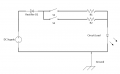
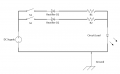
In the circuit provided, will the values of R1 and R2 be calculated as parallel resistors, or will they be single resistors due to isolation from the diodes?upload_2017-4-17_9-56-49.png
 

ian field

Joined Oct 27, 2012
6,536
I have an electronics background, but some of this is pretty rusty. Can someone help me with this?

In the circuit provided, will the values of R1 and R2 be calculated as parallel resistors, or will they be single resistors due to isolation from the diodes?View attachment 124894
If you're working with very low voltage; the diode forward volt drop will mess up your calculations for parallel resistance.

Its about 0.7V for silicon diodes, shottky-barrier come in around 0.2V or so.

For supplies above about 12V, it might not matter.
 

Thread Starter

tinkering

Joined Apr 17, 2017
4
Thanks everyone. Your answers are what i was thinking, but I just couldn't get my head completely around it. Yes, this is an automotive circuit, so the voltage will be between 12.5 and 15VDC, depending on the charge/load state and the vehicle specifics. This is a simplified version of a much more elaborate circuit, where there will also be TVS diodes to protect the LED arrays from the automotive load dump situations.
 

ErnieM

Joined Apr 24, 2011
8,415
When both switches are on the resistors are essentially in parallel. This can result in excessive current into the circuit load.

To prevent that connect the left side of both R1 and R2 to the diodes, then loose R2 so you have a but single resistor. Same current if one or both switches close.
 

Thread Starter

tinkering

Joined Apr 17, 2017
4
Well, like I said, this is a simplified version of the actual circuit I created to exemplify the question. There is a lot more to the actual circuit. The purpose of the two halves of the circuit is to essentially have a high and low intensity of LED arrays. In the low intensity state, only one switch with a higher resistor value will be closed. In the high intensity state, both the switches will be closed, which will introduce the lower value resistor into the circuit, making the LED arrays brighter. This is where I was hitting a mental block as to if the resistors would be isolated by the diodes or not. The diodes are simply there to eliminate the possibility of the user damaging the LEDs by reversing the polarity.
 

Thread Starter

tinkering

Joined Apr 17, 2017
4
Because of the simplification of the circuit created to depict the initial question. I didn't want to create the entire circuit. The complete circuit is much more complex.
 
Top