IR optical receiver system circuit

Thread Starter

LewisMF

Joined Nov 15, 2014
119
Hello!

I'm trying to build a device to measure the obscuration of an IR signal in a free air chamber that will be a few meters accross, between 10 - 50m aprox. This will be used to determine if there are particles in the chamber (dust, fumes, smoke, etc). The chamber will be inside so no direct sunlight but it will be exposed to artificial lighting (fluorecent and incandescent are the most concerning to me).

The device will have a high power 850nm IR LED emitter and a photodiode receiver on one side in the same enclosure, and a reflector on the other side of the chamber.

The IR LED will emit a modulated square wave @ 1kHz with a 10% duty cycle, the light will travel back and forth through the chamber (by reflecting on the reflector) and the receiver will reconstruct the signal and measure the frequency and the amplitude to see how much it has degraded (by obscuration) - this can be done with a microcontroller.

Both the Tx LED and Rx photodiode are optically shielded inside dark cones with NIR band-pass filtered lenses on the optics so visible light is not much of a concern.

I've put together a simple receiver circuit composed of a BPW34 photodiode and an AC coupled TIA followed by a simple HPF:
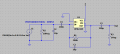
PD TIA.png


Simulations of this circuit have been successful but now I'm having a hard time determining the next building blocks to achieve the above goal, whilst rejecting ambient noise.

I've looked at envelope detection and synchronous detection and I'm inclined more towards synchronous detection but I'm not sure if it is the right approach.

If anyone could help point me in the right direction that would be great, thank you in advanced!
 

ericgibbs

Joined Jan 29, 2010
21,420
hi Lewis,
You state 1kHz frequency with a 10% drive pulse period, consider the distance travelled by a light beam during that 10% period.???

E
 

Thread Starter

LewisMF

Joined Nov 15, 2014
119
hi Lewis,
You state 1kHz frequency with a 10% drive pulse period, consider the distance travelled by a light beam during that 10% period.???

E
Hi Eric, thank you for your reply!

This post is related to one we spoke about some time ago: https://forum.allaboutcircuits.com/...ing-ir-diode-and-photodiode-datasheet.208019/

I'm now building the receiver side. 10% drive pulse period is to be able to drive the LED at higher currents for a shorter period of time to get more optical power at the output. I'm not really sure what you mean by your comment, could you elaborate further?

Thanks once again!
 

ericgibbs

Joined Jan 29, 2010
21,420
hi Lewis,
As you know, light travels at close to 300,000,000 m/sec, so for Emitter On time of 10% of 1kHz is 100uSec.
Are you planning to measure the reflected amplitude for the whole 100uS period, or just the amplitude of the reflected leading edge of the pulse?
E
 

Thread Starter

LewisMF

Joined Nov 15, 2014
119
hi Lewis,
As you know, light travels at close to 300,000,000 m/sec, so for Emitter On time of 10% of 1kHz is 100uSec.
Are you planning to measure the reflected amplitude for the whole 100uS period, or just the amplitude of the reflected leading edge of the pulse?
E
Hi Eric,
Ideally I would like to be able to reconstruct the entire signal as I am interested in the amplitude and the phase.
Do you think that the time it takes light to travel back and forth could be a problem?
Thanks again!
 

ericgibbs

Joined Jan 29, 2010
21,420
Hi Lewis.
What method do you plan to use to create an IR beam transmission amplitude reference, against which you can compare the amplitude of the reflected IR signal?
Also, which type of remote IR beam reflector?
What will be IR transmission beam width?

If the IR light path distance from the TX to the reflector, and return path is also fixed, how do you expect the 'phase' to change?

I would consider using one IR detector, located close to the IR transmitter, slightly off the main beam path, the IR amplitude from this detector being used as the main reference against which the reflected amplitude could be compared.

The project will need to be calibrated after installation.

E
 

meth

Joined May 21, 2016
302
Hello, these devices are commercially available, we have one in our factory that is supposed to be triggered in case of smoke (fire). Unfortunately it is 15 meters above my head and I can't see the manufacturer and the model.

My point was, maybe you can search online for a device and see the specs, maybe the pulse frequency is stated. Your 1kHz seems to be a random number you came up with.. maybe there is more optimal frequency of the IR signal for this exact purpose.
 

Thread Starter

LewisMF

Joined Nov 15, 2014
119
Hi Lewis.
What method do you plan to use to create an IR beam transmission amplitude reference, against which you can compare the amplitude of the reflected IR signal?
Also, which type of remote IR beam reflector?
What will be IR transmission beam width?

If the IR light path distance from the TX to the reflector, and return path is also fixed, how do you expect the 'phase' to change?

I would consider using one IR detector, located close to the IR transmitter, slightly off the main beam path, the IR amplitude from this detector being used as the main reference against which the reflected amplitude could be compared.

The project will need to be calibrated after installation.

E
Hi Eric,
Thank you for your reply.

Regarding the amplitude, the device will be calibrated when the chamber is in a clean condition (no target particles will be present). This amplitude will be saved and used as a reference, so there will be no need to have a second PD.

The reflector will be an Omron E39-R8 reflector for long-range photoelectric sensors.

Beam width would be around 30cm radius at the farthest point (this is not 100% measured but should be approx.)

I am interested in measuring the phase to monitor that no external noise sources are interfering with the phase.

Based on all of this, it does sound like a syncronous detection with a lock-in amplifier should be used. What do you think?
 

Thread Starter

LewisMF

Joined Nov 15, 2014
119
Hello, these devices are commercially available, we have one in our factory that is supposed to be triggered in case of smoke (fire). Unfortunately it is 15 meters above my head and I can't see the manufacturer and the model.

My point was, maybe you can search online for a device and see the specs, maybe the pulse frequency is stated. Your 1kHz seems to be a random number you came up with.. maybe there is more optimal frequency of the IR signal for this exact purpose.
Thanks meth! Yes I have looked into these smoke detectors, I have seen various models online and I see it is very similar to what I need to achieve. 1kHz is not a random number, it is actually the frequency some of them use, I have seen that the ones that do state the frequency of the pulse, operate in the 1 - 3 kHz range.
 
Top