Help understanding IR diode and Photodiode datasheet

Thread Starter

LewisMF

Joined Nov 15, 2014
119
Hello!

I'm working on a project that involves a PCB with an IR diode (emitter) and photodiode (receiver) that will be installed on one side of a chamber. On the other side of the chamber there will be a reflector. The light emitted by the IR diode will cross the chamber, and reflect back onto the emitter.
The purpose of this is to be able to measure particles of different sizes in the chamber by obscuring the light.

For the IR diode I will be using the SFH 4258S for it's high power and narrow beam.
The driver circuit I have designed is a constant current source that can drive it with 0 - 100mA.
What I cannot seem to extract from the datasheet is the relationship between the forward current and the optical power output.
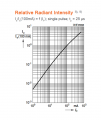
I assume the "Relative radiant intensity" graph shows it, but I cannot seem to fully understand this graph or the (Ie / Ie) units.

For the photodiode I will be using the BPW 34S.
I will be using a TIA circuit for converting the generated current into voltage, and measuring with an ADC.
For this component I cannot seem to understand the relationship between the incident optical power and the current generated by the photodiode.

Any information that can point me in the right direction will be very much appreciated, thanks in advanced!
 

panic mode

Joined Oct 10, 2011
4,864
constant current source is a must but you also want to modulate the emitted signal. this will allow you to reject unwanted signals. as for light intensity with relation to current.... it is proportional but in my experience this is not very linear.
 

Thread Starter

LewisMF

Joined Nov 15, 2014
119
constant current source is a must but you also want to modulate the emitted signal. this will allow you to reject unwanted signals. as for light intensity with relation to current.... it is proportional but in my experience this is not very linear.
Thank you for the input!
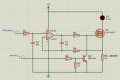
The signal will be modulated at 1kHz. Here is the driver circuit FYI:

circuit1.png

Regarding the light intensity; this is my main question, I need to try and get data that explains the light intensity depending on the supplied current.
 

ericgibbs

Joined Jan 29, 2010
21,390
Hi Lewis,

I would suggest in your set-up, prior [ clear chamber] to each particle sample count that you step the current amplitude from say 100mA down in 10mA steps to measure and record the IR received intensity at each current step.
This should give you a recorded calibration IR profile to which you can compare when running actual particle tests.

E
 

Thread Starter

LewisMF

Joined Nov 15, 2014
119
Hi Lewis,
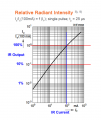
The plot is a of percentage luminosity relative to 100% at 100mA.

E
View attachment 355607
Thank you Ericgibbs!
This makes things much clearer now. I don't know why they don't just use a percentage symbol in the datasheet graph! :)
I assume that 100% luminosity will be equivalent to a typical value of 185mW/sr, according to the datasheet, would that be correct?
 
Last edited:

Thread Starter

LewisMF

Joined Nov 15, 2014
119
Hi Lewis,

I would suggest in your set-up, prior [ clear chamber] to each particle sample count that you step the current amplitude from say 100mA down in 10mA steps to measure and record the IR received intensity at each current step.
This should give you a recorded calibration IR profile to which you can compare when running actual particle tests.

E
Hi Ericgibbs, thanks again!
Yes, when the chamber is clear, the emitter and receiver will be calibrated in such a way that the emitter will gradually increase the current (and optical power output) until the receiver reaches a certain threshold (this threshold is still to be determined and I am still not sure how to do this as it will depend on the distance between the device and the reflector...this may be a question for the future).
Once it is calibrated and particles start entering the chamber, the optical signal will start to obscure. Once it obscures by a certain percentage, I can determine the amount of particles in the chamber, depending on their size.
 

ericgibbs

Joined Jan 29, 2010
21,390
Hi Lewis,
Have you used a Scope to check that output current wave amplitude?
On my LTSpice tests of your circuit, I see very high current spikes at each IR burst.
Post details of the PWM pulse streams.
E
 

Thread Starter

LewisMF

Joined Nov 15, 2014
119
Hi Lewis,
Have you used a Scope to check that output current wave amplitude?
On my LTSpice tests of your circuit, I see very high current spikes at each IR burst.
Post details of the PWM pulse streams.
E
Hi Ericgibbs,
The PWM signal that sets the bias voltage controlling the current source is a 100kHz, 3.3V amplitude and controls 0-100mA current on the output by providing a voltage references in the 0 - 1V region (duty cycle between 0 - 30%).
The PWM signal that modulates the signal by switching the output of the OpAmp ON and OFF, is a 1kHz @ 50% duty cycle.
What PWM signal did you use for the LTSpice sim?
 

ericgibbs

Joined Jan 29, 2010
21,390
hi Lewis,
This is a very basic copy of your circuit, I have had to use close equivalent components, but it gives you an insight of possible problems.
E
EG 1722.png
 

Thread Starter

LewisMF

Joined Nov 15, 2014
119
hi Lewis,
This is a very basic copy of your circuit, I have had to use close equivalent components, but it gives you an insight of possible problems.
E
View attachment 355617
Thank you for taking time to run the simulation!
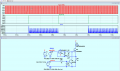
Here is a screenshot of the simulation where I get the correct constant current value (100mA) and I cannot see such current spikes on the 1kHz transitions. I'm not sure why you get this spike, and also a higher current of around 490mA.
Also note that you are feeding the 100kHz signal directly into the OpAmp without a low-pass filter, instead of a smooth (1V) voltage.
 

ericgibbs

Joined Jan 29, 2010
21,390
Hi Lewis,
I need to know the details of both PWM signals and any additional filtering, so that I can set the correct simulations parameters.

E

BTW: I don't see your screen shot???
 

Thread Starter

LewisMF

Joined Nov 15, 2014
119
Hi Lewis,
I need to know the details of both PWM signals and any additional filtering, so that I can set the correct simulations parameters.

E

BTW: I don't see your screen shot???
Apologies, I forgot to attach it. Here it is:
DrivercircuitSIM.png

The 100kHz PWM is 0 - 3.3V amplitude, 30% duty cycle.
The 1kHz PWM is 0 - 3.3V amplitude, 50% duty cycle.
There is no additional filtering appart from the R1-C2 low-pass filter on the 100kHz signal.
 

ericgibbs

Joined Jan 29, 2010
21,390
Hi L,
Please post a circuit showing ALL the circuit you are simulating.
Also the voltage amplitudes and Mark/Space ratios of the PWM

Even with the filtering, there is a spike at the start of current pulses on my sim.
E
 

Thread Starter

LewisMF

Joined Nov 15, 2014
119
Hi L,
Please post a circuit showing ALL the circuit you are simulating.
Also the voltage amplitudes and Mark/Space ratios of the PWM

Even with the filtering, there is a spike at the start of current pulses on my sim.
E
Hi ericgibbs,
The circuit is complete, there are no additional components to it.
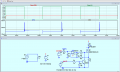
Here it is once again with the graphs zoomed in to 3ms - instead of 10ms.
The "CURRENT" graph shows current amplitude in mA thorugh the LED over time.
The "VOLTAGE" graph shows voltage amplitudes in V of both PWM signals over time.
DrivercircuitSIM2.png
 

Thread Starter

LewisMF

Joined Nov 15, 2014
119
Hi ericgibbs,
The circuit is complete, there are no additional components to it.
Here it is once again with the graphs zoomed in to 3ms - instead of 10ms.
The "CURRENT" graph shows current amplitude in mA thorugh the LED over time.
The "VOLTAGE" graph shows voltage amplitudes in V of both PWM signals over time.
View attachment 355623
Hi L,
Please post a circuit showing ALL the circuit you are simulating.
Also the voltage amplitudes and Mark/Space ratios of the PWM

Even with the filtering, there is a spike at the start of current pulses on my sim.
E
Hi Ericgibbs,

Would you be able to share the SIM file so I can try and replicate and potentially fix the errors?
I assume the current overshoot on the transitions is due to parasitic capacitance of the LED.

Thanks once again!
 

Thread Starter

LewisMF

Joined Nov 15, 2014
119
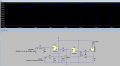
After some days of research and testing, I've made some modifications to the circuit to get the desired output which I will explain below to conclude the thread.

As pointed out by @ericgibbs, there was a substantially big current spike through the LED when turning it ON, on each modulation transition. This was due to the quick turn ON and OFF of the transistor that controlled the gate of the MOSFET and the parasitic capacitance of the LED.

This was somewhat solved by slowing down the turn on time of the NPN transistor that controlled the gate of the MOSFET, but it was provoking some instability within the feedback loop.

To get around this, the turn ON and OFF (modulation) of the LED has to be done outside of the Op Amp feedback loop:

FINAL.png

The transistor Q1 turns the current control voltage ON and OFF by shorting it to GND. The original PWM signal is not affected as it is buffered.

The second part of the circuit is very similar to the original circuit to provide a voltage controlled constant-current source.

This circuit now provides a precise voltage controlled, constant-current source with modulation posibility.
 
Top