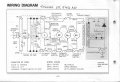
When full-wave and half-wave rectifier devices are powered by the same transformer and their DC commons are tied together, it creates a short for one half of the AC cycle in the bridge rectifier.
You dont understand probably because you did not read this whole thread before you replied.
First, no one is trying to vary the input power to an already inverter type microwave oven. The input power vary method was being used for NON inverter ovens only. That turns a pulsing on/off type controlled oven into a smooth variable power controlled oven. So we start out with a regular non inverter oven and set it on HIGH, then use the Variac on the input to change the power level in a continuous manner rather than a slow pulse manner.
We know there are inverter type ovens, but they are more expensive than the cheap run of the mill non inverter ovens. So if you have a variac you can use it on a regular oven and get smooth power level settings.
If you worked in this industry then maybe you can tell us more.
Yes, you can reduce the input voltage and achieve a lower power output. This is very hard on the magnetron as it also reduces the heating to the filament. It also lowers the high voltage pulse amplitude and the efficiency. Other techniques work better, for example; at Litton we shortened the cycle time when someone entered short cooking times. If you entered a short time, say 50 seconds then at 50% then the cycle time was 10 seconds, 5 off and 5 on. In actual practice it was closer to 6 on 4 off due to the fact that it took more than a second to heat the filament. At longer cooking times the cycle was 30 seconds total.
One of the factors that most people don't recognize about microwave ovens is the penetration depth of the microwave energy into the food. This has a substantial impact on uniformity of cooking. Microwaves will penetrate to about 2.5 cm, give or take depending on the food. If the food is substantially non-uniform the thinner parts will heat first. Even if the food is uniform the edges will heat more since the energy enters from three directions. Lowering the power achieves more uniformity because it gives the energy more time to spread.
Inverter technology doesn't change these factors much since it is mostly about the magnetron. Inverters allow more power at a lower cost. There are ways to increase the power with the older style reactor voltage doubler but it would require two sets of reactors, capacitors and diodes. More weight and much higher cost. Higher power means the energy doesn't have as much time to spread and the cooking uniformity can actually decrease. However, since the frequency is so much higher, the cycle time for power control is much shorter.
Power output was always one of the principal selling features of the oven. Inverters provide a lot more power therefore higher sales. It is all about marketing.
Yes, you can reduce the input voltage and achieve a lower power output. This is very hard on the magnetron as it also reduces the heating to the filament. It also lowers the high voltage pulse amplitude and the efficiency. Other techniques work better, for example; at Litton we shortened the cycle time when someone entered short cooking times. If you entered a short time, say 50 seconds then at 50% then the cycle time was 10 seconds, 5 off and 5 on. In actual practice it was closer to 6 on 4 off due to the fact that it took more than a second to heat the filament. At longer cooking times the cycle was 30 seconds total.
One of the factors that most people don't recognize about microwave ovens is the penetration depth of the microwave energy into the food. This has a substantial impact on uniformity of cooking. Microwaves will penetrate to about 2.5 cm, give or take depending on the food. If the food is substantially non-uniform the thinner parts will heat first. Even if the food is uniform the edges will heat more since the energy enters from three directions. Lowering the power achieves more uniformity because it gives the energy more time to spread.
Inverter technology doesn't change these factors much since it is mostly about the magnetron. Inverters allow more power at a lower cost. There are ways to increase the power with the older style reactor voltage doubler but it would require two sets of reactors, capacitors and diodes. More weight and much higher cost. Higher power means the energy doesn't have as much time to spread and the cooking uniformity can actually decrease. However, since the frequency is so much higher, the cycle time for power control is much shorter.
Power output was always one of the principal selling features of the oven. Inverters provide a lot more power therefore higher sales. It is all about marketing.
I noticed too that to get the best even cooking we need to set it on low and just be willing to wait longer.
With pizza for example, i set on the lowest setting which is "1" and just wait for it to heat up maybe 5 full minutes.
With hamburger meat, i form a round patty as usual, but then before i put it in the mic i cut it in half forming two halves. I then place each half on opposite sides of a round food plate, then start cooking on level 3 which is below medium. This makes it cook more evenly without burning the edges. When i put it on the bread, i simply place the two halves back together again forming a full patty again but it's all cooked now and quite evenly.
I rarely place anything at the center of the turn table except for heating water. So i understand the heating pattern pretty well in the left right front back 2d plane, but i have not yet experimented with the vertical 'z' axis and how the effect of cooking relative to the height of the food.
When talking about industrial not home appliance "inverter technology" most times it means they are using a form of switch mode technology. Stuff like welders are smaller because of doing it switch mode, as do VFDs to a certain point.
When talking about industrial not home appliance "inverter technology" most times it means they are using a form of switch mode technology. Stuff like welders are smaller because of doing it switch mode, as do VFDs to a certain point.
Charlie: Of the several ovens I've torn apart, and of the magnetrons I've cut open I've never found a filament in any of them. It was my understanding that the magnetron chamber directed and redirected energy in a circular sort of fashion to achieve the "Micro" waves. There was some sort of resonance set up. I've never found any micro wave chips in any of the ovens I've opened. I'm talking about the driver for a microwave transmitter used in communications.
I certainly don't profess to know much about microwave ovens. I only remember some of the things I've heard. At least I hope I remember them accurately. But from what I've seen in the few magnetrons I've opened, there have never been any filaments in them. What would their purpose be? MT's are not like TV tubes, I don't think they need to warm up. I DO realize they have aluminum fins on them to dissipate heat, so I acknowledge that they do get hot. Otherwise why the fins and fan?
Anyway - again, thanks for all the answers. I've learned what I believe I wanted to.
This is a typical microwave circuit of the conventional type Tony. There is a heater filliment in the magnetron, & it heats up very quickly. The magnetrons for inverter microwaves are not interchangable. Be carefull cuting open a Magnetron as the ceramic looking insulator at the top & bottom if damaged by cutting or grinding is poisonous.
As for the heater, I guess I've never seen it because perhaps it's within the beryllium body. Which I've never cut into, broke or crushed. I know about the hazards of beryllium.
A magnetron is a vacuum tube (diode) with a cathode and an anode. The filament/cathode is a heavy tungsten coil at the center of the tube. The anode is the outer cylinder with vanes that point toward the filament/cathode to form cavities. Annular magnets set on the top and bottom of the anode. Since the anode is attached to the case and is at ground potential, the tube requires a negative voltage at the cathode. Typically -4000 volts.
The anode has two rings that run around the vanes connecting them together, one ring connect even numbered vanes the other connects the odd numbered vanes. The reason for the alternating connection is due to the fact that the phase is different on each adjacent vane. These connections make the magnetron cavities sync up in phase and couple energy around the tube. A conductor from one of the vanes picks up the energy and couples it to the antenna structure at the top of the tube. (the part above the ceramic insulator). On the oven the antenna typically sets in a short waveguide to couple the energy into the oven, however on some low cost ovens the antenna extends directly into the oven cavity.
A high voltage on the cathode causes conduction of the electrons from the cathode to the anode but the large magnetic field causes the electrons to follow a curved path. Electrons passing the open end of the cavities cause them to resonate at their fundamental frequency, 2450MHz.
As for the heater, I guess I've never seen it because perhaps it's within the beryllium body. Which I've never cut into, broke or crushed. I know about the hazards of beryllium.
The most important thing to know about microwave ovens is that there are no user serviceable parts inside. The voltages are lethal and I know from personal experience that it can kill. A young woman at one of the factories I worked at was killed in an avoidable accident. Stay away from the electrical compartment of the oven!
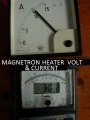
This is the Magnetron heater voltage & current draw. At instant turn on the current peaks at around 30A (These measurements were taken with the HV disabled).
@CharlesWMcDonald Thank you for your input. I've learned more than I hoped for from this question. I've learned inverters are not just from DC to AC but from AC to DC to AC at differing frequencies regarding motors and motor speed control. I always thought of the inverters that are battery powered to provide backup AC power. I've learned that's not the only case for an inverter.
As far as magnetrons, I've learned they have heaters in them. I knew about the resonance thing before, and your explanation confirms what I've heard. As far as the ceramic tips - I heard they were ceramic and beryllium. Never stopped to question why, but I've worked with beryllium in the past. Interesting story - I may relate it some time.
As far as the insides of MWO's I've scrapped several for various parts. I still have every magnet I've taken from the magnetrons. I still have a few laying around. I've torn apart a few transformers and have stocked several high voltage diodes. I still have a couple control boards, one is in use as a timer for my soldering iron. I can run my iron (or other small electronic loads) for up to 99 minutes and 99 seconds. As far as my iron is concerned, I often run it for 10 minutes at a time because I can leave it idling hot for hours if I don't set it on a limit.
The "Serviceable" parts are the fans (have a few laying around), lightbulbs of course, carousel motors and of course, the control boards. I've worked with a few but do not claim to be any kind of expert. I'm well aware of the high voltage potential and even had one non working oven restored when I replaced the high voltage cap. Don't ask me how it failed - I can only say the oven now works whereas before it didn't.
The danger warnings are ALWAYS appreciated. Even when we KNOW about the dangers it's always good to be reminded. I've been shocked by 120 VAC a number of times and have been hit a few times by 65KV. I'm still alive but that's because when working with high voltages I tend to use only one hand. Thats no guarantee, but it does tend to direct any accidental shocks away from the heart.
To all: Thanks for all the input. This has been educational for me, and that was the purpose of the question.
While we are talking about microwave ovens, i took many of these apart just for parts.
Mostly the transformer, and one i took apart, i cut the secondary windings off of the transformer so it is ready to have a low voltage winding to replace the high voltage one for use as a low voltage power source. Other things came up since then though so i have not rewound it yet.
The core is good for around 1000 watts which is pretty good for a low voltage power source (12vac to maybe 18vac).
The term of art 'Inverter' function simply provides an impedance match (acts like a fixed optimized transformer at all power levels) for efficient power transfer at different power levels from a power source voltage/current ratio to another load voltage/current ratio. In mechanical terms it's a variable gear ratio (transmission).
Wish the places I worked at did. Did a lot of grinding of beryllium copper at one place and EDMing(vaporizing it) at another, before they found out about the hazard.

 Facebook
 Google
 GitHub
 Linkedin