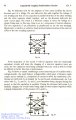
Intriguing circuit on book cover

mvas

Joined Jun 19, 2017
539
Good to see that somebody had the time (and the knowledge!) to actually analyse the circuit and find that it is perfectly viable, rather than just dismissing it as a bit of artistic 'fluff'!
Thank you, Phil Tilson - couldn't have said it better ...!
I did recognize the Pi-filter topology of the two caps with the choke in between,
but the "resonant" character did not dawn upon me - clever analysis, Danko !
BTW: did you use the "component values at the end of the book" (MaxHeadRoom)
as parameters for your simulation ? Ever more curious as to the book ...
No, I do not agree that it is a ... Pi-filter topology of the two caps with the choke in between,
When I look at the circuit diagram, I see ...
A single transformer with one primary and two secondaries
NOTE: The extra single "core" line on Secondary #1 ???
Then also note the single "core" line on Secondary #2 ???
Those two "core" lines are physically the same core.
 

Thread Starter

SYNFONIQUE

Joined Jun 5, 2021
48
No, I do not agree that it is a ... Pi-filter topology of the two caps with the choke in between,
When I look at the circuit diagram, I see ...
A single transformer with one primary and two secondaries
NOTE: The extra single "core" line on Secondary #1 ???
Then also note the single "core" line on Secondary #2 ???
Those two "core" lines are physically the same core.
@mvas: I don't know exactly how to fault your interpretation, but it does not make
much sense to me either. I am aware that a CLC or Pi-filter is usually connected in
a PSU in quite a different way; still, what other explanation could you offer for the
odd position of the two C's inserted in the rectifier bridge as it were ? It seems
reasonable to consider the CLC-part the feature that renders the circuit resonant,
as Danko described it, presenting a simulation as proof. Or don't you agree with
him/that as well ?
What do you have to comment to all this, Danko ? And could you please disclose
the parameters used in your simulation ?
 

MisterBill2

Joined Jan 23, 2018
27,587
OK, so the circuit can be functional.
Now I wonder what the application will be for a "Resonant Rectifier" circuit such as this. In more common power supplies a great deal of effort is made to avoid anything close to resonance in filter circuits, because the common intention of a capacitor inductor circuit is to reduce ripple voltages and currents, so that the output is closer to pure DC.
So where would the Resonant Rectifier circuit be used? What would be the benefit and where would we find it applied?

Also, I too interpreted that second inductance as a second transformer secondary, which did not make sense either. Hence my thinking that it was "just a piece of art." Which is OK for a book cover.
 

Thread Starter

SYNFONIQUE

Joined Jun 5, 2021
48
Without Danko elaborating, I'm afraid we more or less shall remain stuck in more
educated guess work ... So Danko, take the floor, please.
 

Danko

Joined Nov 22, 2017
2,169
Without Danko elaborating, I'm afraid we more or less shall remain stuck in more
educated guess work ... So Danko, take the floor, please.
Excuse me, now I am here.
...did you use the "component values at the end of the book" (MaxHeadRoom)
as parameters for your simulation ? Ever more curious as to the book ...
I never saw this book.
Parameters of components are selected at will.
Then frequency was adjusted for maximum out voltage.
In your schematic, I can't tell if L3 coupled to the the coupled inductor (transformer) L1/L2? The extra lines in the book cover suggest this but I'm not sure.
No, I do not agree that it is a ... Pi-filter topology of the two caps with the choke in between,
When I look at the circuit diagram, I see ...
A single transformer with one primary and two secondaries
NOTE: The extra single "core" line on Secondary #1 ???
Then also note the single "core" line on Secondary #2 ???
Those two "core" lines are physically the same core.
When all 3 inductors are coupled, then circuit becomes "voltage doubler",
(see diagram below), which has not good parameters in comparison with
diode bridge rectifier (number of components, voltage drop on diodes,
out voltage pulsation), therefore I was trying to find better application for circuit.
So "resonant rectifier" appears.
Intresting! How is it possible, that the voltage rises?! It should be kind of rectifier. What ist the coupling between L1, L2, L3? Thanks!
Voltage on components of resonant tank L1, L3, C1, C2, can rise incessantly, when energy enters, but no losses.
And it is rectifier too. "HV" voltage is DC. L1, L2 are coupled, L3 is independent.
===========================================================================================================================
On diagram - Voltage Doubler and its analogue, using diode bridge:
1639040959308.png
 

Attachments

Last edited:

Thread Starter

SYNFONIQUE

Joined Jun 5, 2021
48
Many thanks, Danko, for responding to everybody's questions.
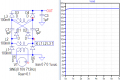
Comparing the two similar circuit diagrams in your posts, I could only spot these
differences:
- 5m instead of 5 for the .tran parameter (transient ?)
- R_LOAD_1 1k instead of no load
The resulting difference in performance is bewildering, though: <30V instead of 5kV !
Maybe adding the parasitic leakage resistance to C3 in the original 'resonator' circuit
could bring the output DC voltage back down to earth ?
As to the "voltage doubler" you mention: starting from 5V sine, one would arrive at
30V DC only via a quadrupler, as far as I know ...
 

Danko

Joined Nov 22, 2017
2,169
Many thanks, Danko, for responding to everybody's questions.
Comparing the two similar circuit diagrams in your posts, I could only spot these
differences:
- 5m instead of 5 for the .tran parameter (transient ?)
Simulated time of circuit's work. Below this difference is eliminated.
- R_LOAD_1 1k instead of no load
Load was necessary for pulsation showing only.
The resulting difference in performance is bewildering, though: <30V instead of 5kV !
Maybe adding the parasitic leakage resistance to C3 in the original 'resonator' circuit
could bring the output DC voltage back down to earth ?
Active load will decrease voltage, therefore it should be balance between load value and
wishful voltage.
As to the "voltage doubler" you mention: starting from 5V sine, one would arrive at
30V DC only via a quadrupler, as far as I know ...
You did not take in account transformation ratio between L2 and L1.
It is sq. root of (L1/L2) = (100m/10m)^0.5 = 3.16,
so voltage on L1 is 5V*3.16=15.8V,
Peak OUT1 voltage is 29V instead 15.8*2=31.6 because of drop voltage on diodes.
===================================================
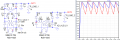
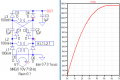
Below are two identical circuits, "doubler" and "resonance", only difference is
L3 coupled/independent.
===================================================
Doubler
1639183664617.png
==============================================================
Resonance
1639184245649.png
 

Attachments

Last edited:

Thread Starter

SYNFONIQUE

Joined Jun 5, 2021
48
Simulated time of circuit's work. Below this difference is eliminated.

Load was necessary for pulsation showing only.

Active load will decrease voltage, therefore it should be balance between load value and
wishful voltage.

You did not take in account transformation ratio between L2 and L1.
It is sq. root of (L1/L2) = (100m/10m)^0.5 = 3.16,
so voltage on L1 is 5V*3.16=15.8V,
Peak OUT1 voltage is 29V instead 15.8*2=31.6 because of drop voltage on diodes.
===================================================
Below are two identical circuits, "doubler" and "resonance", only difference is
L3 coupled/independent.
===================================================
Doubler
View attachment 254829
==============================================================
Resonance
View attachment 254831
Thanks again, Danko !
Sorry for overlooking L1 : L2 voltage boosting ratio.
 

MaxHeadRoom

Joined Jul 18, 2013
30,680
Yes, you should always judge a book by the cover.
I recall when we were Kids, my brother had a school project covering Moths ( Lepidoptera).
He went to the library to dig up a book on them.
He showed it to Mom who wondered what the heck he checked out a book called "Tips for New Mothers". o_O
 

Thread Starter

SYNFONIQUE

Joined Jun 5, 2021
48
Can't help detecting a tendency to wander off ...
So let's put the book's cover aside (at least for now).
Can anybody provide me with a link to the book, so I can have a peek, in order to
decide if it is worthwhile purchasing it at a price, higher than that of TAoE ?
Besides "Handbook of Rectifier Circuits" by Graham J. Scoles, Prentice Hall 1980,
also looking for: J.S. Schaefer: "Rectifier Circuits: Theory and Design", Wiley 1965.
Why ? Because the old textbooks usually are much richer in content, and not
afraid of 'iron ware' - both theory and practice. Thanks beforehand, Ray
 

Danko

Joined Nov 22, 2017
2,169
Can anybody provide me with a link to the book, so I can have a peek, in order to
decide if it is worthwhile purchasing it at a price, higher than that of TAoE ?
Go to https://books.google.kz/books?id=O6g1AAAAIAAJ&q=choke+resonance+"Handbook+of+Rectifier+Circuits"&dq=choke+resonance+"Handbook+of+Rectifier+Circuits"&hl=en&sa=X&ved=2ahUKEwjO5LCqk-D0AhXkAhAIHeP5CNQQ6AF6BAgDEAI
and search inside the book.
For example:
------------------------------------------------------------------------------------------------------------------------------------------------------------------------------------------------------------
__1639376431529.png1639376951411.png1639377528888.png1639377938014.png
 
Last edited:

Thread Starter

SYNFONIQUE

Joined Jun 5, 2021
48
Go to https://books.google.kz/books?id=O6g1AAAAIAAJ&q=choke+resonance+"Handbook+of+Rectifier+Circuits"&dq=choke+resonance+"Handbook+of+Rectifier+Circuits"&hl=en&sa=X&ved=2ahUKEwjO5LCqk-D0AhXkAhAIHeP5CNQQ6AF6BAgDEAI
and search inside the book.
For example:
------------------------------------------------------------------------------------------------------------------------------------------------------------------------------------------------------------
View attachment 255067 View attachment 255068
View attachment 255070___View attachment 255071
Thank you very much again, Danko !
Certainly seems worthwhile to start looking for this book.
 

MisterBill2

Joined Jan 23, 2018
27,587
Interesting indeed. I had been puzzling for a while on how to add a transformer AC output on top of the voltage doubled DC output for the purpose of obtaining a higher total voltage output. The goal being to light a 4-foot florescent tube leaning against the side of my car, with one end of the tube on the pavement. AC or DC, or a combination does not matter for this application.
 

Diletante

Joined Jan 29, 2017
9
The book cover of the "Handbook of Rectifier Circuits" shows a rather intriguing circuit diagram.
As far as I can see, nothing goes BOOM! - so there may be more to this than an 'artist's impression'.
Does anybody recognize this unusual circuit or is willing to volunteer for an explanation ?
Thanks beforehand, Ray
https://www.amazon.com/Handbook-Rectifier-Electrical-Electronic-Engineering/dp/0853121265
I was intrigued by this circuit and I found a copy of the paper book online and bought it. There is much practical information in there, so highly recommended reading.

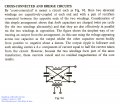
For the avoidance of any doubt in respect of the cover illustration, I attach scans of the pages where this circuit is explained.

Thanks to Danko for the simulation!
 

Attachments

Thread Starter

SYNFONIQUE

Joined Jun 5, 2021
48
I was intrigued by this circuit and I found a copy of the paper book online and bought it. There is much practical information in there, so highly recommended reading.

For the avoidance of any doubt in respect of the cover illustration, I attach scans of the pages where this circuit is explained.

Thanks to Danko for the simulation!
At last: the real thing ! Thank you so much, Diletante !
(As for the second book I inquired about: have been able to find a download -
don't bother, unless you're a fanatic theorist and mathochist).
Danko indeed has provided a stronghold for the 'believers' all through this
discussion.
The scans with explanations of the circuit and a variant really are enlightening.
Still there is a lot of unexplored/-plained ground between Danko's fascinating
"resonant rectifier" and what is presented in the book, though ... Have to think
it over before commenting further.
 

Thread Starter

SYNFONIQUE

Joined Jun 5, 2021
48
As the brains of most of us will have been 'washed' for decades with repetitive
images of how a bridge rectifier should look, it is kinda hard to see that familiar
topology in fig. 9e (second scan by Diletante). I for one recognize the return branch
in the 2 diodes that have been added at the bottom. The diode duo at the top
however is not connected to the former in the usual i.e. conducting sense. So we
have to assume/believe, the physical coupling via the capacitors plus the inductive
coupling between the two secondaries 'hold the bridge together' ?
Following the development from f.g. 9d to 9e, I would not be at all surprised, if some
digitally-biased observer would interpret the diode duo at the top as an OR gate,
leading the charged energies from the capacitors to the load. My musings sofar ...
 
Top